All three of those categories are unacceptable. Each supports systemic racism. Each supports the status quo.
We need to seriously pursue a fourth option: anti-racist white children. And schools have a huge role to play.
What can this look like in action?
As the education world seems poised to take steps toward anti-racist education systems, it is important to learn from teachers who are already centering antiracism and equity.
And their students.
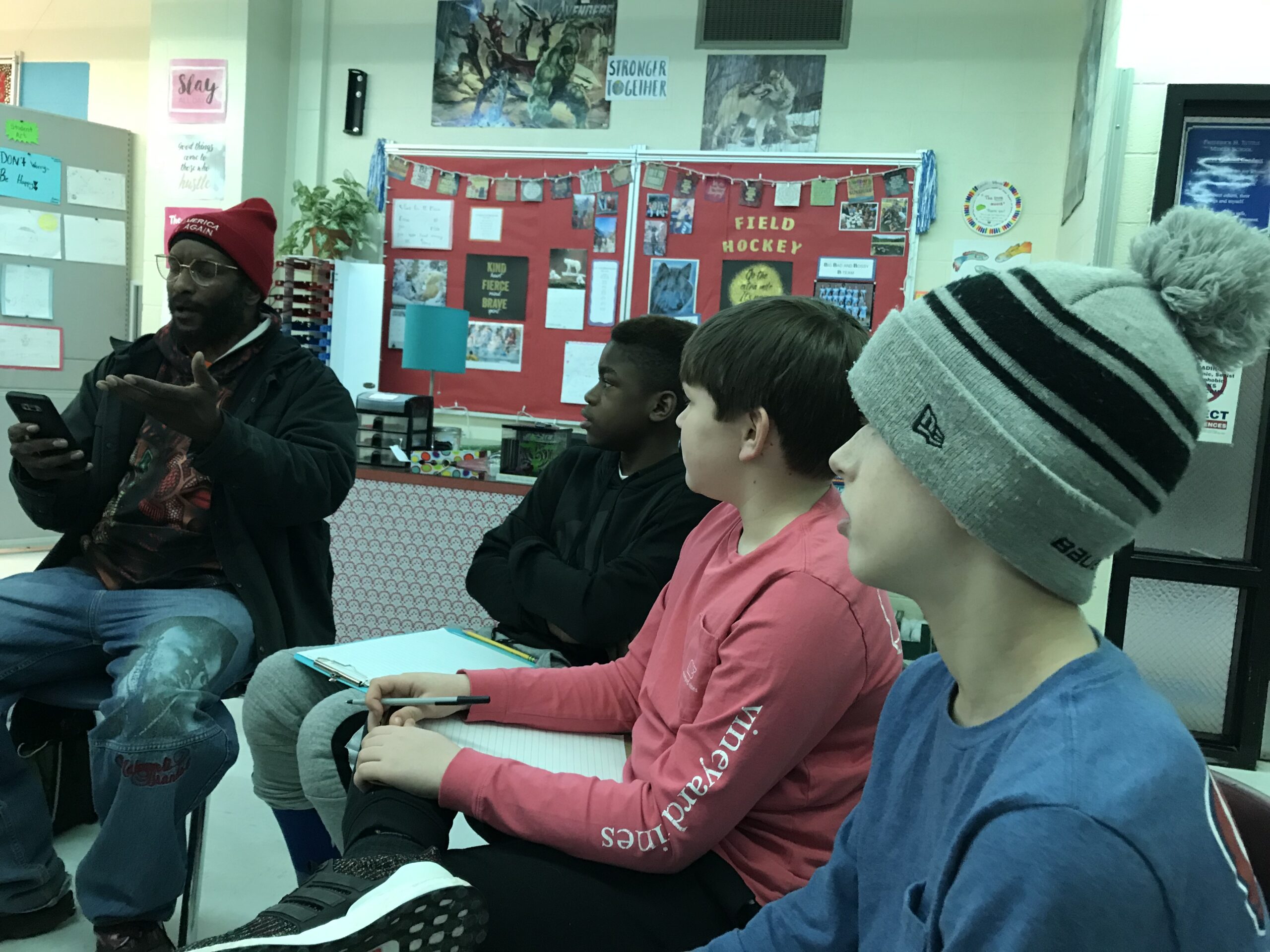
For example, take Christie Nold, 6th grade social studies teacher at Frederick H. Tuttle Middle School in South Burlington, VT. A trio of her 6th grade students led a group of educators from around Vermont through activities in bias-awareness and social identity at the 2018 Middle Grades Conference.
Once the students learned a vocabulary for antiracist education, they turned around and taught others. Not just peers, but educators.
Christie Nold has also generously shared a how she built a social identity unit. And again, her students have generously shared their learning, and their insight.
“The kids we have around us today, they’re going to be the leaders of tomorrow. And the adults and teachers, they’re not necessarily responsible, but they kind of are, because what they say and teach really impacts us.”
–Abbey
Watch these students. Listen to their wisdom. And imagine what we could do if all students were engaged in anti-racist education from a young age. Starting from today.
Do you remember those pre-COVID days? All of the exciting plans, the face to face collaboration, the FIELD TRIPS?!
The teachers and students at Two Rivers Supervisory Union had *BIG* plans: a four-day, four school, in-person Sustainable Development Goal Academy.
Fifth and sixth-grade students from Cavendish Town Elementary, Chester-Andover Elementary, Ludlow Elementary, and Mount Holly Elementary would converge to learn more about the UN’s Global Goals. They would choose one goal of interest and join a team of scholars to dig in and learn more. And they would present their learning, and their recommendations, to local community members and organizations. BUT… you already know what happened… social distancing put the kibosh on all of the collaborative fun and learning.
Sort of.
Once TRSU teachers got their remote learning feet under them, they realized that this project didn’t have to be canceled. They could rework it for an online environment. And that could be done more easily because of the kindness and generosity of one open-source oriented teacher. Let’s give it up for Mr. Kyle Chadburn!
You see Kyle had also been doing some work with his students on the SDGs. He had developed a pretty extensive website to curate resources for his students. AND Kyle being Kyle, he made a copy for TRSU and invited them to make it their own. Blessings on all generous educators! And so they did. They added resources, adapted assessments, developed their own supporting materials, and tied it to the critical indicators defined by their district’s proficiencies.
There was only one thing missing: expert community members and field trips.
Enter the Zoom-trip? The field Zoom? Well, anyway, enter local community organizations and folks with a ton of expertise! Who are also not afraid of Zoom (or fifth and sixth-graders)!
When asked, community partners overwhelmingly said yes to engaging with TRSU students. These organizations were eager to connect with our students and share their experiences. Kelly Stettner from the Black River Action Team was more than happy to answer students’ questions about local water clean up and its importance to Goal #6: Clean Water. The Vermont Institute of Natural Science VINS was delighted to talk about Goal #15: Life on Land, and to bring along a few animal ambassadors as well.
Goal #2: No Hunger was discussed by Jessie Carpenter from the Vermont Foodbank. Rutland educator Erica Wallstrom has traveled to Greenland and Antarctica as an Einstein Fellow; who better to engage students on Goal #13: Climate Action?
Students went to at least one presentation on their own goal, but some students decided to attend more. Rebekah Hamblett is a public health student at Villanova University and she presented on Gender Equality. She reported that one 6th grade boy said,
“This isn’t my goal but I feel like I should know more about this.”
It was surprisingly easy to host 15 field trips in three days.
Really, it was! Here is how it worked:
Choose dates and times that will work for students and teachers.
Brainstorm local organizations that do work related to the Global Goals.
Send out email requests to community organizations with a specific ask: 1 or 2 presentations of 45 minutes or less explaining your work. We definitely shared the focus of the particular Sustainable Development Goal we had in mind but encouraged them to talk more about their work than the goal.
Once we had confirmed guests, teachers stepped up to chaperone. Chaperones provided Zoom links, introduced the guest, served as a chat checker and observer, and thanked the guest at the end.
Share the calendar with families and students.
Enjoy the learning!
The result?! TRSU teachers reflected this week and they felt this unit was a big win for students. The elements they saw as most contributing to the success: student voice and choice, relevant and meaningful topics, and community engagement. You can take a look at their exhibitions of learning here.
Meanwhile, check out how Kyle Chadburn and Andrea Gratton shared the origin of their Sustainability Academy here.
When the quick switch to a remote environment was required, Charlotte Central School decided to go with what they know. And these folks know their students. Specifically, they know “Personal Interest Projects” (PIPs, aka passion projects, aka Brainado, aka curiosity projects) work for their students. Charlotte Central students in grades 7 and 8 had both worked through a few rounds of PIPs, providing educators with rave reviews. And as the distance (learning) lengthened, honoring students’ individual joys and passions seemed the best way forward.
It generally always is.
But for these PIPs, remote learning environment removed a lot constraints in terms of time and place. This middle school truly wasn’t a building, but instead a networked community, working remotely to support, engage and more deeply know their students.
Keep it simple:
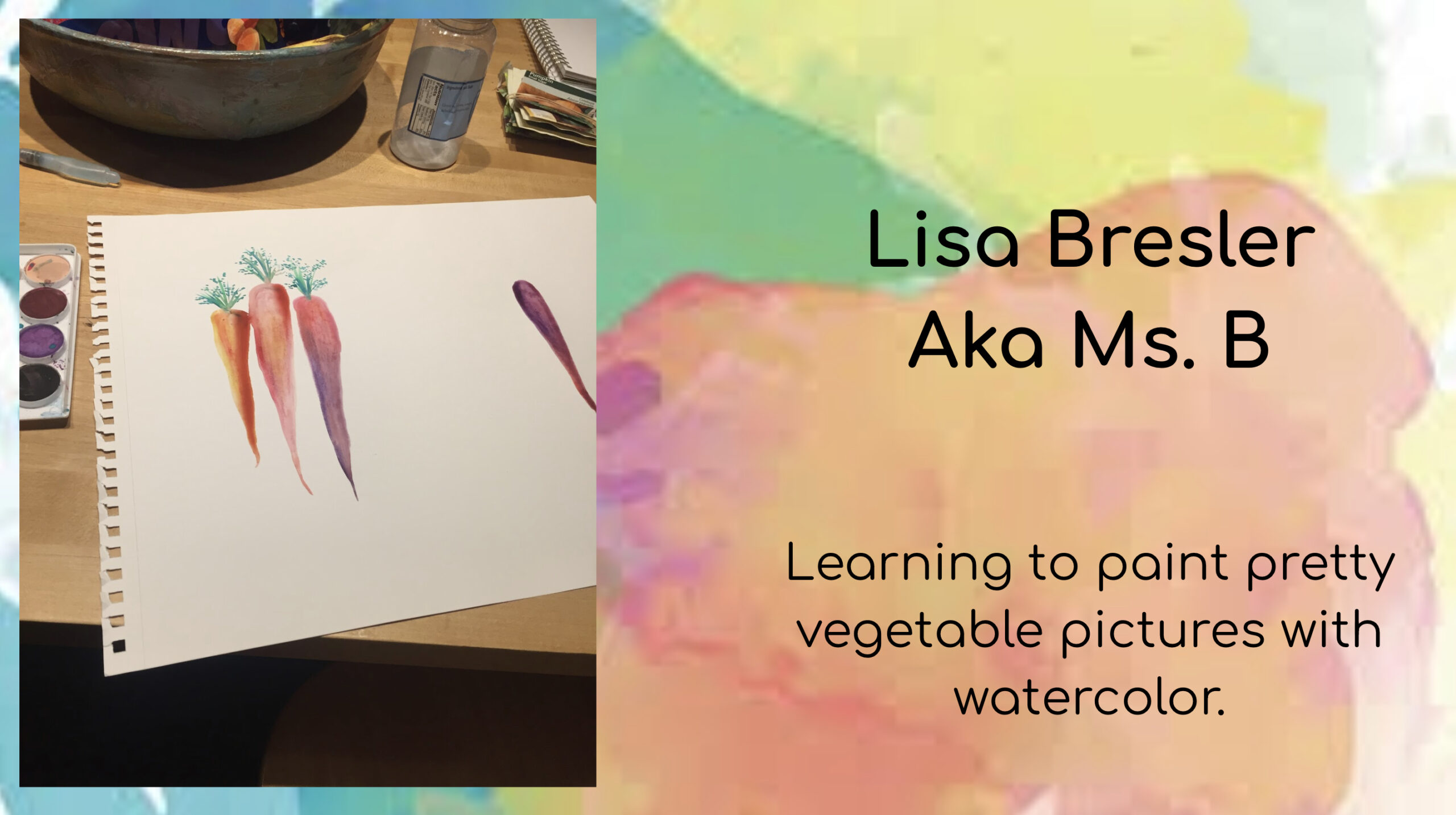
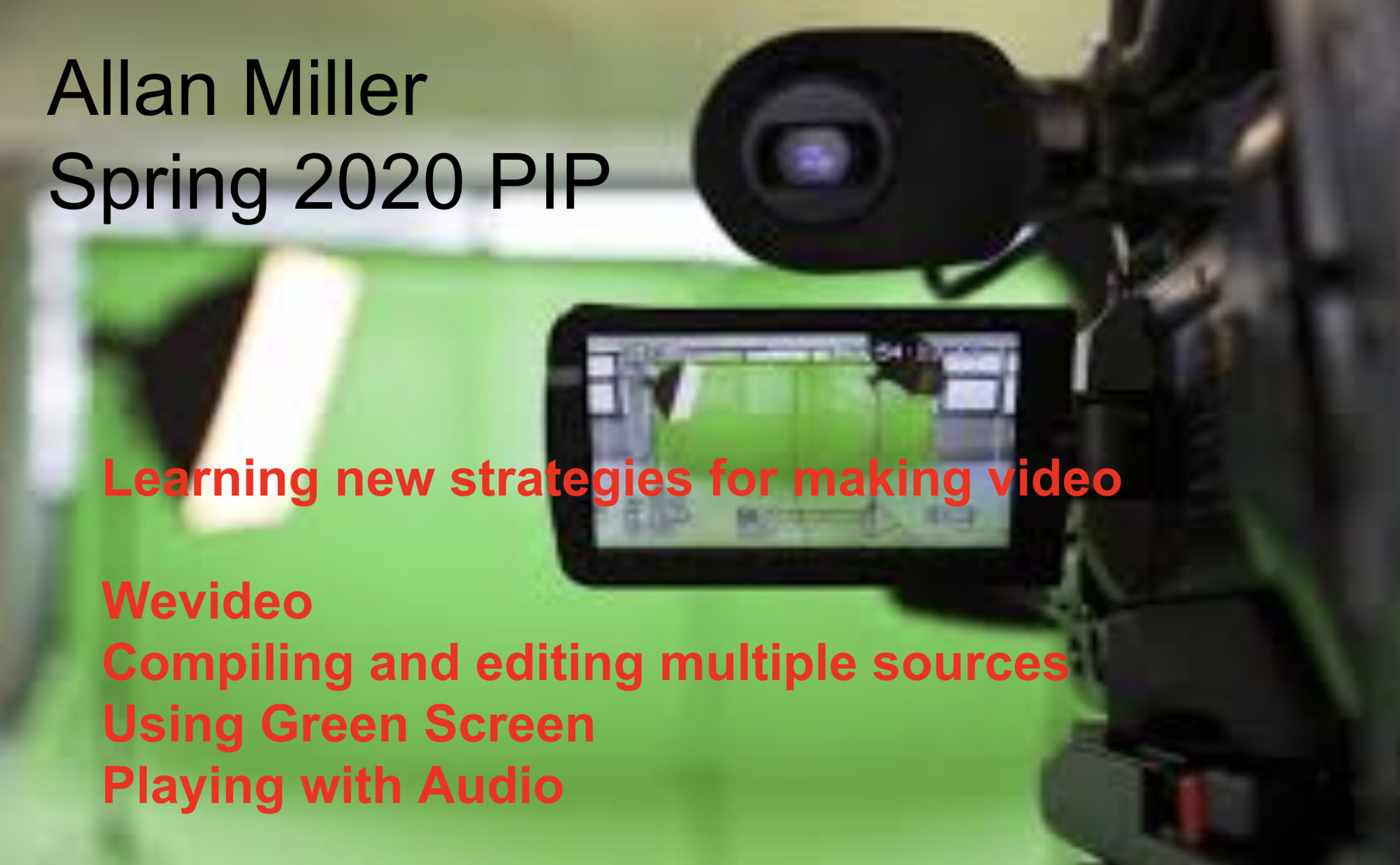
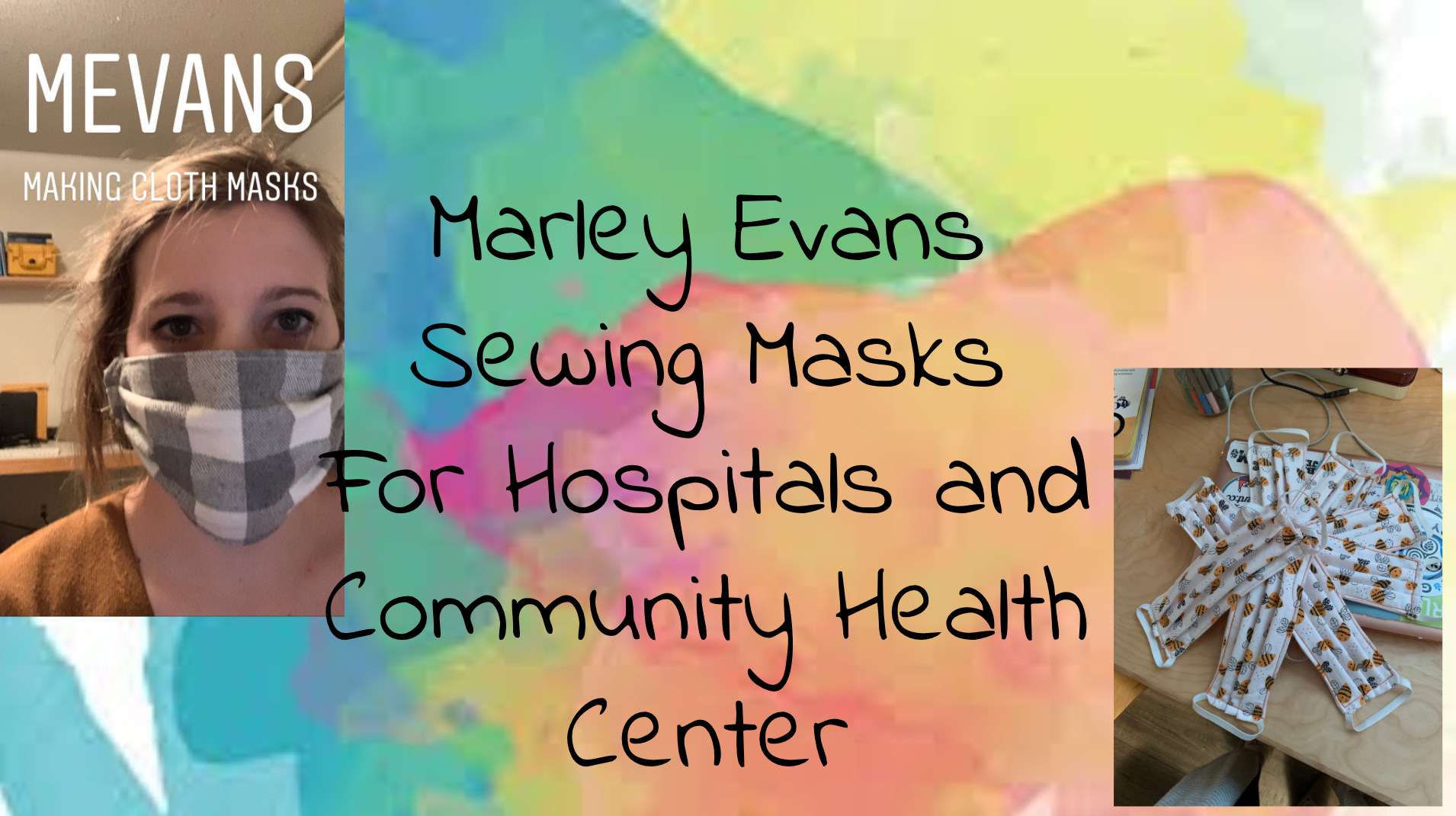
Educators Marley Evans, Lisa Bresler, and Allan Miller started to wonder how to make this work in the wild new environment of emergency distance learning. First, they started with some guiding statements for students:
Pick something that’s engaging
Fun and not overwhelming
Something you’ll stick with
They were hoping for something that created a meaningful back and forth dialog. Something that could be synchronous or asynchronous. A dialog that supported a growth mindset and a little self-direction.
Plus, they really, really missed their students. And this would be an opportunity to reach out and connect. But however would they cope with the virtual reality of the situation?
Roll Call:
An email went out to staff and other interested educators, requesting a little help.
The response? Overwhelming. 17 adults in the school community stepped up to the plate and volunteered to be a PIPs resource. That represented a 240% increase over the last round, and created a 1:5 ratio for adults supporting students. Take a moment and think about what a 1:5 ratio could look like for student learning year-round…
And onwards!
Rollout:
Marley, Lisa, and Allan let students know that spring PIPs were on their way and there would be a virtual rollout.
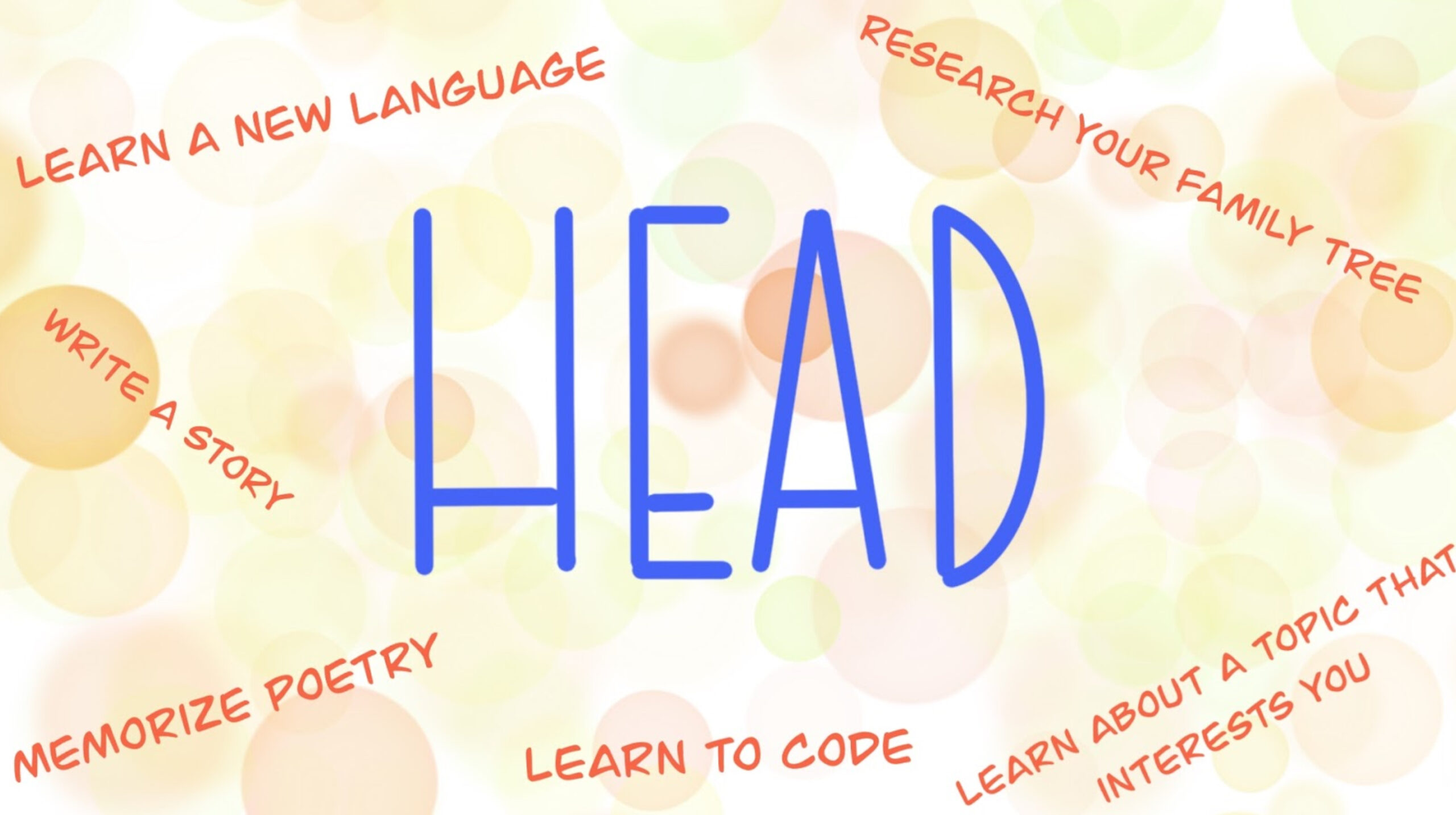
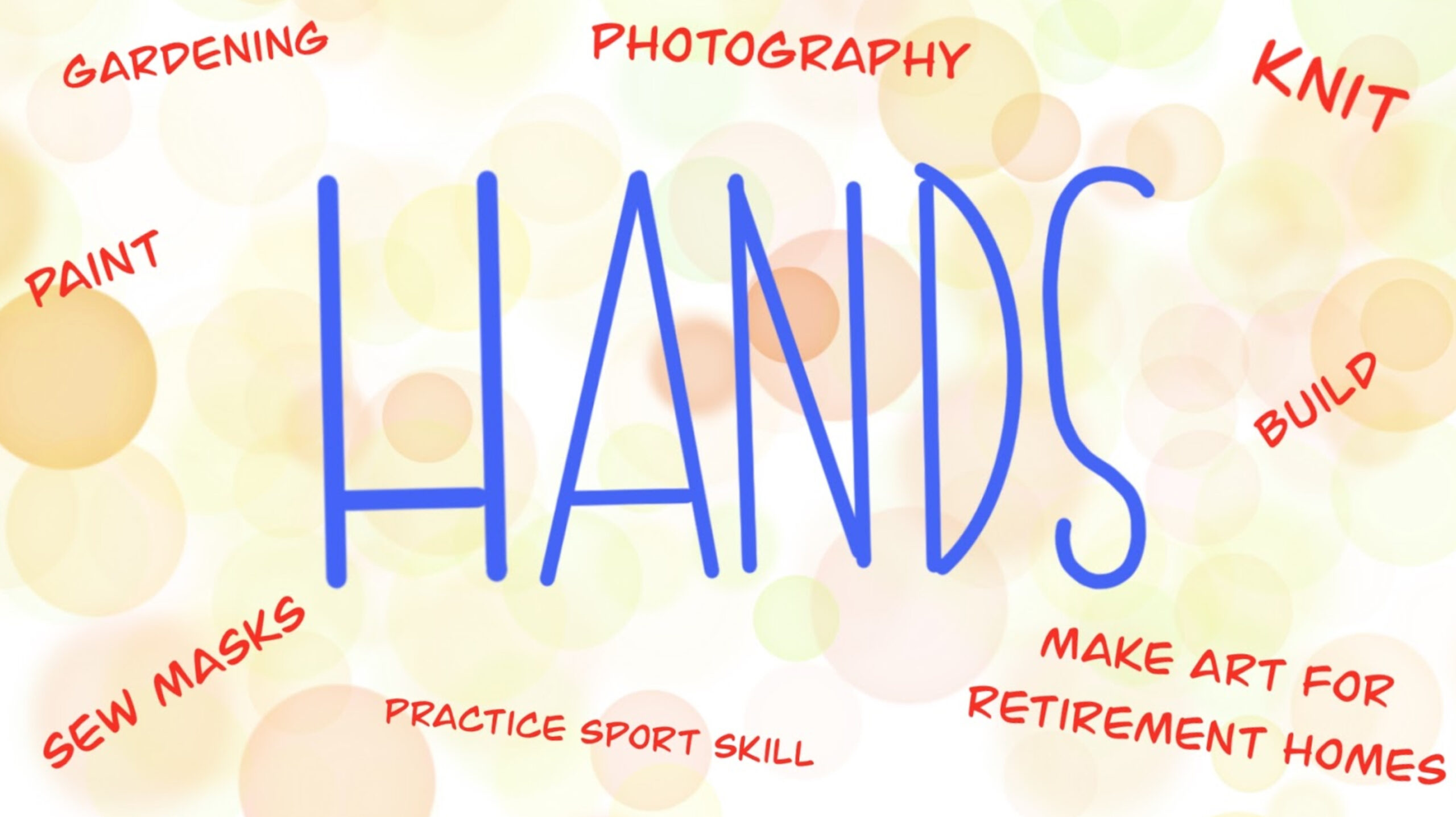
They framed this round of PIPs with Head (thinking), Hand, (doing), Heart (feeling). Not a new idea for the students but new to tie it explicitly to the PIPs. Students then joined their advisors in small groups. They talked possibilities and posed questions, until each student had the tools to create a single slide, capturing the basis of their PIP.
The support
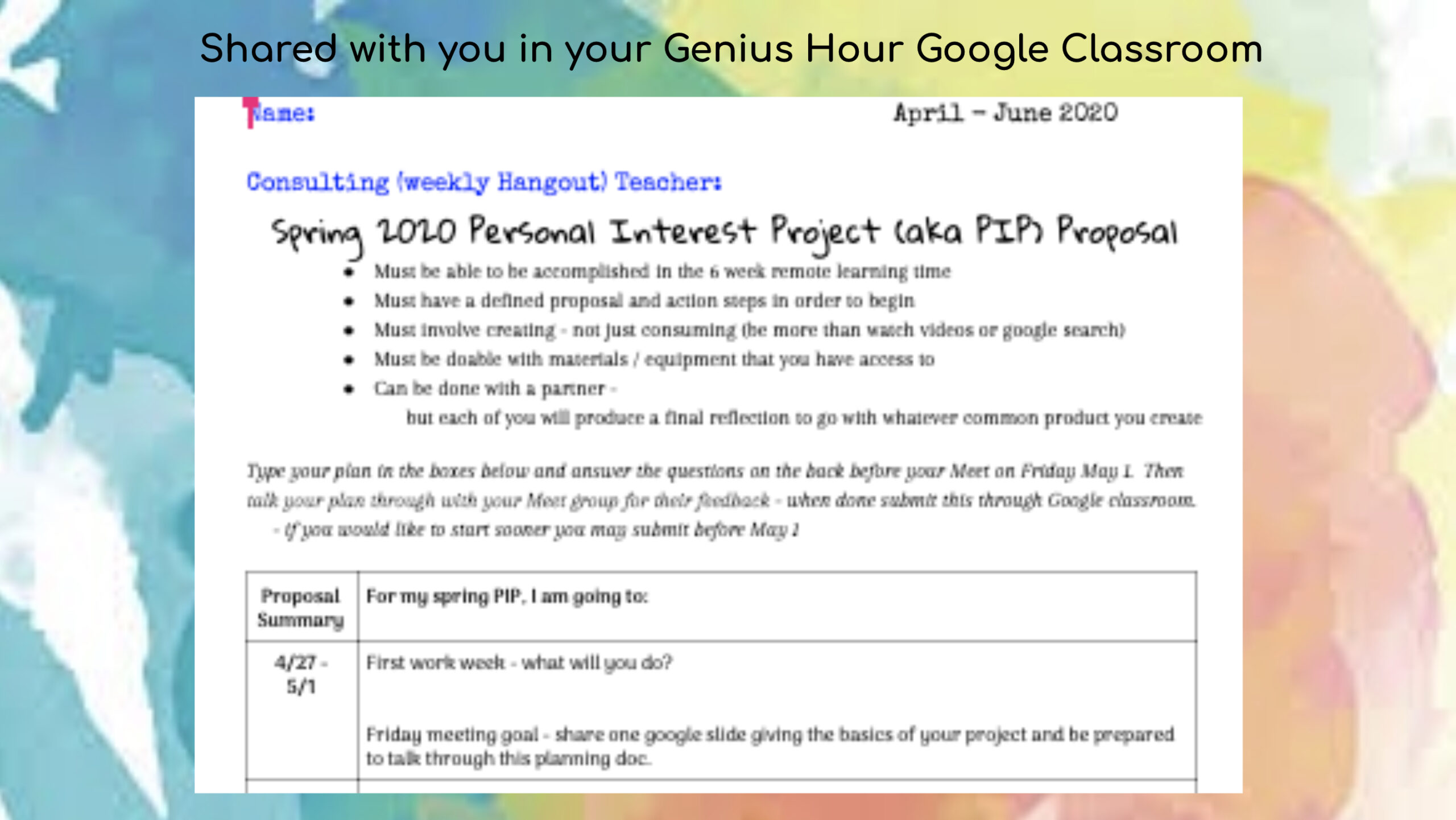
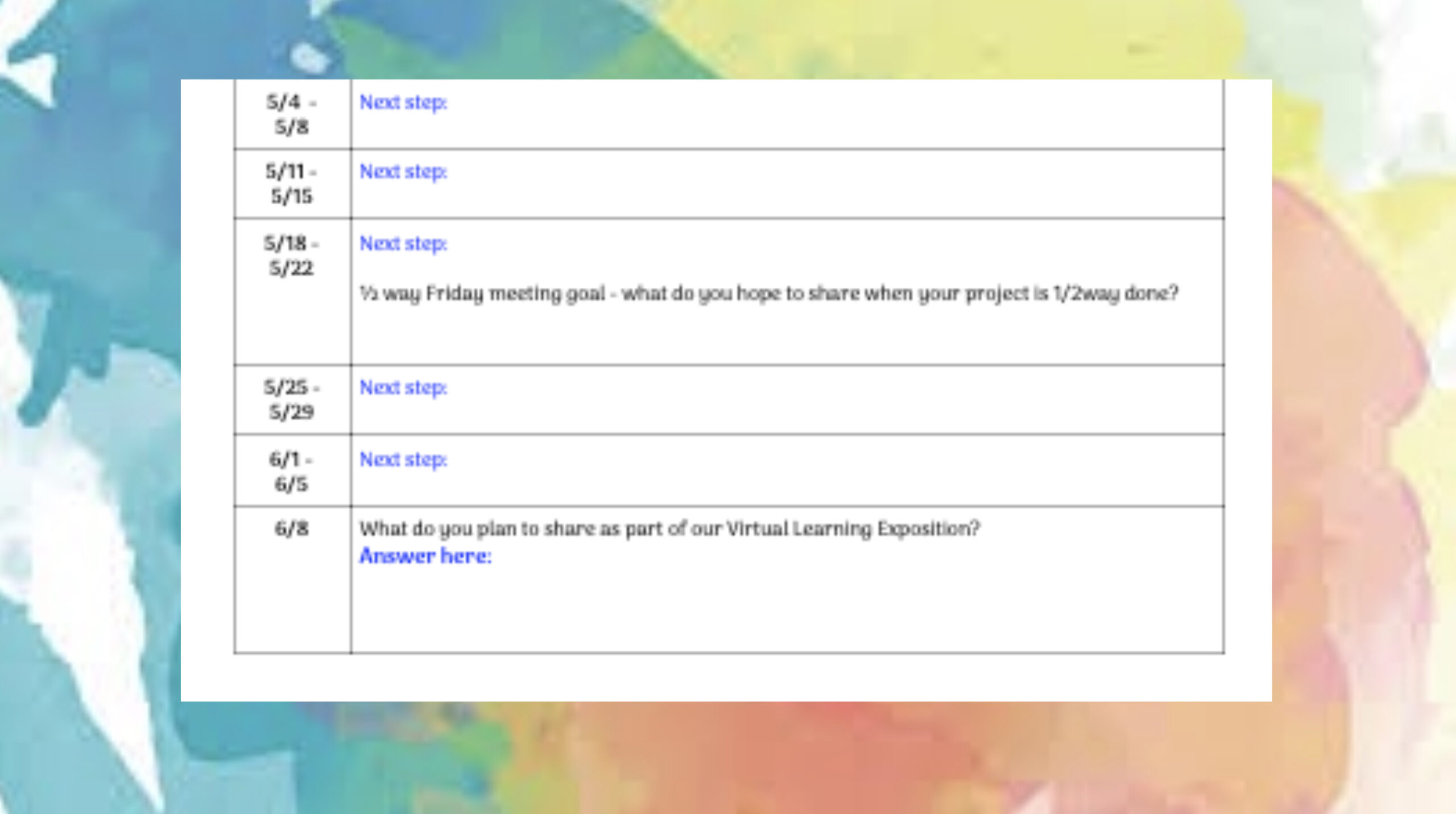
Each Monday the team sent out a reminder through Google Classroom, then each Friday small groups would meet to answer questions, share progress, or problem-solve. It’s the little nudge that keep momentum going. The planning group shared a list of prompts, for people who were new to this type of project.
And the results were GLORIOUS.
Charlotte Central has always tried to say yes to a PIPs proposal. But, sometimes the gym wasn’t available or the art room booked up, so the answer had to be no. Well, this round of PIPs produced work that wasn’t possible in the traditional school structure.
Some students worked at 6am, others at 8pm. Students worked with their family’s needs and their own biorhythms, based on the sheer joy of going for it.
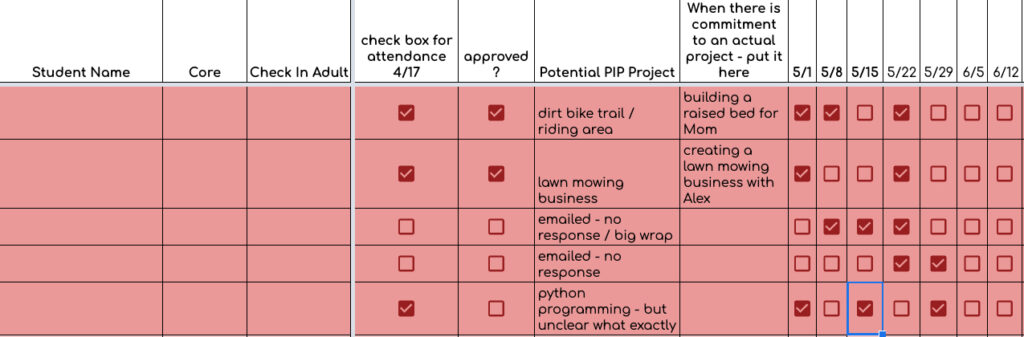
One student launched a lawn-mowing business. Another student learned a backflip. And still another planned out his garden *and* built bike jumps for his backyard. And one engaged his dad in a conversation about chickens. If you build the coop, dad said, we’ll get chickens. Blueprints appeared almost immediately.
“How was this assessed?”
It wasn’t.
…thank you for coming to our TED Talk.
No, but in all seriousness, assessment was pretty much the furthest thing from anyone’s minds. The idea was really: let’s engage students with what they want to study, and give them a venue for showing us who they are, then sort assessment out for next year. Because the rest of this year has just been a whole DEAL.
Lessons learned?
Now, while many students embraced the opportunity to follow their joy, student participation was not 100%. Some students did their projects but skipped the check-in meetings. Not every student felt comfortable meeting virtually, especially with the 1:5 adult-student ratio (small groups can be awkward). Before the school closure, not every student had a strong relationship with an adult in the school community, and that… didn’t improve by going remote.
Friday afternoons were the perfect time to meet when school was in session, but during distance learning? Not so much.
Plus, let’s name it: equity remained a problem. Access to resources was an issue in school and it became a greater issue away from school.
Let’s go back, Jack, and do it again:
The only certain thing about school next fall is its uncertainty. No one knows for sure what it’s going to look like. But the Charlotte Central team do know they want more PIPs. Here’s their quick list of takeaways for the next round, if school stays remote.
NO FRIDAY MEETINGS.
Take advantage of existing relationships for groupings like advisory
Remoteness does not meant devoid of rigor, relevance, or relationships. This is one way to honor student passions and create a venue for them to show you how they learn. It’s a way to open flexible pathways to student’s goals. And for Charlotte Central, it was a way to connect with the students they missed so very much.
Schools are committed to bringing anti-racism into curricula and systems more than ever before. Even in predominantly white schools there appears to be a growing acknowledgment that anti-racist education is crucial for all students.
Big changes seem to be underfoot. And that’s a wonderful thing.
But there will be pushback. White fragility and white rage will ensure a range of resistance to anti-racism. Some of it will be coded and couched in other concerns. But some of it will come in the form of violent, ugly, and harmful backlash.
We need to be ready.
For educators, whose first priority is their students, we need to have a plan for students who struggle to incorporate anti-racism into their current worldview.
For those students caught in the middle of the inevitable backlash, we need to be ready to provide support. What might a system of intervention look like for anti-racist education?
Systematic support for anti-racist teaching and learning
Let’s start with the premise that our goal is for students to be active citizens in our pluralistic democracy. And that in order to do that, they need to understand anti-democratic systems, starting with racism. This is so they can analyze, navigate, and transform our currently imperfect system for a more just and democratic future.
A widespread concern in Vermont, and central to this blog post, are our anti-racism goals for white students. In her book Raising White Kids: Bringing Up Children in a Racially Unjust America, Jennifer Harvey draws on the work of racial identity scholars Janet Helms and Beverly Daniel Tatum, both Black women, to define “healthy white kids” as anti-racists.
“A healthy white identity is nurtured through experiencing the growth, freedom, and power that comes from taking anti-racist stances and learning to negotiate different racial spaces.”
With the goals clear, what would it take?
To help students become anti-racist democratic citizens, we need to mobilize such systems and strategies as:
Curriculum that includes identity work, people-centered history, systems analysis, and tons of transferable skills. Something based on the Teaching Tolerance Social Justice Standards, for example.
Professional learning on the above content. This is especially important for teachers who will center this content in their classrooms (social studies, history, humanities). But really all teachers will need to learn much of this because it impacts how they approach the world.
Professional learning on student-centered, asset-based teaching methods. Such as Gloria Ladson Billings’ Culturally Responsive Pedagogy. For white teachers in particular, this would include reflection on their racial autobiographies, a deep dive into their social identities, and constant examination of their biases and impacts.
System changes including discipline policies, dress codes, diverse representation in the halls and literature, honoring student voice and agency, etc. Students learn from what they observe and experience.
Engagement with the community in new and deeper ways. Many families will have powerful assets to bring to this work. Some of them are the same families that may have felt alienated or been marginalized by school practices in the past. And other families will be resistant, overtly and covertly.
This last point brings us to our present focus.
In a predominantly white state and school system like Vermont, we will have a lot of white families, white students, and white-ness to consider. If we are teaching about anti-racism we are going to need a serious system of intervention.
White children
If students are going to learn about anti-racism, they will have a lot of unlearning to do, too. They will hear contradictory stuff at home and from the world around them via every type of media (social media, news, music, magazines, radio, etc).
White students in particular are unlikely to have encountered sophisticated thinking about race at home. In the article What White Children Need to Know About Race, Ali Michael and Elenora Bartoli noted that
“The research suggests that for fear of perpetuating racial misunderstandings, being seen as a racist, making children feel badly, or simply not knowing what to say, many white parents tend to believe that there is never a right time to initiate a conversation about race.”
If families don’t teach their kids about race, society will.
As Jennifer Harvey put it,
“White children are living in a society that is racially hierarchical, divided, and unjust. It seeks to draw white people into collusion with hierarchy and injustice every step of the way” (p. 100).
Put together the tendency for families to avoid talking about race with the damaging messages of society? We can start to see why we are where we are. When we consider how and what white people learn about race? It’s clear that we have a lot of work to do.
White-dominant culture: “How white people and their practices, beliefs, and culture have been normalized over time and are now considered standard in the United States.”
Internalized dominance: “Describes the experience and attitudes of those who are members of the dominant, privileged, or powerful identity groups. Members of the [dominant] group accept their group’s socially superior status as normal and deserved.”
White supremacy: “An ideology where white people are believed to be superior to nonwhite people.”
So for white children there is a cycle where they are raised in white-dominant culture which socializes internalized dominance and ultimately upholds white supremacy ideology. And that bestows benefits on white people, thus reinforcing white dominant culture. The cycle keeps chugging along.
In a future where anti-racist education is widespread, all students will deal with the contrasts between anti-racism and white-dominant culture.
And this is why we will need to think carefully about intervention.
White students will be struggling to counteract their internalized dominance. And this is a particular problem we have to account for in the intervention model.
Plus, for a small set of white students, that internalized dominance will be especially extreme. These are the students where white supremacy is *explicitly* part of their home environments. Where a loving caregiver espouses white supremacist ideology, for example.
There is a danger that without strategies and systems in place, these students may be pushed harder toward white supremacy. Which underscores the importance of this work. Schools may be the only chance for intervening in a life course based on white supremacist beliefs and actions, harmful to them and potentially ruinous or deadly to others.
The stakes are that high.
We have literacy support, math support, executive functioning support – all critically important. Yet without adding a layer of support around this work, I worry.
Schools have systems in place to support students who are struggling with math, literacy, or behavior. Schools often call them multi-tiered systems of support (MTSS). This is based on the premise that students receive different intensities of support based on their needs.
What if our goal was a healthy relationship to race?
Based on the work of racial identity development scholars such as Janet Helms and Beverly Daniel Tatum, Jennifer Harvey envisioned the end goal this way: “A healthy white identity is nurtured through experiencing the growth, freedom, and power that comes from taking anti-racist stances and learning to negotiate different racial spaces.”
So what would a multi-tiered system of support (MTSS) look like to help develop anti-racist students with healthy white identity?
Christie Nold, 6th grade social studies teacher Frederick H. Tuttle Middle School, imagined how anti-racist teaching might map onto a MTSS model:
“Tier 1 is what everybody gets in classroom instruction. I have a long way to go in my practice to make it true. Responsive, relevant, and sustaining pedagogy for all students. That’s the goal for Tier 1.
Tier 2 for me is collecting formative data throughout instruction, what higher level instruction for groups of students who are grappling with certain aspects of identity or with learning in a pluralistic society. I imagine in Vermont this is particularly important because not all students are getting natural exposure because I imagine many of them live fairly segregated lives.
To me the Tier 3 level is who are those students who are showing red flags and pushing back against Tier 1 and 2 instruction.”
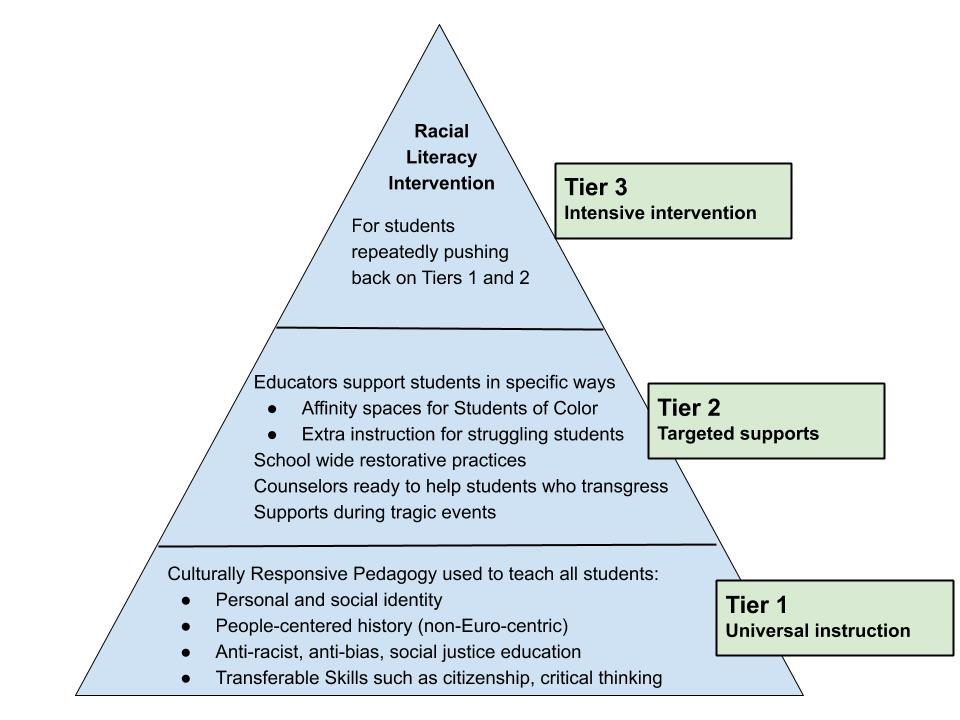
Here’s a visual of a pyramid model of multi-tiered systems of support for anti-racist education:
Tier 1: Universal Instruction
Culturally Responsive Pedagogy used to teach all students:
Personal and social identity
Non-Euro-centric history
Anti-racist, anti-bias, social justice education
Transferable Skills such as critical thinking, citizenship
For students repeatedly pushing back on Tier 1 and Tier 2 instruction
A couple of things to notice from the pyramid
First, as in a traditional MTSS system, the main emphasis is Tier 1. As Christie put it, “I wonder if students were getting high quality Tier 1 Culturally Sustainable Pedagogy from Pre-K on, we start to lose the need for Tier 2 and Tier 3.”
In contrast to math and literacy intervention, however, with anti-racism we will have schools swimming against the tide of the dominant culture in our society. Denial is the heartbeat of racism, to paraphrase Ibram X. Kendi. So students will be learning about things that many of their home families haven’t come to grips with.
Especially white students.
On this point, Christie referenced the example of recycling. She noted that it became standardized practice through schools. Students learned about it at school, went home, and shamed their parents into it. Perhaps adults could become enlightened about anti-racism and oppression through their kids.
Another difference with applying the Tier 2 concept to anti-racism: identity and social identity really matter here.
Students will “struggle” with Tier 1 very differently depending on their relationship to racism. For Students of Color, especially those in predominantly white institutions, Tier 1 anti-racist instruction is likely to trigger some of the trauma they’ve experienced living in a racist society. They will need “healing centered spaces,” as Christie calls them, such as a racial affinity group facilitated by a skillful mentor where they can process together.
When white students struggle with the ideas and skills of Tier 1 instruction, at times they may do so in a way that could be harmful to Students of Color. Consider a misconception such as the idea that it is post-racial to believe that “I don’t see color, I treat everybody the same.” This can be harmful because it invalidates the impact of race and racism. If a student clung stubbornly to this stance, a teacher could not allow it to enter class after class. The lived experience of Students of Color is not up for debate.
An example of Tier 2
Christie recounted one student who was struggling and whose comments during class were doing harm. “Luckily in this case I already had a strong relationship with the student and family, so when I contacted them we were able to work out a plan.” The plan involved the student writing down responses rather than objecting out loud when certain ideas surfaced. The student then decided whether to give the writing to Christie and whether he wanted feedback from her.
If the student was severely struggling to engage with a certain topic, or couldn’t contain what was likely to be harmful commentary, there was a plan in place to involve the school counselor.
Happily, Christie reported that the student made a lot of progress, and “came out on the other side.” She also noted that this kind of success was rare. Often there weren’t resources or receptive families available.
When Tier 2 doesn’t work
Christie shared that,
“Every year I can identify at least a few students who this is going up against something they have learned, something they have already built up walls about. They are being conditioned into white supremacy culture – in 6th grade there may be walls but often I can break them down in Tiers 1 and 2. But for some they have cemented too much. Two or three years later I hear ‘oh this student was involved in an incident,’ and I’m not surprised.”
These are not students who hold common misconceptions. They aren’t merely blundering as they grapple with complex concepts. Instead, they are students who are “pickling in white supremacy at home,” as Christie put it, drawing on a term used by her friend and mentor Shadiin Garcia. “They are hearing something very different from at least one caring adult in their life. It’s not their fault that they are confused – they are just kids.”
These students, typically white males, are in a tough spot. These are the type of students who Christie may expect to hear about later. She wondered aloud “What would a system look like to prevent the harm that student perpetuated? And also the harm they perpetuated on themselves? Because this system hurts everybody.”
How do we provide Tier 3 intervention for these high priority students?
Before we get to the how, let’s consider the who.
I brought in Netdahe Stoddard, a racial bias consultant from Cabot. His specialty is working w/white students who support the Confederate flag, as a self-avowed redneck.
We dreamed up a new cause: Rednecks for Racial Justice.
Netdahe Stoddard lives in the Northeast Kingdom of Vermont, where he grew up. He describes himself as a “Vermont rednecky dude who makes a living with [his] hands.”
He has fought racism in all aspects of his life for as long as he can remember, and has been working with schools for the past few years. This work takes many forms but the place where Netdahe feels like he has the most impact is intervening with white boys who are doing harm through racist behaviors. “As a member of the in group I can help them disentangle the ugly racist parts from the beautiful things about being a redneck.”
He calls himself a Racial Literacy Interventionist, based on a term used by psychologist Howard Stevenson to describe the skills required to defuse stress caused by racism.
The system will surely be stressed if we are going to seriously take on racism in Vermont. We are going to need a lot more people in this role.
A success story
To illustrate how Netdahe operates and why who he is plays such an important role in the work, let’s dial back to a time before he worked in schools. Netdahe has worked for more than 20 years on job sites where mostly white men labored together to build, chainsaw, and dig whatever the job required. And one of his main rules was that “I won’t tolerate racism, sexism, homophobia, transphobia, or any of that sh*t on a job site.”
This has caused a certain amount of tension with some of his co-workers.
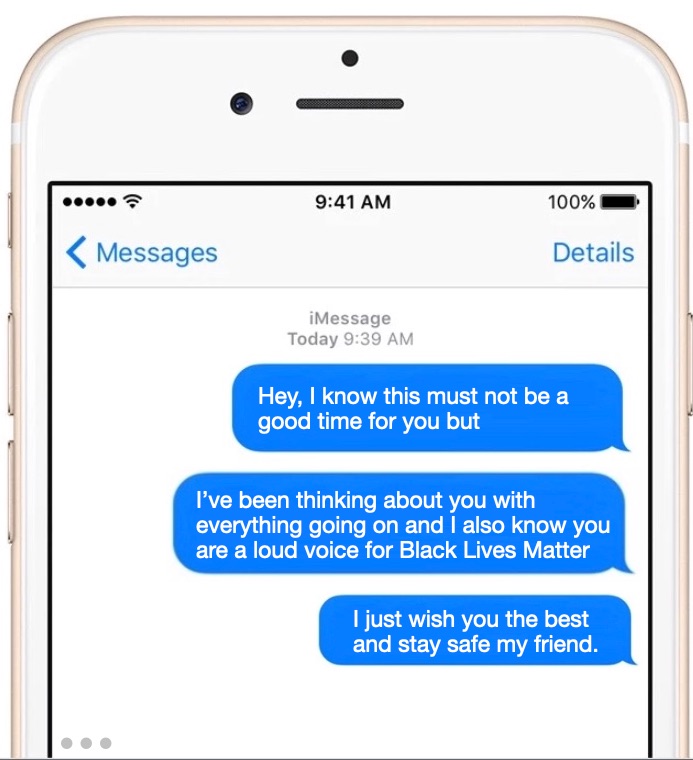
Which is why this random text last week, from an unknown number surprised Netdahe:
He called the number and sure enough it was a man that he had worked with years ago. They had clashed repeatedly as Netdahe called him out for racist behaviors. At one point things nearly became violent between them.
But now? “I consider you a friend,” the man told him by phone.
Netdahe recalled that he had stood up for this man when it looked like he might lose his job. “I had treated him like a human and showed I cared enough to try to help him grow.”
Netdahe reflected on their relationship: “We had a bunch of hours together as fuller humans, busy being humans together in the world. That allowed us to come to this heightened place after almost becoming violent with each other. And over time we chose to engage in more depth around these issues.”
Believing in humanity is the crux of Netdahe’s approach with students as well.
In fact, Netdahe worked with this man’s son a few years ago. He talked to his former co-worker before meeting with the 8th grader, and the man hadn’t been super happy about it. After a two hour conversation Netdahe had told him to please follow up with his son, and to circle back if there were any questions.
In that case, the student had gotten in trouble a few times for flashing a Confederate Flag. Eventually the school asked Netdahe to help when he asked whether it would be okay to wear a Confederate Flag in rainbow colors.
The school assumed the student was intentionally pushing buttons.
Netdahe, on the other hand, approached the situation with curiosity. “The kid told me ‘this is a flag that I identify with and that I care about. I don’t understand how it is tied to hate. Other kids have Black Lives Matter flags or Pride flags, and this is mine.” Eventually the student came to understand that the other flags did not exclude him or other people, which is what set the Confederate flag apart as a hate symbol.
In another case he worked with a student who wore the flag out of pride for a great-great grandfather who had fought in the Civil War. Netdahe made space for them to admire what it must mean to fight in a war as a young man, and to connect to other soldiers around the world throughout history with the courage to risk their lives. “I tried to get him to realize that rocking the flag might actually get in the way of people respecting his ancestor.”
These stories illuminate the importance of the identity, or “social position” as Netdahe calls it, of the interventionist when we are talking about racism. The socialization process is strong and internalized supremacy can build thick walls. Netdahe’s background, his connections in the community, and his social identity as a white man make a difference in his ability to successfully intervene.
He also has a deep grasp of the literature. He’s developed a range of practical strategies. And he’s built a system of support and accountability so he can carry out his work with integrity.
Building Fearless Futures
As long as he’s been working in schools, Netdahe has partnered with educators of color to do so. He does this to help guard against the ongoing influence of white-dominant culture on the way he carries out his work.
As he put it, “I’m a broke white dude from Lyndonville, VT. I exist as a middle-aged man with white skin. No matter what I know about racism, I’m having the experiences of a white skin man in our society.”
Natdahe and his partners recently created a non-profit organization called Building Fearless Futures. They take a team approach where the process looks something like:
A school calls in Netdahe, and they provide him with a description of the situation. Usually a student is in trouble and being forced to meet with him as part of a package of consequences.
He drafts a plan and then consults with one of his educator of color partners. They provide feedback on his approach with particular attention to any ways he might be inadvertently reinforcing white-dominant culture or white supremacist ideology.
He meets with the student.
He consults with one of his educator of color partners to process the session. They help him make a plan for any future sessions.
If the student’s actions harmed students of color, one of Netdahe’s partners may come in to meet with them, and hold a space for healing. The educators of color get compensated for their time, while Netdahe doesn’t get paid for the pre and post-session consults. He considers it professional development.
Key skills for racial literacy interventionists
Netdahe’s approach to working with students boils down to honoring the positive parts of Vermont rural culture while exposing and extracting the racist and oppressive parts.
His main strategies:
Build relationships by leading with love. “When I meet a student I want them to know that I’m super excited about these things. I love talking about them. All kids are genius and beautiful souls. I have no history with you but I’m just pumped to be here with you. What are you thinking? What are you interested in?”
Seek common cultural ground. “What are you proud of as a Vermonter? Family, making it work, hunting and fishing, having fun with friends? Me too.”
Show students how their expressions of rage and violence, although projected as strength, actually display weakness and insecurity. “I let them know I see through it because I am them. Underneath that rage is someone who doesn’t yet know how to love or believe in themselves fully. They fear living in a world with folks of color, unless those folks are limited, controlled and harmed, and they fear living in a world where women have full control of their own bodies. This says something sad about us. Luckily we have the power to shift our thinking. You can actually just live in a world with equal rights and still be a whole person in the world.”
Use analogies with zero emotional triggers. “I might explain intent versus impact by showing them my split thumb and explaining that though I intended to hit the nail, I sure feel the pain of hitting my thumb on accident. I don’t need to feel ashamed about it but it doesn’t do any good to deny it either.” Another favorite of his is the Christmas tree: he could have a great Christmas without one. And rednecks can live great Vermont lives without the Confederate flag.
Celebrate successes. “I hold them up intellectually every chance I get. And they may not hear much of that in school. Every tiny bit of ability to pop out of that bubble they are in, I tell them ‘you impressed the hell out of me.’”
Be ready for the rhetoric. “I keep up with the media put out by white supremacists so I know what these kids might be encountering.” And he’s ready to break it down.
Build class consciousness. “I show them examples of how racism is used to justify policies that hurt them.”
Show them examples of collaborative efforts between races to reach share goals. “I hold up Black, brown, and white people in every era who fought back against injustice.”
This approach is a powerful alternative to purely punitive measures. A suspension may feed resentment and reinforce the narrative that the world is against a student. It also gives them time to potentially expose themselves to online recruitment by white supremacists. Whereas the Building Fearless Futures roots their approach in humanity, dignity, and learning.
Netdahe is clearly a special guy. He has developed strategies and has resources and readings at the ready to tailor his work to each student.
Now: imagine many Netdahes deployed as interventionists to support Tier 3 services in anti-racist MTSS systems.
Netdahe thinks he could teach his approach to other people who occupy his social position. “I have three or four righteous broke white dudes I can think of off the top of my head who I could train up to do this work.”
In this same vein, is a recent blog post by self-described hillbilly Adam Jordan (who happens to have a PhD). He spoke directly to people across Vermont: “Folks throughout history, usually rural folks, who have felt economic oppression, and who have pushed back against that oppression through collective action or self-reliant practices.”
Then for the call to action: “If you fall into this description of redneck or hillbilly, and you benefit from whiteness, I’m talking to you. Consider this a hillbilly roll call. We have work to do.”
Yes indeed, there’s a movement afoot.
Wrap around anti-racism
Netdahe and Christie have strikingly similar pictures of what a dream system of anti-racist education in predominantly white schools could look like.
They both talked about schools becoming more connected to communities and providing an array of wraparound services, similar to the Community School model.
Both affirmed the crucial role of healing spaces for students of color such as affinity groups.
And they both described diverse teams of interventionists that could work with students and support teachers.
It may sound far fetched but if we are going to get serious about creating anti-racist education systems, we need to take seriously the investments required. Intervention to support anti-racist education is even more necessary than math and literacy. While math and literacy intervention is meant to close gaps, to do something similar to what Tier 1 is meant to do with more intensive structures, racial literacy intervention provides alternate structures such as affinity groups that serve entirely different functions than Tier 1.
And as we’ve pointed out, the stakes are high.
In her seminal book on racial identity development, Why Are All the Black Kids Sitting Alone in the Cafeteria, Beverly Daniel Tatum talks about how we need to support the development of an identity she calls “white anti-racist.” Truly committing to anti-racism in education would mean that the typical categories of white identity identified by Tatum – ignorant, colorblind, or racist – would all be viewed as unacceptable outcomes.
We are in this together
To create a less racist society we will need to redistribute resources to people of color and transform systems to decrease white privilege. AND, racism is a problem caused by white people. So we will need to invest in changing white people’s beliefs and behaviors.
Both Netdahe and Christie agreed, as would almost any educator, that children are not at fault for their internalized supremacy. They should be held accountable for their actions but they are fully redeemable.
“Simultaneously with our commitment to disrupting and dismantling structures that degrade humanity, a commitment to the practice of engaging the humanity of people wed to perpetuating those structures must co-exist. Whether by arrogance, ignorance, or fear, we must bear witness to their suffering as our own. Challenge what is unjust. Invest in their basic goodness. Always moving toward integration. Without this commitment and practice, we merely mirror the destructive forces of polarization and power.” (p. 203)
In the most extreme cases, for those students being misguided by their caregivers toward a path of white supremacist ideology, we must ensure schools “invest in their basic goodness” by providing the intervention they deserve.
Middle level educators at Randolph Union Middle School believe integrated and thematic learning help students see their place and role in the world. And a shift to remote learning meant they’d simply have to be more creative and coordinated to make it work!
Given the challenge to provide instruction remotely, the team agreed they needed to make learning expectations manageable and meaningful. A thematic unit became the focal point to end this year well for their students. And the collaborative effort was worth it in more ways than one.
Why implement thematic/integrated units?
Here’s what the 7th grade teacher team believes:
“When curriculum is integrated, it is no longer a list of skills and information that must just be learned for a test. When learning is tied to a specific theme, issue, problem, etc., students are able to naturally see the interconnected way information and skills from the different subjects work together. The study of themes and world problems relevant to the lives of students increases their motivation and engagement with the material.”
In addition, developmentally appropriate, relevant integrated curriculum:
fosters collaboration
deepens students’ critical thinking abilities
highlights transferable skills
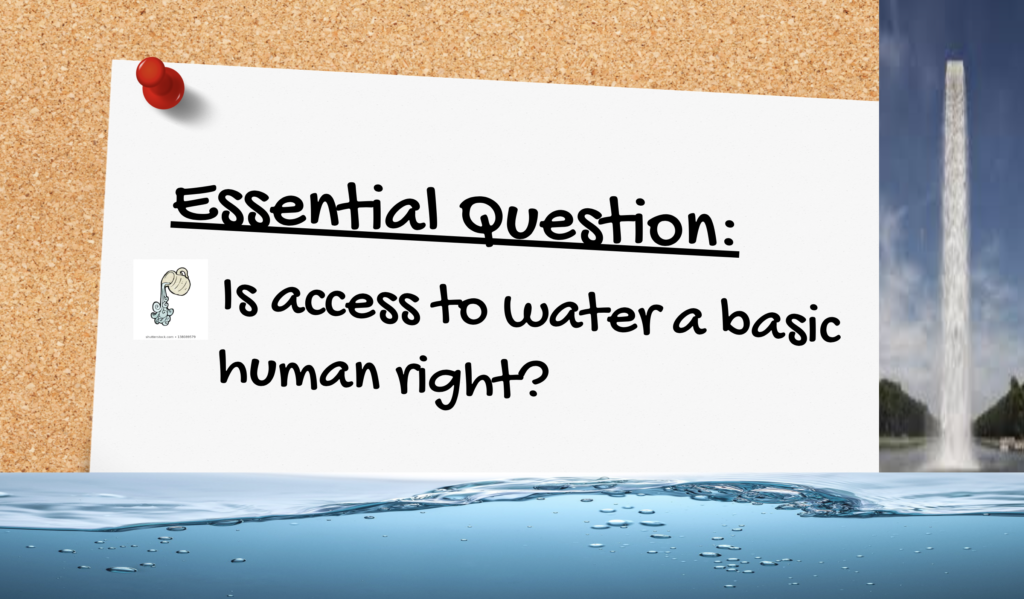
Launching remote learning through a thematic unit: Is access to water a basic human right?
Once all agreed on the commitment to keep the thematic integration going, they all selected the essential question. Their students would end their 7th grade year learning enough about water from the different discipline lenses to answer the question: Is access to water a basic human right?
Each week, the team shared an overview calendar of assignments with students and families. Students recognized that, although they were doing school work from each subject area, they were working on the Water unit as a unifying force.
Transforming teaming routines
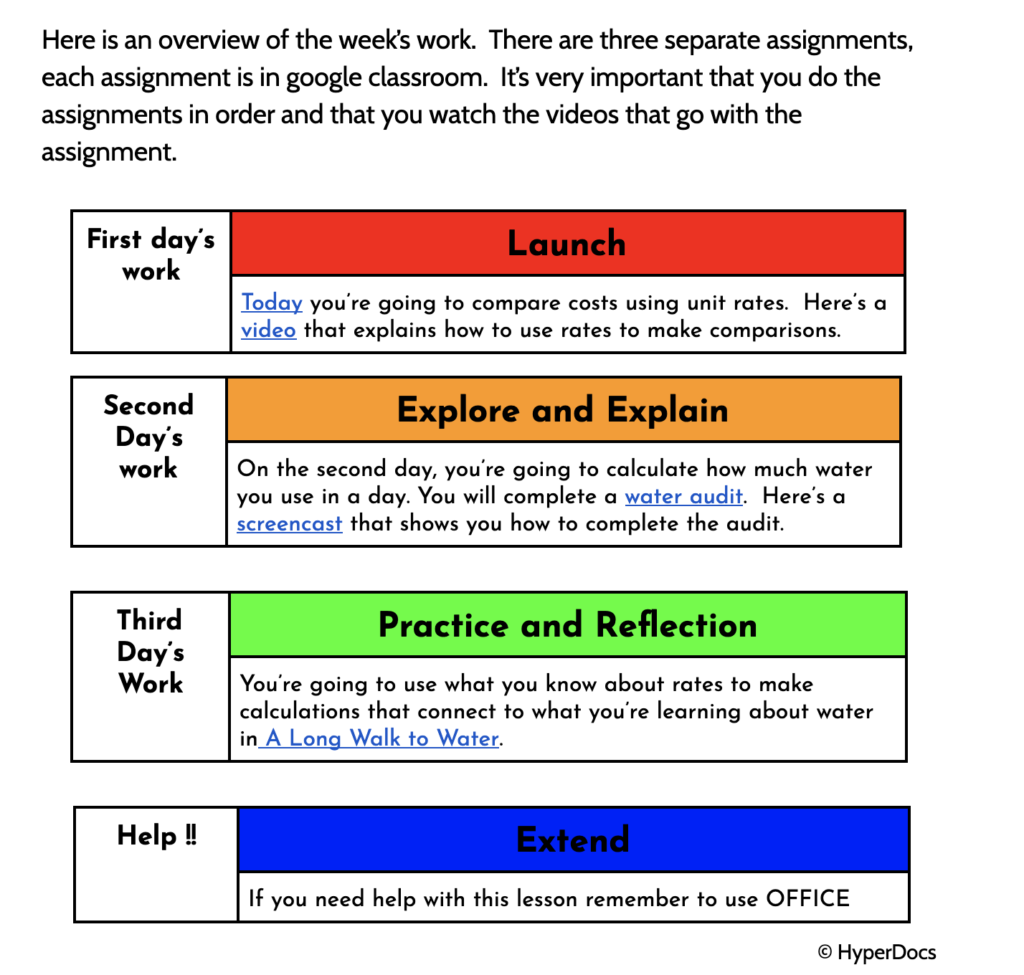
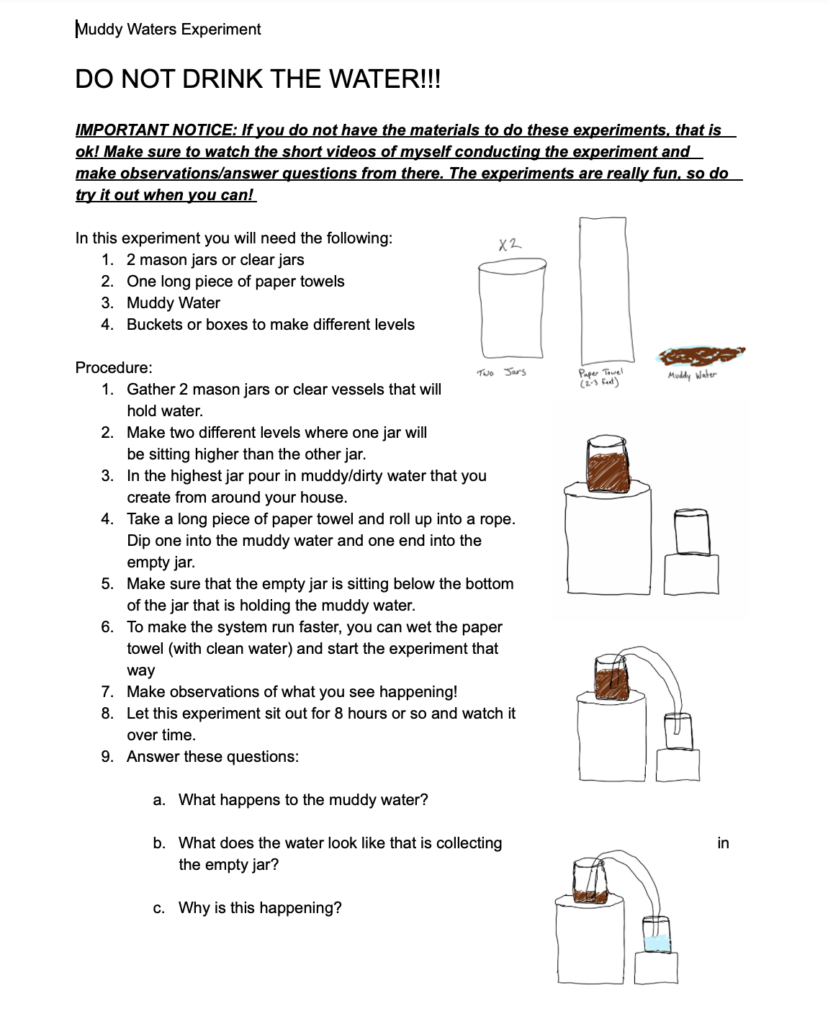
Each member of the team used Google Classroom to deliver instructional materials and receive student work. Yet, they recognized, an efficient workflow through Google Classroom wasn’t enough to help students and their families navigate assignments remotely. Each crafted hyperdocscontaining the week’s worth of work. That way, learners could see the scope of required work and plan accordingly. Here is an example of a math assignment hyperdoc:
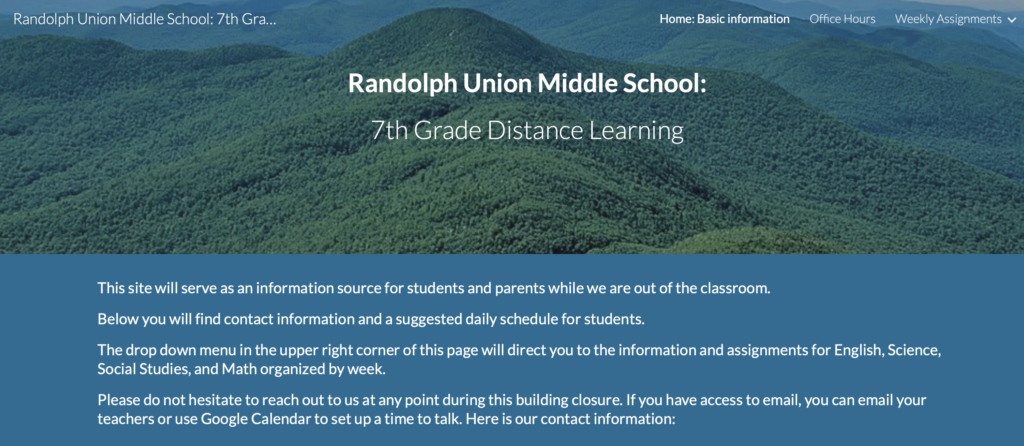
In addition, the team created a website for easy access to all assignments and supporting resources.
The best benefit to the teachers on the team in this thematic alignment work? It incentivized them to streamline delivery for students, and to plan instruction and assessment practices in a way they’d never done before.
The power of teacher collaboration
Weekly they carved out time as a team to share drafts of the remote lesson plans they were getting ready to launch this thematic and integrated learning unit. Tuning together meant that each was able to hear feedback from their colleagues about content, work load, and clarity of delivery.
Who might need to scale back?
Who might need to add more details, more diagrams, visuals and scaffolds to support self-direction?
Example of science activity improved to include diagrams & time-lapse video
Teaming at its best
Since they saw the workload for the week assembled in one place, they could make group decisions about the reasonableness of the student workload.
Example from group feedback:
hyperdoc formatting ideas included adding icons to slides to indicate if students would need to listen, read, or do.
include time recommendations for assignments so students could plan effectively
shorten instructional videos into chunks and clarify instruction
Other benefits of taking the time to tune together
Weekly tuning helped them be better advisors. During office hours each team member could support their students’ struggles and answer questions from other classes. Why? Because they were familiar with their colleague’s instructional plans and expectations in a way they’d never experienced before.
Tuning work can be intimidating. It takes time out of incredibly packed days. Yet, because of its impact, they value it above almost every other meeting at this point in this tumultuous year. Never again, Alyssa Matz the social studies teacher on the team shared, will she go back into a planning silo. She’s recognized the immense value in collaboratively sharing and critiquing lesson planning around a thematic topic for her growth and for the benefit of her students. The team agreed with her to never go back to individualized, discipline specific instruction! How cool is that.
Reflecting on thematic remote instruction
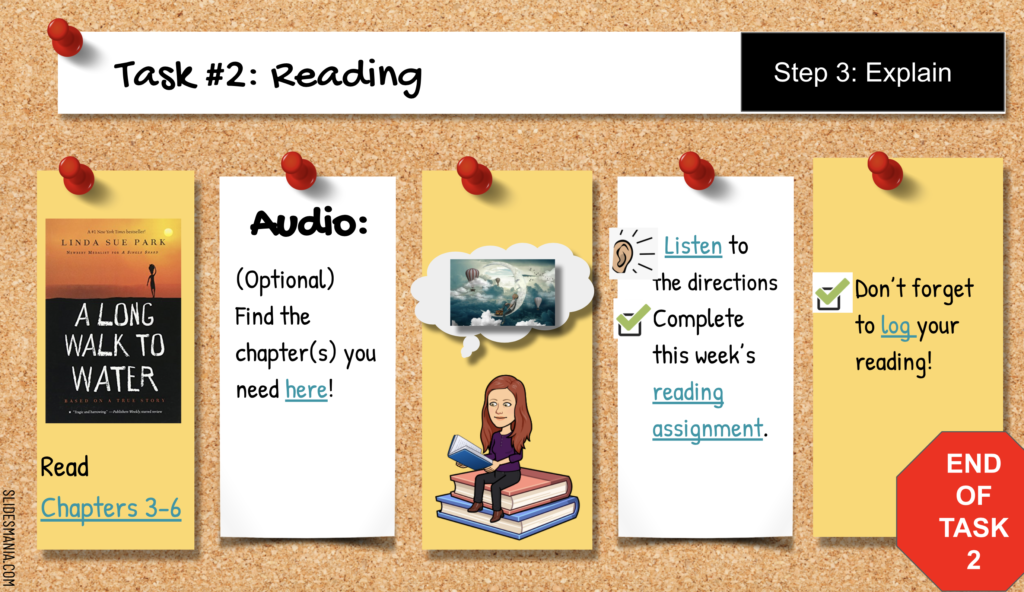
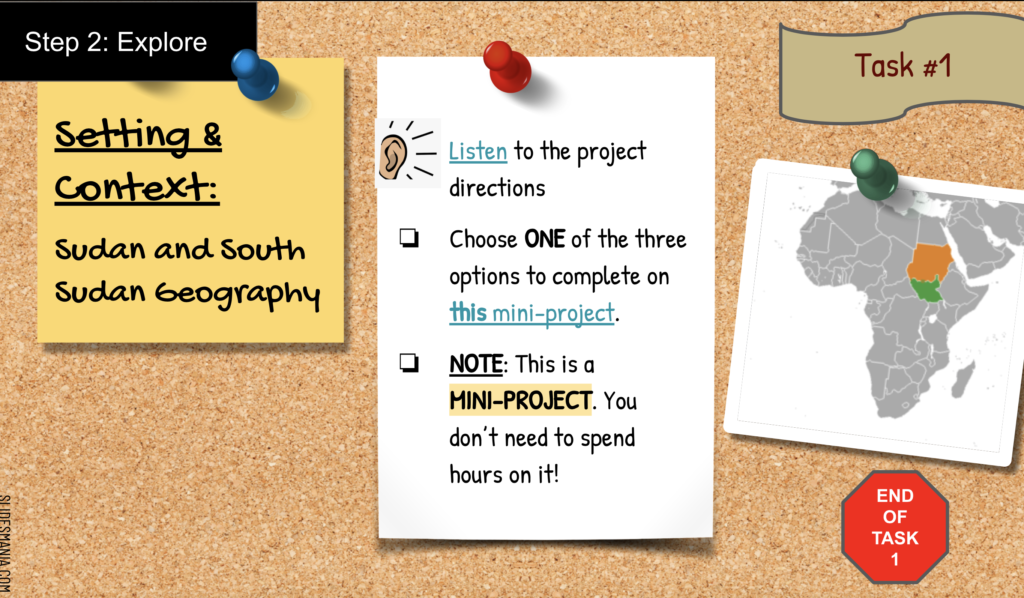
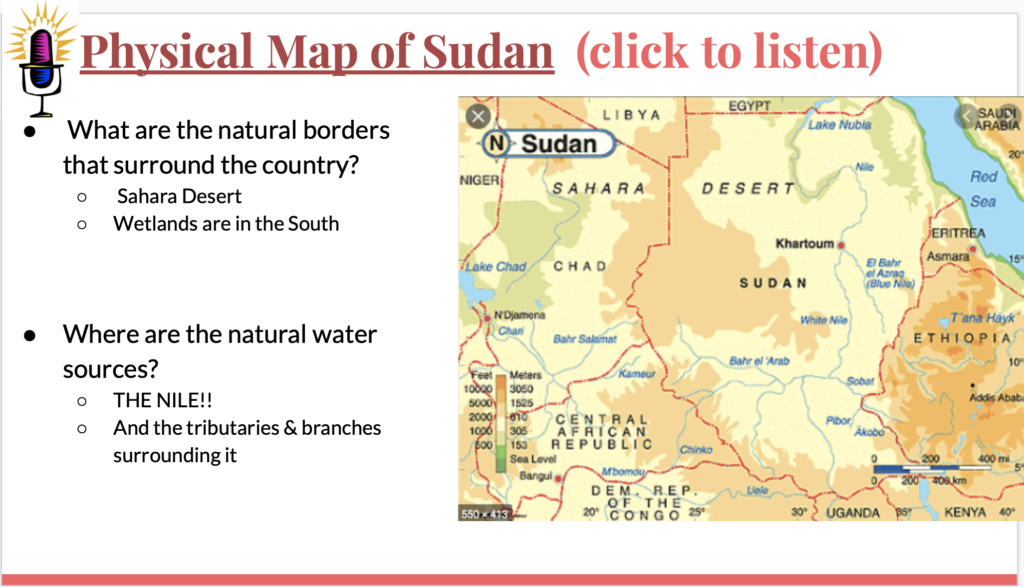
Looking back, the team saw students making connections, voluntarily without prompting, between content areas. Helping student make connections is a primary goal of the humanities curriculum. The intentional alignment of content clearly affected learners’ ability to synthesize. And the intentional integration gave students a framework to build the new learning upon. They recognized how key ideas in the shared reading of A Long Walk to Water, the science experiments on the water cycle, and the study of border disputes all played a role in their assignments. Even in math!
All agreed the power of teaming in this way was a game changer.
How might you incorporate thematic instruction in your work with students?
What has taken shape in the world with COVID 19 has given me pause to wonder what matters most in life and as an educator a chance to query about what matters most in education. I am quite sure that for all of us, the COVID19 pandemic is uncomfortable, disruptive, scary, and deeply saddening.
I am also quite sure it is a rare chance to rethink how we do many things from how we spend each day to how we do schooling.
Now, I have been a middle school educator for decades trying in one capacity or another to ensure the growth and wellbeing of young adolescents. It’s been a steady joy to work with and on behalf of this amazing age group who are inquisitive, energetic, idealistic, and a whole lot of fun.
In those years I have observed that our habitual patterns of schooling all too often undervalue the two most powerful needs of this age group and perhaps the two most influential variables in student learning and life: relationships and relevance.
Right now, as the world throbs with difficulty and discomfort, I feel called to revisit these two needs and consider their importance in middle grades education.
Relationships
Relationships have always been touted as the number one priority in middle school education and for good reason.
Every middle school teacher knows that young adolescents (all of us, really) are often most invested in school because of the friendships they find and develop there. Ask any middle school student what they most look forward to at school, and many say “lunch” not because they love our food, but because lunch is their chance to be with friends. While we all hope students engage in our program of studies, curriculum alone, even the best most relevant and student-centered curriculum, has rarely been the sole motivator for middle schoolers.
Right now, as a result of the COVD19 pandemic, our students are disconnected from their friends at school and friends in their communities. Many are left bereft of what sustained their motivation to do school, and supported their social growth as caring and empathic beings. They express longing to be back at school not because they yearn for that lesson on igneous rocks, or the elements of fiction, or the Dust Bowl.
They are eager to be with others.
Many middle schools were prepared for this challenge.
They had in place some sort of arrangement that emphasized relationships. In the middle school world, this has often been called “Advisory” or “Morning Meeting,” a time that can afford students the guidance of one adult and the fellowship of a small, caring group of peers.
While Advisory programs vary by name, or configuration, all aspire to promote a sense of belonging, to insure every child is known well by at least one adult, and to engage students in activities and discussions that help them build healthy social skills and caring dispositions.
These should always have been among the educational ambitions of every middle grades school, but our current circumstances make it abundantly clear that if we had not been serious about relationships, we’d better get serious now.
Little did we know however, that one day we would be required to do this virtually.
What could a virtual Advisory look like in these times of change?
If you’ve been lucky enough to have had an Advisory style program in place, you have history and momentum. If for you or your school, time for deliberate relationship-building is still new, it’s not too late to implement a virtual version for the fall. Every school and every teacher has the chance to craft plans for learning that put “relationships” first.
Here are a few ideas to consider as you journey ahead:
1.Reconnect with the big “why”: Relationships.
As I take in current projections about how life may unfold with COVD19, I hear expressed concerns about lost academic learning. While of course I share that concern, I am far more concerned about the disappearing opportunities for young adolescents to learn how to get along with others, to cultivate empathy for those different from themselves, to engage in self-reflection and to learn to value a caring community.
Young adolescence is a potent developmental window during which the lines of social character are engraved. When we take that seriously, and spend time building relationships, the results are extraordinary: heightened investment in school learning, a stronger sense of social efficacy and the development of the social skills needed to live a better life.
COVD19 has brought out the best and worst in our culture, reminding us that while we may have what it takes to get there, we have a long way to go towards building a fair, just, kind, sane and caring nation and world.
2. Tap into how you are experiencing all of this.
If we hope for more humane middle grades schools, we have to first and foremost allow ourselves to be more human.
In short, we need to bring our fullest and most human selves into our classrooms.
Take stock of how you are experiencing the loss, stress and disruption associated with this pandemic. Notice first and foremost how this is effecting you. I have had sleepless nights, restless days and times when I felt I was not able to be productive.
Students and families will experience these same ups and downs.
I hear some arguing that we should “keep calm and carry on”, which may be well and good, especially the calm, but really? I would argue that pretending things are far better than they are is not helpful.
Emotions are running high for all of us and here’s a chance to honor emotions and feelings as part of being human, part of learning and rightfully, part of school life.
3. Make everyday personal.
I am learning from COVD 19 that empathy is a capacity that needs our collective attention. Easy kindness is simply not enough. Even the face to face struggles that emerge when we are confined with people we supposedly love, puts deep empathy to a daily test. Can we understand this person right in front of us? Are we able to care about his or her welfare even when they are terribly annoying?
A sure COVD 19 lesson for me is that relationships demand so much more than we think. They demand a recognition that we are all perfectly imperfect and inextricably connected.
We now teach on the edge of our students’ doorsteps, and as such we have a unique opportunity to make every day more personal. Using whatever platform we have, students can share their lives in new ways, introducing us to special parts of their lives. Maybe they have special hobbies we never witnessed or treasures tucked away at home they never had the chance to share. Students need to feel a sense of belonging and connectedness with us and their peers and sharing real life stuff matters now more than ever.
Above all, this pandemic has the capacity to move us toward greater interpersonal intimacy. We are all equally vulnerable.
As such, this is a lesson in our common humanity we don’t want to miss. Keep your classroom plans open to feelings and emotions, and give yourself and your students permission to bring up the tough stuff. Structure time each day for some sort of check-in, whips around the room, or share time. Most of all, make it human and make it personal.
4. Stay close and connected to students.
While Advisory meetings held on Google Meet or another virtual platform enable students to see friends and experience fellowship, students also need our support in more individual ways.
5. Consider weekly Dialogue Journals with your Advisees.
If you don’t have Advisees, you could initiate peer Dialogue Journals. Students can write to you or a peer, and you or the peer write back. I find this a powerful way to gain tremendous insight as to how students are doing emotionally.
If you try peer Dialogue Journals, students can use a shared doc, and share with you once a week. Peers can shift partners after several weeks. This will allow you to see into the hearts and minds of students you were once able to discern from a face to face glance.
There are of course many other ways to let students know you care. As you see certain students struggling or losing heart, try to reach out by email, phone or facetime. Obviously, it would be wonderful if we could google meet with every student but that may not be realistic. We can however, reach out in many different ways. A short note can mean the world. Even snail mail notes can be a lovely and fresh gesture of caring.
To smile things up, one 7th grade team at Stowe Middle School, took to wearing different, playful hats each week to virtual Advisory. It was fun — even funny — and always created good feelings that were contagious. Try games, like Charades, or Pictionary or other virtual friendly games. Infuse play and laughter in some way in Advisory or in your classroom life.
At Stowe Middle School, a leadership group of Advisory Advocates have been giving feedback on virtual Advisory. They all declared two things to be critical during COVD19: daily check-ins where we share our lives and playing games where we remember to have fun.
Relevance
Right now, as a civilization we are facing a world challenge of grave importance. It has nudged many of us to question much of what we once took for granted. The current conversations in print or media repeatedly recount a renewed appreciation for quality relationships, the pleasures of a simpler way of living, the sacredness of the earth’s resources, the critical importance of civil discourse, and the certainty of our interdependence.
On the school front, educators and students alike are experiencing in sometimes painful ways, a hard truth about the school learning. When stripped of the trappings of school life including lunch with friends, sports, proms, graduations, what is left, is not all that compelling. Students talk of missing friends and teachers, but algebra apparently is not that memorable.
Over the past several decades, educators have used the word “relevance” to capture a sought after quality in school learning.
The hope has been that somehow what students learn in school could be compelling: real and relevant to them.
Ambitious efforts have been abundant as creative teachers have designed projects that address real life issues and often engage students directly in working on such projects right in their local communities.
These projects generally win enormous student investment so much so that at the close of a school year, when asked about what learning had been most significant, it is only these projects that students can remember and recount.
While these projects have a powerful impact on student enthusiasm for learning, they also have had a tremendous impact on skill development, and abiding understanding of how the world works. In effect, they represent relevance at its best in contemporary school learning.
Authentic school projects, while wonderful, have historically only punctuated the typical school curriculum.
The hefty load of student studies often consists of addressing a massive number of content standards in fragmented and discrete subjects that are only indirectly connected to life as it is being lived. This is not to suggest that the disciplines of knowledge (eg; history, science, math and so on) are not needed and useful in human inquiry. They are. It is to suggest that they are only useful, relevant and meaningful when they are applied to address the questions or problems of living.
All of us know this truth: knowledge stays with us when we need it, yet so much of school knowledge is given to students without relevance. Content without a cause is content lost.
Today, as this pandemic has the attention of the world, we are asking students to engage in doing assignments that have little to do with this enormity swirling around them.
Like us, students have a zillion questions about COVID19, about how any virus spreads, about how families, communities, states, nations are dealing with this crisis, but instead of exploring those very questions in school, they are heading into on-line assignments that suggest nothing has changed.
Here’s the hard part: hasn’t this been a pattern in education?
And, isn’t this the very reason why what kids miss from school has nothing to do with the curriculum?
I am not suggesting that everything that students should be invited to explore in their on-line learning should revolve around COVID 19 because it is the issue of the day.
I am however, advocating for serious and planned attention to the questions this raises for students and for us. After all, an issue of such complexity if it is to be understood, would demand that we call upon a wide array of knowledge, drawn from many disciplines or subject areas.
When this pandemic ends, what will our students have learned about it?
What will they have learned from it?
Do we have to wait until this life changing event is over and logged as a chapter in a history book before we dig in?
There are many ways to ensure that life as it is being lived can become the curriculum of study.
As one example, we could begin by culling from our students all of the questions they have about this pandemic, identifying those dominant questions we and our students have in common, and then crafting pathways to explore, understand, and share our common learnings.
With the work of serious investigation and sharing, the transferrable skills needed for lifelong learning would be emphasized.
Ultimately, this curriculum would be a democratically created curriculum and as such enormously relevant to those who created it.
Students could effectively specialize in areas of most concern or interest to them (personalization), while also providing a service to their peers and communities, by sharing their new knowledge and wisdom with others and applying it to crafting promising solutions to real local problems.
Imagine students working alone and in small groups charged with investigating different identified areas of inquiry and then finding many ways for them to share, report and extend their learning and ours.
No doubt this would be an integrated unit of study, where the separate subject boundaries are blurred. A unit like this could go on for many months, letting all dig deep.
The products students could create could become a legacy of sorts reminding us all of what we’d learned from this crisis and helping communities garner wisdom for our lives ahead.
No doubt it would be messy and imperfect, and would demand team teaching, but imagine the authenticity and relevance of such a learning model.
Imagine the many critical skills students would be honing in this kind of work.
Imagine the capacity of such a curriculum model to be a great equalizer.
Most of all, imagine the relevance of using school learning to study this unimaginably challenging problem.
Lastly, imagine all school learning centered on addressing the real life issues of personal and social significance as students and teachers collaborate to create a worthy education.
This is not a new idea.
Some years ago, James Beane advocated for such a novel approach to curriculum planning. He called that approach curriculum integration: to propose a school curriculum centered on life itself.
“Curriculum integration is …concerned with the organization of curriculum around significant problems and issues, collaboratively identified by educators and young people, without regard to subject area boundaries…In curriculum integration, organizing themes are drawn from life as it is being lived and experienced.”
The true dream for curriculum integration was that it would not only be compelling to many more learners, but ultimately by its very design, would model the purpose of being educated.
That knowledge and research are essential to managing our own lives and to creating a saner, safer, kinder, and better world for all.
There are too many Americans who were happy to exit school style learning and are fairly committed to staying clear of it for the rest of their lives.
Some are now middle school parents.
When I talk with the adults who hated or merely completed school, they tell me they could never see the point.
What they often say is what students at times will confess:
‘When will I ever use this? What does this have to do with anything real? Why do I have to wait until I graduate to explore issues that demand real knowledge in real time?’
It is time to craft better answers to those questions, not so much to please students or merely engage them, but to ensure that school is about what matters to us all.
While it may seem fitting to engage in such a progressive model of curriculum only now while we are in the midst of this pandemic, this is a model we need to take seriously as a promising pathway to better schooling in the years ahead.
In that talk, Skinner argued that human beings tend not to make huge needed changes unless the pain is sufficient to force them to do so.
As a student, I wanted to believe that Skinner was wrong and that humans were capable of dramatic proactive change.
But maybe he was right.
Maybe it takes a pandemic to get our attention. I know it has prompted me to rethink many aspects of life.
The crack in our schooling foundation has us all buzzing.
We are all wondering what to make of this new way of doing school.
I say we use this hefty nudge to think bravely about bold steps we can take to make middle grades education richer in both relationships and relevance.
Most of all, I want to clear out the clutter we now know is strikingly useless and replace it only with what will lead us all towards living life more humanely, more creatively, more sustainably and more equitably.
You have made it through what could be described as one of the most challenging, confusing and heart-breaking few months of history in your lifetime, and likely ours, too.
So as you finish up the school year, all of you students and teachers out there deserve a hearty thank you, for sacrificing, for caring for each other and for showing up, and pivoting to remote distance learning rapidly, and for offering each other grace.
We know it hasn’t been easy.
We know you all gave up some of the most nearest and dearest experiences in this moment, and that you suffered significant loss, of beloved family or friends, or once in a lifetime experiences. And you did this to help other people, most of whom you have never met. In fact, your actions, your staying home, staying physically distant, your hand washing, directly impacted the lives of others, helping them stay healthy during this crisis. YOU did that. And we have you to thank!
And teachers? Whoo! You have led with love.
You have called, emailed, video conferenced, coordinated, created, shifted, so many things, all in service of caring for your students and colleagues. This was a monumental task. We have been incredibly moved, inspired, and touched by your expressions of care, love and connection with your students. To you, we are forever grateful.
And now, to the ones moving on.
To the ones changing schools, launching into middle school, launching into high school, and the ones launching into life post-high school. It is you we wanted to bring this message to. It is you who gives us hope for the future. Why? Because during all of this, you met the moment with creativity and perseverance. You are both missing the culmination of your learning experiences, and are launching into uncertain times. But you are also the generation with the greatest amount of compassion for each other, poised to push our society into a new era, one centered on a shared humanity, one that we see in each one of you when you tell your story, when you advocate for new laws and policies, and when you check in on your friends, neighbors, and communities.
We need you.
The adults in your world have left much undone. There is so much to dismantle and to recreate. Our society continues to perpetrate oppression, to separate, to label, to devalue and harm. There is so much left to do, and we believe in you and will join you in this work.
We salute you, as you move on to new horizons. Know that you can always redefine who you are, and who you want to be. This is your chance to decide. To change course if you want to. And to work toward the values and vision only you can know.
Raising a toast to you, graduates, students, and teachers. You did this incredibly hard thing, under the most difficult circumstances, and we congratulate you. You made it.
Listeners: our hearts are breaking. Our hearts are breaking for all of Vermont’s Black students, Black educators, and Black families.
But frankly, our broken hearts are not nearly enough.
Right now, we need to talk about what this all means for Vermont. What it means to interrogate in schools, and in classrooms, and in ourselves.
On this episode of the podcast, we grapple with a challenging short story by Hemingway (yes, that Hemingway), called “Indian Camp”. Now, a content note: this story contains language and attitudes that we as a society no longer find acceptable, and in fact, one of the terms that Hemingway’s characters bandy about, a derogatory term for Native and Indigenous women, we just won’t be saying on this show.
But.
Given that this is a story that’s primarily about the experiences of a young white boy, and how the death and injury of Native people reaffirms his view of himself as entitled, why does Vermont principal Elijah Hawkes use it every year in welcoming new educators to his school?
Because that young white boy, and the people he injures with his entitlement? They’re in your classrooms, your communities, and your homes.
This remains #vted Reads. Black Lives Matter. Now let’s chat.
Jeanie: Thanks for joining me, Elijah. Tell us a little bit about who you are and what you do?
Elijah: Hi Jeanie! Thanks for having me, for this conversation. I’m currently principal at Randolph Union, a 7-12 school in Central Vermont. It serves three towns and a bunch of others in the surrounding county: Randolph, Brookfield and Braintree. About 400 students at the school. We’re adjacent to the Randolph Technical Career Center and all the benefits that come with that neighborhood.
I live in Middlesex Vermont; I grew in Moretown Vermont, about 20 minutes away. Began my career as an educator though in New York City and was an English teacher and then founding principal of The James Baldwin School, a small alternative public school.
And then moved to Vermont about 9 or 10 years ago and I’ve been here and in this role in this place ever since.
Jeanie: Thank you for that. You are also a writer.
Elijah: Yes, I’m also a writer. Like conversations like these, writing is a conversation with myself and with other people and with ideas. And it’s one of the ways that I digest the work of being an educator. The work of being an educator in public schools, the work of being a public school educator in a democracy, the work of being an educator with adolescents. The work of being an educator as a father who has children. I pour that into my writing and try to make sense of the world that I’m in. And then when I can try to share that with others and have further dialogue about it.
I just got a book out actually this past month. The book launch parties have been few since social distancing, but I’m excited to share that with people as well. It’s called Schools for The Age of Upheaval and the subtitle is Classrooms That Get Personal, Get Political, and Get to Work. And perhaps there’ll be some intersections with those ideas in our conversation today.
Jeanie: I’m ready to get to work! Let’s see, well, one of the things I always like to ask books because I’m a librarian and an avid reader and I’m always interested in what other people are reading, do you have something on your nightstand right now, that you’re working on?
Elijah: I do yes. I’m just 20 or 30 pages away from the end of The Water Dancer by Ta-Nehisi Coates. My brother’s reading it at the same time; we’ve been having some correspondence about it. So we’ve been enjoying that novel by Coates, whose essays, of course, I’ve read in other publications. But this is his first long work of fiction.
Jeanie: I loved that book, so much. Yeah. It’d be interesting to pair that with — I don’t know if you saw the announcement yesterday but Coates Whitehead won the Pulitzer for fiction for The Nickel Boys which is another just phenomenal sort of historical fiction take.
But I really love The Water Dancer.
Actually it’s come up a lot with people who’ve I’ve had on the podcast! They’re either reading it hoping to read it, suggesting it to me, suggesting it to others. Great. So, I want to start with: why did you choose this text? Why choose “Indian Camp”? (.pdf)
Elijah: It’s actually a text that I’ve used as a jumping off point for professional development discussions about our purpose of our work, and how we do our work. And it’s a short story. I thought: why don’t we talk about that and see where it takes us in terms of conversations about our work as educators.
It’s not about school but it’s about a child. It’s about children and the families that they live in. And they live in a divided society. They live in the United States at the turn of the last century somewhere in upper northern Michigan. And it’s a Native American family and it’s aAnglo-American family and they cross paths in a fairly traumatic way. And the question that I ask my colleagues and I ask myself is:
Consider the protagonist of the story, the boy Nick, who’s the son of a doctor, and ask yourself: if he was in your classroom, what would he need from you as an educator? What he would need from your school? And then ask yourself the same question of the Native American child that we meet in the story. What if he was in your classroom? And how’s that similar or different to what the son of the doctor needs?
Then the other question is more about the purpose of schools in our society and the question is:
What does the society need the children to get from their schooling?
Jeanie: Let’s set the stage for our listeners. Nick is on vacation; he’s fishing with his uncle and his father. His father is a doctor. And they’re called in the middle of the night, I think, or the wee hours of the morning to this Indian camp. They have to get there by canoe. And when they arrive; as they’re arriving, as they’re traveling there, Nick’s father is telling him that this woman has been in labor for a couple of hours and…
Elijah: Or longer.
Jeanie: Sorry a couple of days, you’re right. Not a couple of hours. As they arrive…
It’s Hemingway, so it’s sparse, but there’s a bit of commentary on this on the homestead, if you will that really jumped out at me about the descriptions of place, and of people.
Uncle George is not very kind. He uses a racial slur against the young Indian woman and so it sort of sets this stage of these two separate worlds. Is there anything you would add to that? Or what you took from it?
Elijah: Well you’re right. It’s Hemingway. So you know: short, staccato sentences — very observational. You have to do some work as a reader to try to intuit what people might be feeling or thinking beyond their surface phrases.
You might even say the first page or two of the story are boring. And part of the why I choose this story is for that reason actually.
And I’ve been using this story mostly in the last 5 or 10 years in my work with predominantly white educators. like myself. So one, choosing Hemingway, and two, choosing a story that starts off the way that it does, you know, kind of from the perspective of a child: very slowly moving across the lake, in a deliberate and sort of banal fashion. No one is going to really have their defenses up.
So we’re about to have a conversation about race and class and violence in the country we live in and I don’t want people to be defensive, as we enter into that conversation. And Hemingway actually allows them to do that, with a diverse audience or with an audience that includes mostly white educators. Mostly white people.
Part of the reason why I like this story is that slow entry into content that is very important and troubling.
Jeanie: You know, that makes me think of the slow way in which we are acculturated around race too. Like that Nick is this five or six-year-old kid, maybe seven, and he’s picking up all these quiet messages about difference, right? Who matters. And what’s important.
Elijah: Absolutely.
Jeanie: And I think about that’s how experience in the United States, living in this highly racialized society that doesn’t really talk about race, right? We slowly accumulate as children all these ideas.
And for me, I’ve been doing a lot of reading around decolonizing methodologies.
It’s not just about the people, and the places, and who matters, and who’s important, but like which ways of being and knowing we value.
And in this case it’s Nick’s father’s very Western medicine way of knowing that’s valued. Right, like he gets to be the savior, he gets to come in and rescue! And his scientific knowledge is what’s important. While all the other quiet ways of knowing that belong to the Indigenous folks in the story, are completely unvalued.
Elijah: Yes, you’re absolutely right. You know: again, it’s not told in the first person, but you more or less are seeing things through the eyes of the child. Nick who I think is probably 5, 6, 7 years-old just based on how he talks and thinks (and I also have two boys, and so I remember them at that age and it does remind me of 5, 6, 7 year-old boys), and he sees his father conduct a Caesarian section in the most impoverished of conditions.
These are bark peelers; this is a bark-peeling camp, is how I understand it. So the logs are drying out of the forest. There’s dense and very rough and dangerous work of peeling the bark off of the log, before I assume there then sent by some floatation across the bay or down a river.
It’s the hardest work of logging that’s done by the Native people here.
Nick and his father enter this what’s called a shanty, and most of the men of the village have moved away because the woman’s distress is so troubling. It’s a breech birth so she’s not able to have the child. And my assumption is that she is going to die unless some kind of intervention happens. Which probably is why somebody went for help from this doctor.
Because you’re right there’s a woman who’s there attending to the young woman who’s pregnant. She’s exhausted; her head is on its side. She’s been in labor for days. Her husband is also in a state of destitution because he’s wounded himself through his work. His foot is cut, and he’s now disabled lying in the bunk above her, and so he can’t escape her pain. He’s trapped in his world of violence in so many different ways so he’s there and the doctor doesn’t bring any anesthetic…
We’re not really sure if he had any anesthetic and could have brought it, but he doesn’t bring it. And he conducts a Caesarean section with a jack-knife and some rough thread…
There’s more that happens, but Nick witnesses this all.
And on the other side of it, he’s heard his uncle use a racial slur towards the young woman who bites him — which is a very interesting moment in the story, a moment of resistance you might say. It’s one of the few times that a woman in the story speaks or does something. And she bites this man who’s holding her down.
But Nick hears the uncle use a racial slur. He hears his father say that the woman’s screams are not important — “I just need to focus on my task” — and so the father’s bias and racism and insensitivity to the pains of the people he’s working with, are clear.
And on the other side of this Nick is going back across the lake with his father. At the end of the story they’re going back across the lake.
The man in the bunk above — the father of this child, the husband of this woman — takes his own life over the course of this story.
And Nick’s father by then is completely deflated. When he sees the trauma — to a degree through the eyes of his child — he’s deflated. And he wishes that he hadn’t brought his son. But the last thought that child has as he’s crossing the lake is, or it’s a thought that he doesn’t have… He has a sense that he would never die. There’s a sense of you are in power. You are in a place of power from people with power, of strength and invisibility and you’ve just…
Nick has just experienced extraordinary violence and he’s experienced death, and he’s experienced pain… and on the other side of it he understands death as something that happens to other people.
There’s all of that that comes with this story about a young white boy and his rite of passage into what? Into power. It’s a rite of passage into power and privilege. It’s a solidification of that. Again, I think the question that to ask of ourselves as educators is: what does that kid need? He’s in our school right now he’s in your classrooms.
That person with that power and that privilege is in our classrooms — or is in your own home. What is it, that person needs from our school?
And then also what does the other child need?
Because the other child lives.
And if it’s a public school in Vermont we also have that child in our school, too. The child is living in a camper. The child who’s homeless, the child who’s coming from great systemic poverty and the violence that comes with it. Both of those children are in our schools. What do they both need? Unless the doctor son is actually left to school because that happens. That’s happened several times since I joined Randolph Union, actually.
Jeanie: Already left your school for private school, is sort of what you’re saying?
Elijah: That’s what I’m saying is that the doctor’s son and the doctor’s family may have the choice, of not being in your classroom.
Jeanie: So, you’re reminding me: I teach collaborative practices and facilitative leadership and we just focused on equity using protocols and structures to have hard conversations. Because these are hard conversations. About equity, about bias, about the way assumptions color our teaching practice, and how we see kids.
And many times in Vermont I will encounter teachers, educators, principals, administrators who will say,
“Well our school is all white so we don’t need to deal with race.”
What kind of white children do we want our kids to be?
What kind of white folks do we want our graduates to be in the world?
If we never talk about race, if we don’t equip students with conversations about race they can’t develop a positive white social identity.
Elijah: Totally agree with you there. And I’ve tried to train myself to not ever say anymore, that we’re not a diverse school community. To say, “We’re not diverse,” erases… five, 10, 15, 20 individual students. Even though Randolph Union is 95% students who identity as white. I can say that we’re mostly a white school, but I can’t say we’re not a diverse school.
Jeanie: Yes. I think we fall into a trap when we minimize or erase those students who may be biracial, or presenting as white or may have more complicated ethnic backgrounds.
But we also fall into a trap by thinking that white kids don’t have a race.
So:
What do we need to focus on?
What are some of the things that come up?
And what does schooling need to provide for this sort of entitled young man who thinks he’s never going to die?
Elijah: Well I think Nick need to have a personal and historical understanding of himself. And he needs to have a personal and historical understanding of others.
I’m fond of saying, as we approach complex topics in the school community, that we need personal stories and historical facts. Personal stories and historical facts, personal stories and historical facts. And if we have both of those in our classroom, at our assemblies, in our professional development work, we have what it needs to have truthful conversations.
Now I know we can certainly debate what counts as historical fact, but look: we’re educators and so we’re academics to degree, so we’re going to default to what academia legitimizes as historical facts. And we should.
But Nick needs to be in a classroom where he’s enabled to reflect on his own personal story.
Where he’s been invited reflected on this trip that he had as a five-year-old.
Where’s he’s asked questions.
And where he has to reflect on the society that he lives in.
And where he’s asked questions where he has to consider the perspective of other people.
Hopefully it’s a classroom that’s diverse by class ,and it may also be diverse by race to a degree. The teacher needs to carefully create a trusting and bonded classroom community — and the teacher may need help to do that. But a bonded classroom community where personal stories can be shared.
So that’s the classroom that gets personal.
Nick needs to be able to hear other people tell their stories. And he needs to also be able to reflect on his own, and to share it. That’s one thing that he needs.
And then he also needs a politicaland historical understanding of where he comes from, and the society that he lives in.
Jeanie: Can I poke at this notion of historical fact a little bit?
Elijah: Yeah.
Jeanie: I think you’re right. I think history — or inaccurate history — is a huge part of our problem in this country. That we tell the stories that we wish were true about what our American society. And not just the like, “chopping down of cherry trees, never tell a lie” kind of stories.
So yesterday, Nicole Hannah Jones won a Pulitzer for work on The 1619 Project. Which is wonderful. Because The 1619 Project really disrupted all of the history I learned as a student, right? By centering the experiences — and not just the experiences but the work — of Black people, and the way that Black and brown people have really built this country. Not just buildings, not through slavery but like: *built* our democracy. And moved it forward.
And so I think this idea of historical facts means we need to trample the historical fictions we’ve been telling ourselves as if there are facts.
Elijah: I totally agree. And we’re fortunate to have, you know, unending resources at our disposal to access those stories that are going to trouble our fictions.
These are organizations that offer educators off-the-shelf resources and daily reminders, about this day in history, 200 years ago: What was the experience of working class people, and people of color, and immigrants? They do center those stories and so the resources are there, there’s no excuse for not considering them as we plan our lessons, and using them as we teach.
Jeanie: What I hear from you is that we to do the work as educators. And that we have to disrupt or challenge our own indoctrination into a certain kind of history. And ask ourselves:
Whose story is being told?
Whose story isn’t?
What does power have to do with that?
And where do I go find those that haven’t been told?
The work is for all of us at all levels, right? Like it’s just not for young people. In many ways, we’re Nick, too.
Elijah: We are Nick, too. Absolutely.
Jeanie: And so there’s a quote. It’s before the Caesarian section, when Nick’s father the doctor is getting ready to perform surgery. He’s just explained that the birth is breech, and he says to his son, “But her screams are not important. I don’t hear them because they are not important.”
And thinking about the context of this conversation with you, the question I wanted to sort of interrogate my own practice with, is:
What are the things that I as an educator sometimes was not able to hear because I consider them unimportant?
Elijah: That’s a great question, Jeanie. I’m wishing I would ask that kind of question when reading the story. You have here a doctor who feels like his primary task is to get the child out of the belly of this woman. And to do his best to save both of those lives in the process. So if he’s preoccupied by her emotional distress, then he’s not going to get his task done. That’s one interpretation, right.
In the broader context of this story there’s huge insensitivities, and there’s huge settler colonial racism that’s playing out here? But the narrow view is you have a professional who’s trying to get his job done.
What are the corrollaries there to our work as educators?
I’ve got to get these grades done! So I think it’s important for us to ask: what are we not listening to? What pains and cries of distress do we not listen to, or do we shut out, in our efforts in the institution that is school, in our efforts to stick to the routine to get the task done, to tend to what we feel is urgent?
I think that’s a really important question.
Jeanie: Well and in this current moment here we are in the middle of COVID-19. And we know that this illness, which some people are falsely calling ‘The Great Equalizer’ in it impacts everyone — is really impacting people of color way more than it is white folks.
And I’ve been you know not trying to read too many of those stories because then I end up not able to function for the day. But. This is also true of childbirth, this true of all medical problems actually, for people of color. How often doctors are not able to count their pain as real, right. And I don’t think doctors are evil people, just like I don’t think teachers get into the business of teaching to hurt kids.
I think what happens in these moments like with Nick’s dad, is that we have work to be done, and we fall back on implicit bias in way that actually has huge impacts on our students, on patients of color who are dying.
A hugely disproportionate rate of COVID-19 or not being admitted to hospitals because their symptoms aren’t being take seriously. And I can’t help but see these as intertwined.
Elijah: Yes, absolutely. I think we need professionals in every institution who look like, represent and are from the same places that the people that are “being served”. We need a kind of diversity in our positions of power so that we can better listen and better understand the work that we’re doing through different lenses.
Jeanie: I think it’s not just diversity, because I don’t think we can just rely on people of color to do the work here. But when we hold power and privilege? We need to personally do the work of disrupting our own biases and drawing attention to them and noticing them.
Because I think that our biases do show up in what we think is important and what we think is not important. I can think of countless actually white students, but white students who’d experienced some sort of trauma in their lives, or who were coming from a family of abuse or poverty, who we couldn’t see, we couldn’t hear them, because we didn’t consider what they were going through important.
And by that we I meant me and the teachers I was working with in my last school.
Elijah: I agree with you there. But what I mean to say is for instance, right now if it was only white men in leadership positions at my school I would not be doing — *we* would not be doing as good a job as leaders right now, meeting the needs of our teachers who are young mothers or who are about to go and give childbirth.
Because I have an associate principal who’s a woman — so a woman in position of power at my school — the school is doing a better job of working with women who have had children, or are going to have children. And that is part of my learning; as in listening to my colleague.
And because we have a person in power at my school who is born and raised in the towns where we work, and whose family is been there for six, seven, eight, nine, ten generations? She’s at the table when we’re deciding how to allocate resources. Her voice matters because she understands the needs of the community in a different way than I do for all of my good intentions about putting myself in someone else’s shoes.
I agree with you that there is work to be done by me as an individual. And I think part of the work to be done is in listening to my colleagues who have different perspectives as well and ensuring that my colleagues do represent different perspectives.
I don’t think it’s an either or I think both of those things are important.
Jeanie: I agree: it’s a “both and” for sure!
Elijah: So the children born into the most desperate of circumstances seem to be more and more in number. How can I support my colleague? How can I support myself? Hence all of the conversations we’re having across the state about trauma informed practice and secondary trauma, vicarious trauma.
How do we ensure that the teacher core is strong in this work, working with a Nick and working with many other children from different and more challenging circumstances?
And I guess what I’ve come to think, Jeanie, is that it’s less about victories and thinking about each child as potential victory. You know each child has a chance. Like: help that kid beat the odds. We need to continue with that kind of energy and activist educator effort, to get every child to have the most fulfilling experience they can have in our school.
But at the same time? The goal may not be the individual victories; the goal is solidarity in the struggle.
Jeanie: That reminds me I love everything you just said and it reminds me of a story. There are these folks on the side on the bank of a river and these babies start coming down the river.
And so they do what you do: they start grabbing babies out of the river, right?
They’re pulling one baby after another out of the river.
And then one of them, like, takes off!
And they’re like, “Wait where are you going? There are all these babies! Come back! Help us? Why are you like giving up on these babies?”
And they’re like: “I’m going up river to see where all these babies are coming from!”
Right? So it’s moving from triage to systems-level change.
And I think in schools I think it could be really easy. I know it was really easy for me to think of myself as somebody who could help save kids right one at a time, relationship by relationship and I think relationships are so crucial and important. And work with kid s is really important but I think I had some blinders on. I’m thinking that I could save anybody that my work was somehow will somehow to save these kids.
My boss, John Downes, often asks me to think with the systems-level lens, and it does not come naturally to me. I have to work really hard to think about the systems change in that. I’ve been thinking about I went and saw Ibram X Kendi when he came to UVM this past winter, and it was so profound. He’s really asking us to think about racism at the systems level .
A racist idea leads to racist outcomes. And that’s really thinking about policies and procedures. That’s really helped me think about this, too. But like, if we’re dealing with one baby at a time, we’re not upending the system at all that creates that puts all these babies in the river.
Elijah: It’s very easy to focus year after year on the small number of kids who beat the odds and think that that’s actually what schools can do. Whereas, really we’re best at recreating inequities of the wider society.
Jeanie: I just feel really the need to say: I so admire the work schools do and that educators play. Like I think educators are working their tails off and that the society has given them way too much to do and I sometimes wonder if that’s a huge part of the problem. If you’re just trying to keep up, you’re not going to look around and say,
“Hey what’s going on in the greater world that our student are showing up like this?”
Like, it makes it really hard to like sort of see the big picture if you’re just wallowing in the work we have to do day-to-day and we’re expecting schools to feed kids and provide medical attention for, and to like. There are so many things that schools are doing and so I don’t want to lose sight of the fact but I think educators not only are their intentions good but they’re working so hard and they’re hearts are in this work.
Elijah: Yes. (I’m nodding; I agree.)
Jeanie: Yeah, you can’t hear a nod on a podcast! *laughs*. I really appreciate this.
Elijah: No that’s fine. I also want to say just in terms of giving credit where credit is due that that when I hear myself say that that solidarity in the struggle and maintaining the struggle is the essence of the work? That I’m hearing James Baldwin, and I’m hearing Ta-Nehisi Coats in Between Me and The World.
You know I’m hearing a man who’s named his child after the word for the struggle and give that message to his child. And so I want to credit those authors for educating me and helping me see the world in so many different ways and giving me some of the language to describe my world.
Jeanie: Thank you for that. I really appreciate that.
Elijah: In terms of the work at Randolph my mantra when we try to think about how to write curriculum that has relevance and is engaging to students and the wider community is: don’t start with the notion of interest.
A lot of us as educators will think, “I want to engage the kids in what they’re interested in? Joey what are you interested in, what do you like?”
I think that’s a reasonable question. It’s an important question. We need to engage and know our children in terms of their interests but I think the more important question is:
What do you need?
What does your family need?
And what does our community need?
And if we can ask ourselves that question then and design our curriculum around those questions personal needs and societal needs, community needs we will be doing the work. We will be much more likely to do work that engages people in personal reflection and knowing yourself. A
nd also we’ll be positioned to do the systems change work and enabling kids to take action in their communities in those ways.
The past couple of years we’ve had what we call The Project-Based Learning Lab at Randolph Union which we staff with an administrator who supports teachers in designing courses that are project based in that they’re oriented towards addressing some need in the community.
We’ve had courses that are focused on racial justice and restorative justice, climate change and economic injustice, food insecurity and food systems.
This is something schools can do: like, plan for it for next year. Do this next year: take something that’s in the extracurricular realm, and it gets maybe an hour every couple of weeks, and make it a class.
If you have a service club at your school — we’ve had an Interact Club at Randolph Union for years. And so when the Project-Based Learning Lab opened up, we talked to Scott the teacher who’s helped do that work — whether it’s blood drives, or whether its supporting the education of girls in Asia, whether it’s work with veterans who are homeless, lots of different local and international initiatives connected with the Rotary Club in town — we’ll make that a class. So instead of an hour every couple of weeks with the kids who can make it after school, give it 220 minutes a week. And see how deep we can go in terms of understanding the work that we’re asking kids to do.
Jeanie: Yes.
Elijah: We partner with an organization in Montpelier that works with kids and educators in schools in Nicaragua. And just your understanding of the world we live in can go so much deeper. So instead of just being a tourist you’re actually doing home-stays and you’re learning in much different ways about the culture that you’re visiting.
So. Those are some things that we can do. Take initiatives that people are passionate about in terms of working with their local and international community, make it a course and provide some resources to help teachers to pull that off.
Jeanie: It sounds to me like what that also does is make space for both the needs of Nick and for the baby in our story. Right, like that it’s making space for Nick to question… the truths, the learning that he’s had, that’s lead to some entitlement in the sense that what he’s bringing. And also for this child who maybe couldn’t afford an international trip. Or maybe couldn’t stay after school because they have to help out at home. They both can engage together in the dialogue and the learning but also in the travel, or the experience of service.
Like oftentimes we limit who gets to be a volunteer and serve? To kids with privilege. And yet everybody feels the need to serve and have an impact. And so I’m just thinking about that.
It seems like it’s coming back to our original question of how do you create curriculum that meets the need of kids whose experience spans a broad continuum.
Elijah: It’s key also that Nick is in a classroom with people who have different life experiences.
And again the classroom community is developed intentionally enough so that Nick feels vulnerable enough to say something and then be questioned. And that the people who can question him feel like they have the support to question him, or the teacher can. We need those classroom community with the norms for personal discussion and political discussion and debate to be established. And that’s hard to do, you know? If you’re talking about personal things in the right way you’re going to be having political discussions.
Once a story that’s personal and maybe shame0laden comes out of the closet and is shared you start to see that you’re not alone in your struggle, right?
James Baldwin writes that literature can also do that. You can start to see that you’re not alone with your pain. In fact the pain you’re struggling with is the only thing that really makes you human in the first place — that we share that experience with other people.
And so what that means is that we have common stories and our common stories are shaped by common circumstance and our common circumstances social, economic, political, historical are shaped by public policy.
So all of a sudden your personal story about your mom, who’s struggling with several generations of poverty, who’s not making a living wage, who can’t pay the rent and who maybe is tending towards struggles with addiction — all of that has a public policy context.
There are regulations about opioids that influence how many opioids are in our community. You know like on and on and on. You all of a sudden can see a personal struggle in a political context.
That’s something that often and I think our teacher core is not supported enough to do, and is not supported in their training to do? And that there is a lot of work to be done by educators and by the educators of educators? To help us be able to approach this work carefully and intentionally.
Jeanie: I was going to ask you and then you sort of went there is like how do we prepare teachers? How do we prepare ourselves as educators to hold space for brave and hard conversations? That feels really important and I don’t think that we should expect teachers do that without focusing on that in our professional development and giving them space to learn. Even to be in spaces like that in the first place.
And I think that’s a lot of the work I do with collaborate practices. Creating and building relationships in communities that can allow us to poke at in a very public way our own biases and assumptions that we’re bringing so that we can better serve all our students.
The other thing I’m hearing from you — and I thought a lot about this as I was reading the story is that this story describes the “shanty” I think is the language it uses, and the lives of native people completely out of context of colonization and genocide.
I think that as teacher in my past I have also seen students without the context of the way policy has shaped their lived experience, right? And I see this in the news and I see this in our political setting. And I see this in the way policies are shaped all the time? In the way in which we want to think that slavery is over and doesn’t matter anymore. Or that a people — any people — have done this to themselves, right?
And so whether it’s when we want to donate to Africa for poverty and we’re not able to see how colonization has led to the very poverty we think we can fix with a concert and some dollars.
Or whether it’s in our own communities in the way, that some folks are judged for choices they make. I think about that a lot. I think a lot about and it comes back to what you talked about earlier about historical facts. Ruha Benjamin talks a lot about this and about the importance of getting past history and talking about things like red-lining.
Jeanie: So, what professional development, what PD should I be designing or should I be engaging in myself, to begin to hold, to help teachers do these two things that I’ve heard you say. One is to be able to have these brave conversations. And not just to hold them but to facilitate them in their classrooms. And two, to sort of learn about and then teach about, the historical context, and the political context that shape our experience of the world.
Elijah: We need to understand that if we want people to understand how to create spaces for courageous conversations in their classrooms they’re going to need modeling and experience of that. Because they may not have gotten it.
They probably didn’t get that in some of their own high school experience or in their own teacher training experience, so they going to need to get it in your faculty meeting experience.
So part of it is about allocating resources so that we have time and space in our school year, in our months of school year to have those conversations, to have them modeled and so that people can become strong facilitators themselves.
We learn by modeling.
So it’s important that there be a strong core of facilitators in the school. Not just administrators — especially not just administrators — but teacher leaders and others who can “hold the space”.
And then there need to be conversations about that are personal and political at the level of faculty. And then we’ll learn how to do those in the classroom. I don’t know. That’s important!
And I think we could share the models that work. Every school has teachers who are doing this work already.
You know a pretty firm believer that most communities have the resources they need to solve their own problems. And those resources are usually human resources. And so if we can help you know there’s that classroom over here where there’s a fabulous Socratic seminar that’s happening and the kids are speaking from the heart about complex topics that are both personal and have public policy implications — let’s figure out how to get that teacher’s works read across the school.
Looking internally for the resources that are there is also a really important strategy.
And then modeling it, of course.
We never have *this* much time, you know, that you and I have here today to talk about this story and the implications for our work in the way that we are. But one of the reasons why I choose to read this with administrators, or teachers in training, or teachers who are new to my school no matter where they are in their professional career? Is I just want to model that we can have conversations about these topics and I want to model my own vulnerabilities and my own mistakes.
And the risks that’s I’m taking. And how I think you know in some ways it’s a bad idea for me to read this story with you, because I don’t know you very well.
Yet here I am, a white man reading this story by another white man about people who are very different from me and I want to be able to talk about that with my colleagues to make a first impression. We do this with our new teachers every year. So there’s modeling as well as creating the space for people to have the conversations.
Jeanie: Well I appreciate that you read this story or had me read this story and have a conversation about it because I would not have chosen this story! *chuckles* I would not. And even the name when you sent it I was like, “Huh. Do I want to read this?”
And then reading it and I’m currently rereading one of my very favorite books in the whole wide world. I’m rereading it because I just turned in all my work for the semester and I have this opportunity to like sink into a book I love and it’s called The Marrow Thieves. Have you heard of it?
Elijah: No I haven’t heard of it, Jeanie.
Jeanie: It’s by Cherie Dimaline. And she’s a First Nations woman; Canadian. Oh gosh. I wish I could just send you a copy right now.
It just like, speaks to my heart. And I’m rereading it with this new eyes from a semester focussing on reading decoloniozing methodologies.
It’s dystopic –which does not sound like a fun thing to read right now but actually is very relevant in this current moment.
It’s post-climate change. California has fallen into the ocean and white people have stopped being able to dream. But what they’ve found is that that Indigenous folks don’t stop dreaming. So [the white people] look back at history. And they start using the modes of residential schooling as a way to round up Native people and extract their bone marrow. So that [the white people] can dream.
That all sounds wretched — and it truly is — but what happens in the story is our main character, Frenchie, gets separated from his family and is on his own. He runs into this rag-tag group of other Native folks — all generations, different backgrounds, different tribes, I guess, if you will.
And they sort of exist on foot: traveling, hunting. Just surviving. But the book is really about community and healing and other ways of knowing, and ancestral wisdom.
And it’s so beautiful, I just can’t say enough about it. But I thought about it a lot in relation to this.
I think they would have an interesting conversation.
Anyway, one of the conversations we didn’t get into that I’m really interested in, is the ways in which we can find, ways of knowing and being brilliant and smart and extraordinary into such narrow categories.
What would it look like if schools really allowed a diversity of ways of knowing and being and flourishing and being brilliant? Because every kid I’ve known has been brilliant in some way. It’s just that we only count a few kinds…
Elijah: Right. Yes.
Jeanie: I know you have to go take care of your puppy, but if there’s anything you want to add.
Elijah: No, I just think that’s someplace where I think this story can and should take is: if Nick is only knowing the world in the way his father is knowing the world, what is he missing?
He’s missing the universes. And so the story needs to take us in that direction. It needs to take us to The Marrow Thieves and to An Indigenous People’s History of the United States. It needs to take us in other directions.
We can’t just think, “Oh yes Nick is going to be okay because… yes he’ll be fine.” Let’s focus on like, how we can save someone else in the story.
Like, if Nick leaves your school only knowing what he knows now and only understanding his father’s perspective on the world? We haven’t done our job as a public school in this country.
Jeanie: Well because Nick’s likely to become or congress person right or our president, or the CEO of our company and reproduce the same systems that lead to very narrow ways of knowing.
Elijah: Yes. Or your school principal.
Jeanie: *chuckles* Or your professional development coordinator.
Elijah: Yes.
Jeanie: Or your school librarian. Thank you so much for this conversation.
Elijah: I feel like [this story is] not a *back door* into discussions about whiteness and race and privilege. But it’s a *convenient* door into those discussions. Especially I think with white educators. But we’re really lucky to have had this long conversation with you it’s not like…
Jeanie: Yes.
Elijah: It’s not like we’re standing in line for food at a conference, it’s like a real conversation! So I thank you.
“What is the implication for how we understand ourselves and each other in reference to our racial identities? And if we are dissatisfied with the way things are, what can we do to change it?”
–Beverly Tatum, Why Are All the Black Kids Sitting Together in the Cafeteria?
This is not the post we originally planned to publish this morning.
We have been so inspired, lately, by Vermont educators and families and students, all making this strange and challenging pandemic learning work for students as best they can. We have been so inspired by everyone’s creativity and flexibility in making this pandemic situation work on any level.
But this is not the pandemic learning work we’re talking about today.
This is the other pandemic learning work.
The pandemic of white supremacy and racism.
It’s work on a pandemic that’s been raging for centuries, one that has infected all levels of American education and society. This pandemic has long infected our government, and our social infrastructure.
It infects us.
As an organization, we focus on personalized learning that honors student identities, and their lives and learning outside of school. Their communities. And for Black students, and students of color, those identities and communities continue to come under attack. Those lives have been, and continue to be, under attack.
The current political situation has emboldened white supremacists to violence at every level. We’re all seeing the news reports, and the twitter feeds. So the question becomes: what do we do?
Before anything else? We admit we’re going to get things wrong because of privilege.
First off, an admission: the writers of this post, personally, are going to get things wrong, in a way that hurts Black educators and students. We will bumble through and try to fix things with imprecise helping hands and accidentally make things worse and then have to start over with those same hands. Because the authors of this post are both white, while we are committed to being anti-racist, the way we try and make things better will likely be blind to some realities. We welcome feedback on this post, either in the comments down below or via our contact form.
But while we get things wrong, we still have to try.
We can begin by acknowledging the decades of hard work done by BIPOC — Black, Indigenous, People of Color — educators, writers, activists and thought-leaders.
We commit to reading and learning from BIPOC work in this area and beyond. White educators, students and community members need to learn and unlearn the true history of this nation, and listen to BIPOC people about issues of race, racism, and history.
Then we as white educators get to work, holding explicitly anti-racist work as a constant goal.
Honor student identities — and protect Black students and BIPOC students. This might look like making sure you create an intentional educational space for students of color to feel safe, valued, and important. This will take work of building trust, calling out and calling in students and staff, and creating a loving community that can openly discuss hard topics and plan action.
Honor student lives and learning outside of school — especially those of Black students and BIPOC students. Schools have often valued a limited way of being for learning.
Honor student communities — especially those of Black students and BIPOC students. Student communities encompass the full range of communities any given student exists in: their family, their peer group, their place of worship, their service organization. How can we support and validate the learning done in those communities when the communities of Black students are under attack from white supremacy?
With a focus on the needs of BIPOC students, educators can develop a framework for personalized learning that responds to the pandemic of white supremacy. Paul Gorksi’s Equity Literacy Framework (.pdf) is an excellent tool for this work.
What can this look like in action?
Honor student identities
Scan the curriculum:
Let’s do a diversity audit of our school and classroom libraries. Whose voices are represented? Whose voices are missing? And are we interrogating the conventional literary canon? Are we reading about Black experiences? Are we reading about the experiences of other people of color? How are we centering Black voices? How are we centering Indigenous voices? How are we centering the voices of all marginalized students as we negotiate that curriculum?
Check on students and their experiences
But beyond that, how are we providing direct support to Black students and others as they negotiate our schools? We know that BIPOC students are on the receiving end of hundreds of micro-aggressions in their lives. How are we constructing spaces in our classrooms where we work towards having everyone understand a) what micro-aggressions are, b) why they are actual violence against students of color, and c) how we repair the damage in our constructed communities when they occur?
How are we building restorative justice systems for our classrooms that center Black students and mitigate those violences?
How are schools handling:
Hats, hoodies and other unequal dress codes
Display of the Confederate flag in any form outside a textbook
Policies affecting anyone’s hair at any time
Disciplinary rates that affect Black students and students of color disproportionately.
The list goes on; ask your students and they can fill that list out for you.
…But they shouldn’t have to.
Instead: negotiate school policies with students and their families, and your colleagues, in a way that centers and protects BIPOC students. Provide students with the support and means and the structure to negotiate and design more equal schools. Open that door, and be the educators and administrators who listen, who advocate, and who pro-actively create anti-racist spaces and structures in your schools.
Honor student lives and learning outside of school
We need to ask ourselves how school currently provides a way for students to get credit for the work they do outside of school. For their work with Girl Scouts, or their mosques. For the work they put into family businesses, and the work they do looking after siblings. The work they do showing up to protests, organizing action and doing protest support.
And then we need to figure out how to dismantle systems that block students from getting that credit. We need to examine those policies for assigning credit for out-of-school learning and dismantle any piece that upholds ongoing racial inequity.
Honor student communities
Center Black voices and Black community organization. Support Black families. Hold a space for them to share their knowledge of their students, for them to share their experience — uninterrupted. Listen to Black students when they share who those communities are, and how valuable those communities are in informing and supporting their learning. Then go listen to those communities some more..
In conclusion:
As an organization, we are going to get things wrong about race, and about educating about racial equity.
And again, the writers of this post, personally, are going to get things wrong, in a way that hurts Black educators and students. We will try our best not to make things worse, and we will take responsibility for our actions and try again.
But we are committed to this work.
The point is always the starting over and the doing again.
Because if we were silent, we would do even more damage.
Our silence would be a form of violence. We are not satisfied with ourselves, and our organization’s work, when racial inequality and violence continue to plague Vermont’s education system.
We are in no way experts on equity, but we know that we and everyone else need to focus on equity — hard and consistently, in-house and beyond — in order to be anything like effective in whole school change in Vermont.
There is so much we have to do, right now. There is so much work to get stuck into, fighting this particular pandemic.
But we have always known the work is worth it. We are not here for white supremacy. We are here for Vermont’s Black educators and students, and their families and communities. Black lives matter.
Please note: The original version of this post featured an image of a plain black square. It has been brought to our attention that that image has been recently used in ways that are hurtful to the Black Lives Matter and activist communities. We deeply regret this error, and will use the moment to think through better guidelines for image choice in all blogposts moving forward, and will post those as part of the editorial guidelines we’ll make publicly available on this site. Photo credit: Elly Budliger, age 13.