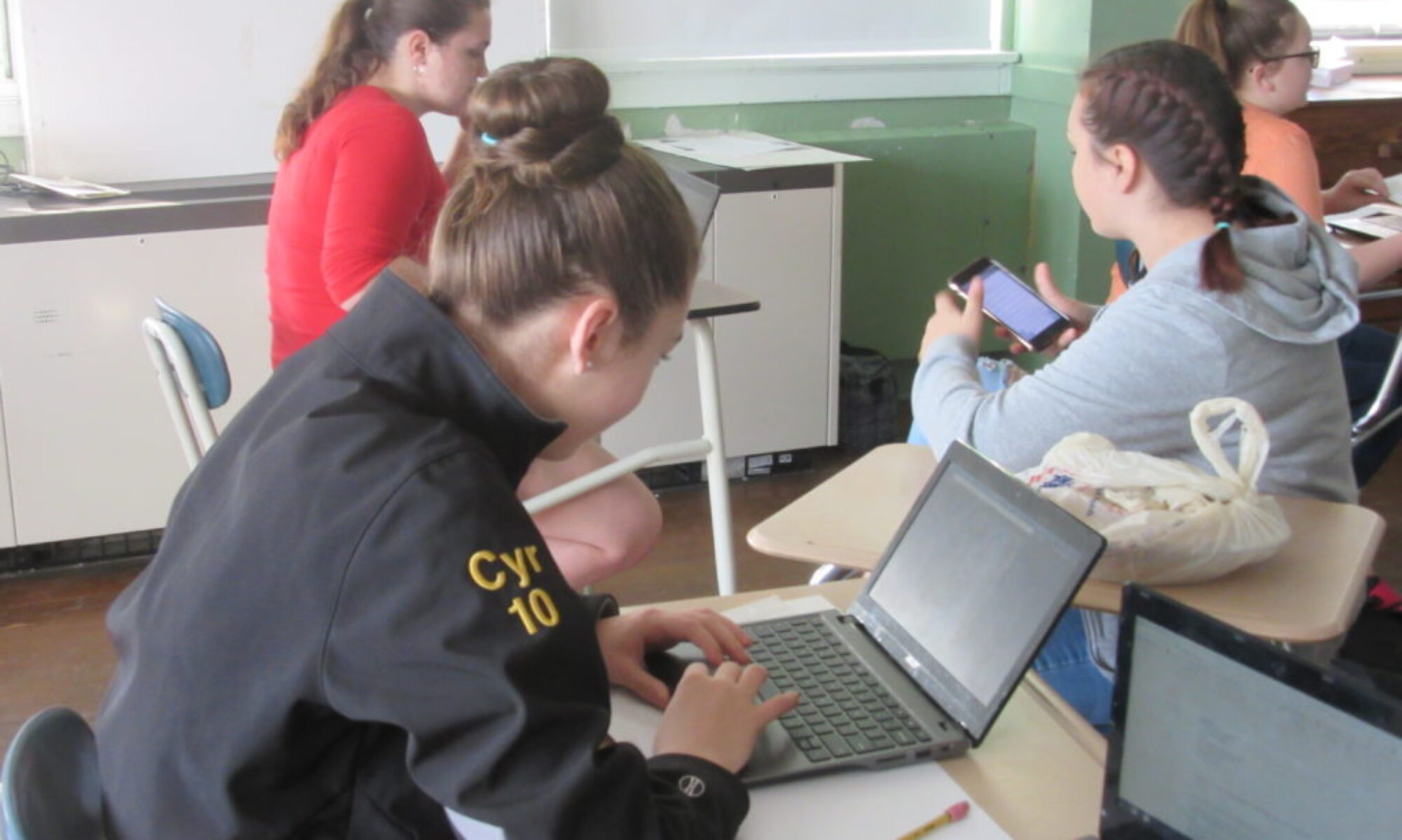
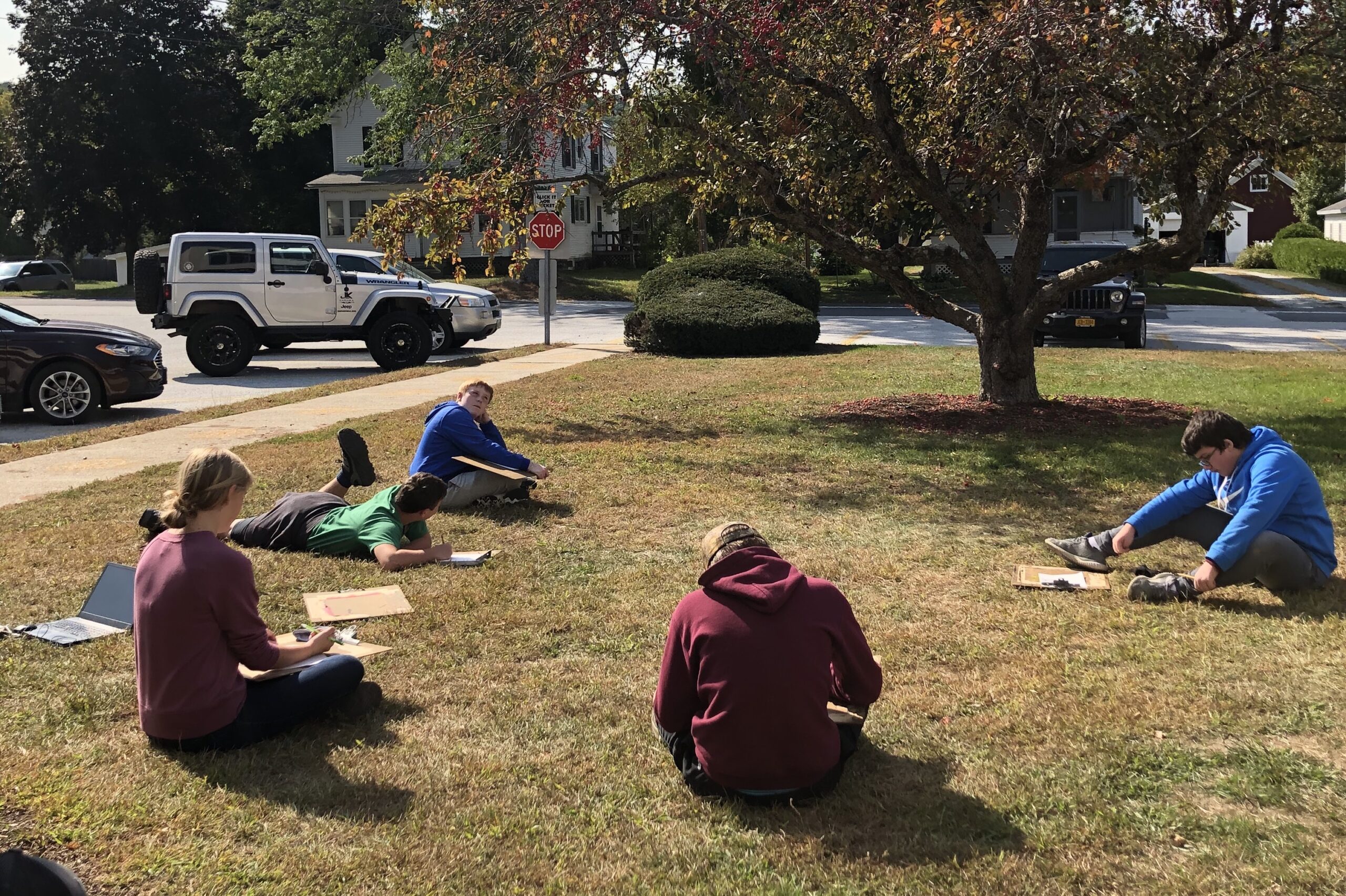
In the past few months, we’ve been meeting with groups of students from six Vermont schools, asking them about their experience this year. What might next year look like if they had a say? Inspired by the Imagining September Project–the MIT Teaching Systems Lab & Harvard’s Graduate School of Education that gathers student input to imagine what school might be like in September–we set out to conduct our own mini September Project.
We have access to students who are accustomed to talking with their teachers and each other about what’s working and what needs work in their particular setting. As co-facilitators of the Learning Lab–a network of educators conducting classroom research in partnership with their students and each other–we connect educators and students in a community committed to frank conversations that honor, and help improve, teaching and learning now and throughout the school year.
Most recently, we’ve met with students in three contexts:
Has the pandemic caused you to realize that there are parts of school that you were taking for granted that you now have a new appreciation for? What are the parts of school you’ve grown to appreciate?
Are there silver linings to the pandemic, new ways of living and learning in the world that you would like to see continue and evolve next year? What might those parts be?
Looking back over this last year, what are you most proud of?
Single teachers who were curious to learn:
What’s working for you as a learner? What can I do to improve your experience?
Middle School Team & Principal who wanted to know:
What are some of the things that you do in school that you enjoy or that are helpful for you when you’re learning?
With Them
Something unexpected happened with each group we listened to. Toward the end of each conversation, we asked if there was anything else they wanted to share. To our delight, individuals in each group conveyed a deep gratitude for us asking these questions and listening intently to their answers. We’re not talking about a casual end-of-conversation “thanks”, but an effusive outpouring of appreciation. Most importantly, when they learned that we planned on sharing these findings with a wider audience of educators, they were blown away.
We shouldn’t have been so surprised. Throughout the year-long Learning Lab experience, students provide formative feedback to their teachers to help them improve. Some students even join a Site-Based Sounding Board team, who occasionally meet with their teacher to make sense of recent data. We’ve witnessed first-hand the enthusiasm of listened-to learners.
Their enthusiasm, in part, stems from the novelty of the experience. Most students, be they adults or youngsters, are not part of an ongoing conversation with their teacher and their classmates about how things are going and what might make them better. They might be asked to complete an end-of-course evaluation, after the ship has sailed and ended its journey. As John Hattie puts it, “Assessment is something we have done to students rather than with them.”
Their Ideas
Thayer, a student at Orleans Elementary School, puts it a little differently. As educators consider how to move forward next year, he advises that they aim for balance. “Balance is key, a mix of what students want to do and teachers need to do in a great structure fixes problems.”
Our most recent round of conversations with students kept returning to this idea, that there needs to be more give and take for learners to experience the kind of agency that keeps humans engaged. And this affirms one of the most important findings we’ve taken from five years of Learning Lab. Doing assessment to learners, rather than with them, poisons even the most well-designed learning well. But making the shift from doing assessment “to them” to doing assessment “with them” makes a profound, positive impact on learning. Making assessment an ongoing conversation, it turns out, improves the quality of the learning well.
Here are three patterns identified across all of our recent conversations with students:
New appreciations for this thing we call school
One student shared he took for granted “having the ability to go to different places for different classes.” Another surprised himself with an awareness of how much he appreciated being in school 5 days a week. One student shared her appreciation for her teachers’ ability to create engaged and authentic learning experiences despite the constraints. “Our teachers do 3 different things in humanities that teach us real world problems and work toward changing our school’s environment.” While another saw teachers’ supports in a new light. “I appreciate the mini-lesson and the teacher support we have in person.” And some mentioned the collective efforts to keep each other healthy and safe. “People are more considerate and aware about how what they were doing could affect other people.” “Better hygiene!”
Pride in their growth in terms of time management and self direction skills
“I feel like I’ve gotten to figure out what learning environments work best for me, and I’ve gotten better at time management” For some following this thread they pointed to teachers’ efforts to publish work in advance. That made it “easier to catch up on missing school work because everything is available online.” While many of us are zoomed out, some students found technology to be useful. “I like using more technology to do more things. It feels more efficient. Sharing our work visually on the computer has been cool.”
Breaks, breaks, and more breaks
One group all agreed that Brain Breaks were a key to their ability to engage and stay focused. “Brain breaks are very helpful when you want to chill. Or to have some time to breathe without a mask.” “We need more breaks. School limits them now to snack, lunch, and a brain break at end of day.”
How to strike the right balance between on-task time and breaks? One student offered his perception that “school can only do so much in the way you want it to go. It’s a place for learning even though we want breaks some time.” But teachers might consider “a break day every third Friday: with no work. I’m not sure if we are allowed to have no work.” Imagine the informal learning that takes place during these breaks! Time for consolidating learning and engaging in relationship building. We think they’re onto something here.
Courageous Conversations
It can be scary to invite students into an ongoing conversation about how their learning is going and what adjustments we and they can make to make things better. It takes courage to listen and really hear feedback that challenges us to change.
But when we walk this walk with our learners, the journey improves. We are relieved of the crushing load of doing all of the planning, teaching, assessing, and reporting. And students are more engaged and doing more, achieving the kind of balance that Thayer and so many of his peers described.
Learn more about how to make assessment an ongoing conversation. Check out the resources we’ve included below. And if you’re interested in joining a network of educators committed to this approach to teaching and learning, learn more here.
This seven minute mini-lesson/screencast describes the assessment rut we can easily fall into. It offers a few ideas and resources for heading for higher ground.
Assidere/Adsidere
Share with your students the latin derivation for assessment (to sit beside / to sit with in counsel or office). Propose to your learners a plan for moving away from grading / scoring everything. Rather, aim towards an ongoing conversation about what’s working and what needs work–in their work and ours.
Students Own Their Progress – watch 6th grade students track their strengths and challenges as they analyze their own data.
A fantastic resource brought to you by the remarkable Cult of Pedagogy, Jennifer Gonzales’ website. She curates resources that support “crazy good teaching.’
Daniel Pink’s compelling exploration of what motivates humans. The counterintuitive findings explain why a compensation approach to assessment leads to low-level compliance rather than deep engagement.
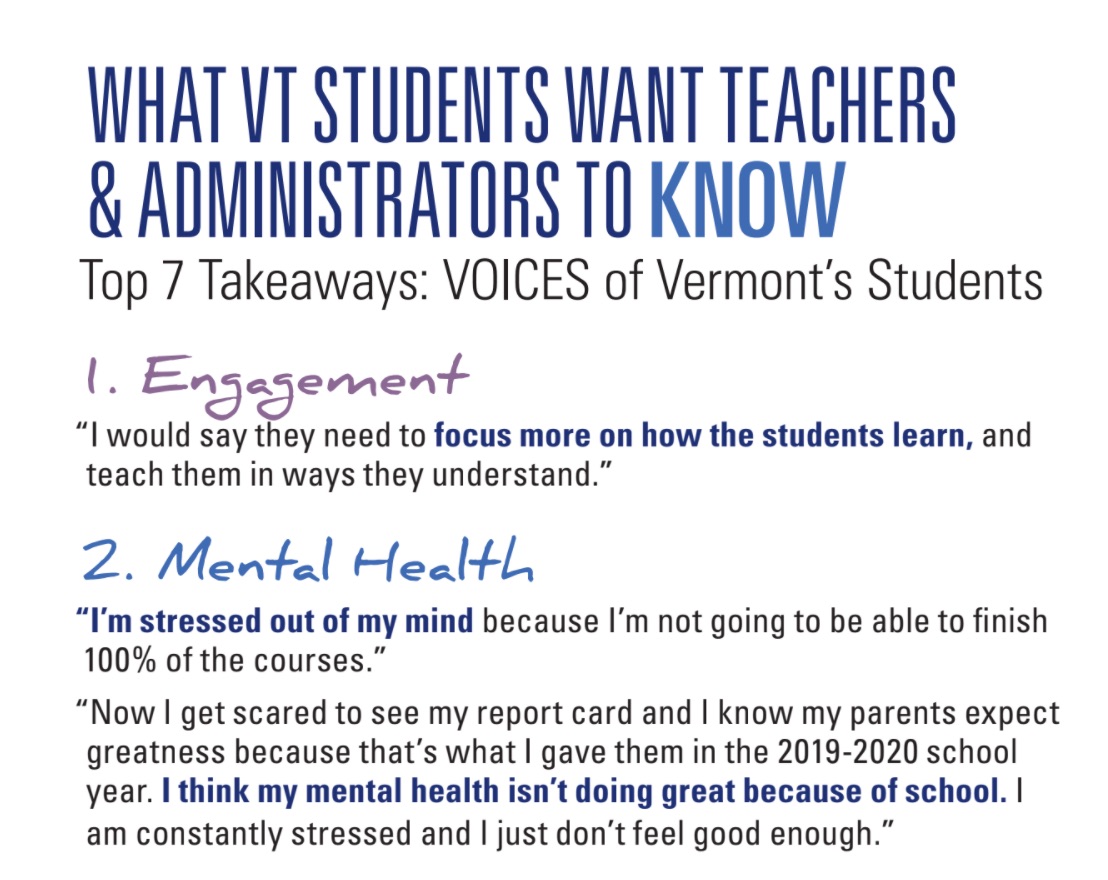
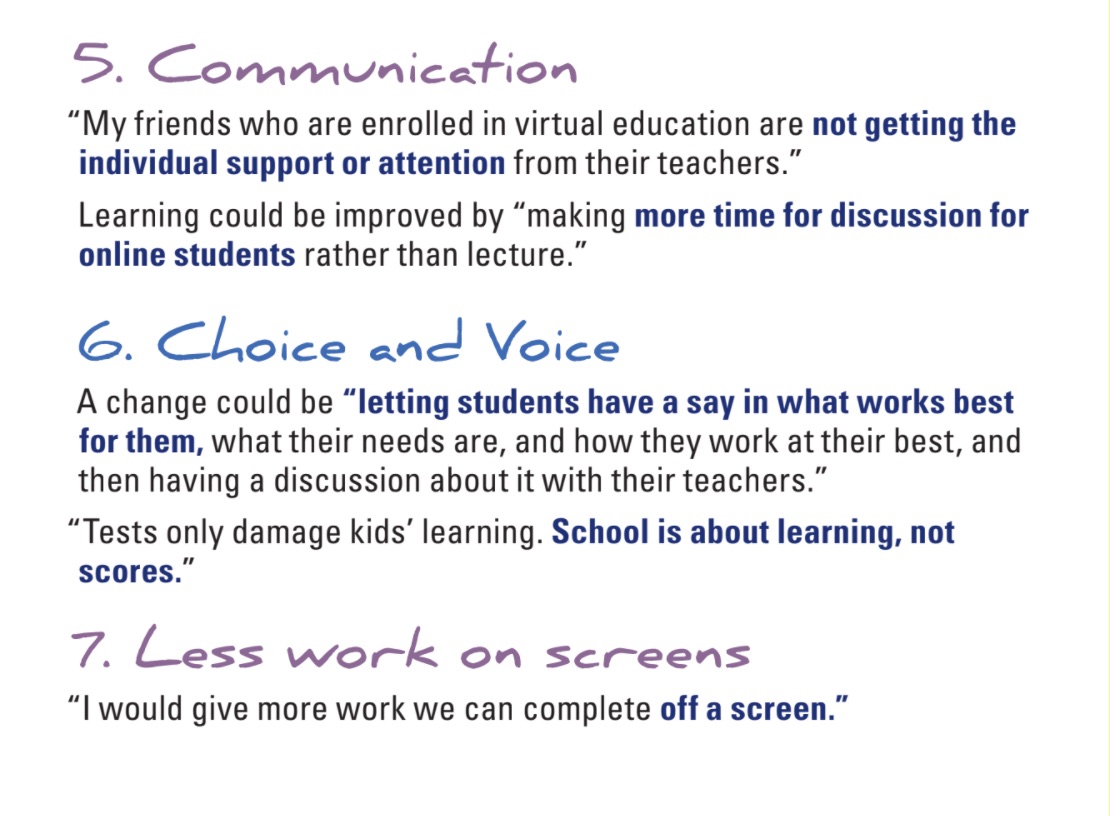
When schools closed to in-person learning in March of 2020, UP for Learning’s Youth Advisory Council (YAC) continued to meet regularly. We wanted to check-in and dialogue about their experiences and the experiences of their peers. Through these conversations, it became clear that it was important to understand how youth across Vermont were experiencing their new reality of the pandemic.
The YAC put out a survey in Spring of 2020. In it, we asked Vermont middle and high school youth what support they needed during full remote learning.
What was the purpose of the survey?
Why did we want to gather this data?
What rose to the top were:
social connections
academic support and
access to resources and information.
We then connected with youth across the state to support their needs throughout the remainder of the academic year.
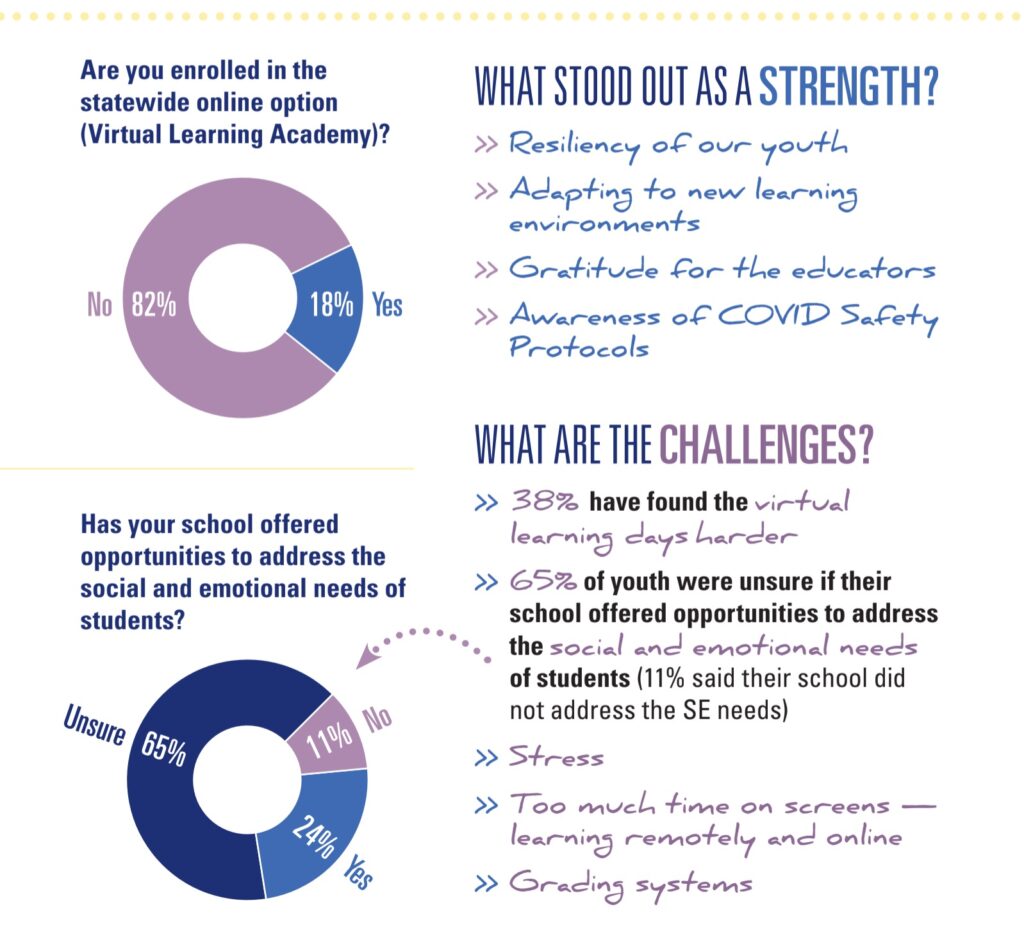
The YAC also wanted to revisit Vermont’s youth needs as we moved from full remote to hybrid to full in-person learning and sent a new survey out in winter of 2021. The main purpose of this survey was to gather data about what was learned during the 2020-2021 academic year and what opportunities arose for change.
Youth responded from 14 different communities across Vermont, as well as youth who were engaged in the Virtual Learning Academy.
Evelyn: My initial reaction was that it was interesting to see how my reality and understanding and adaptation to learning during the pandemic mirrored the experience of many other youth across the state. More specifically, I have been struggling with my sense of engagement and mental health; hearing that other youth are identifying these as opportunities as well makes me believe that we can begin to create real, systemic change as we re-enter full in-person learning.
Lindsey: My initial reaction to the data was that what was already known about what does not work for ALL youth in the educational system became even more abundantly clear. It really just put an exclamation point on it. Youth want an education that is built on deep relationships, engaging learning opportunities and time to care for all of their developmental needs: social/emotional, physical and cognitive.
What stood out as a major takeaway?
For both of us, what stood out was the lack of knowledge about, or experience with, social emotional learning. In our minds, this was the opportune time to create opportunities for more in depth community-building, prioritizing young people’s social emotional needs during such an uncertain year.
The potential for changing school schedules in particular, struck YAC student member Galen. He put it this way:
“I love how tactile that feels? It feels like something we can do, like, right now. Get it done, and make change. I think sometimes we almost get lost in like, the systems thinking. I think people often talk about making change but it’s hard to find concrete ways to do it sometimes? And I love that we’ve kind of put a name to that. Like, here’s something we can do to make change… right now.”
Harnessing the power of community
The YAC also gathered with community members to look at this data. And from there, we worked together in small, deeply connecting groups to draw conclusions from it as to how best to move forward.
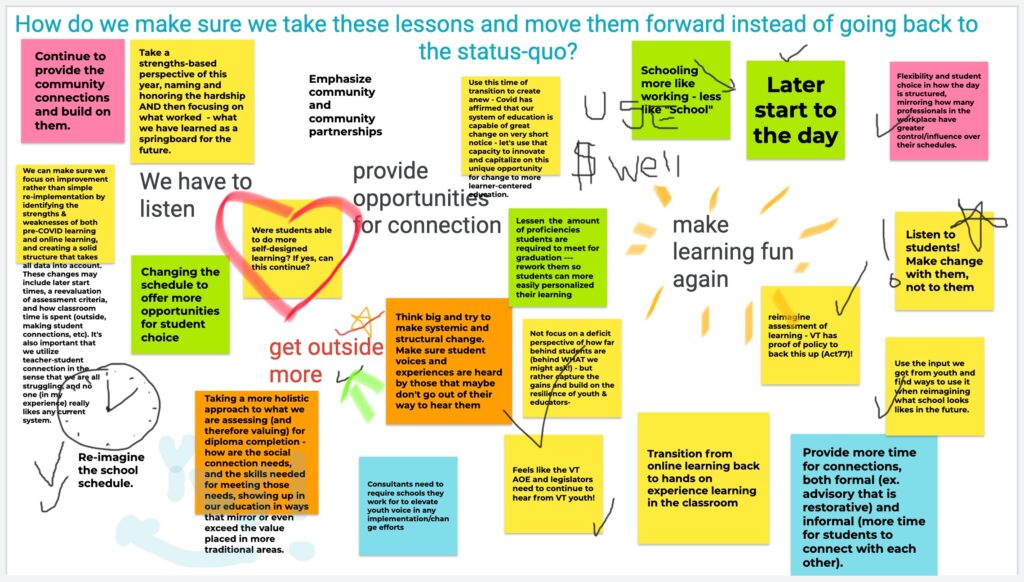
How do we make sure we take these lessons and move them forward instead of going back to the status-quo?
This is a quote that resonates with us from adrienne maree brown, author of Emergent Strategy: Shaping Change, Shaping Worlds. She writes that “How we live and grow and stay purposeful in the face of constant change actually does determine both the quality of our lives, and the impact that we can have when we move into action together.”
Purpose. Trust. Relationships. What if we designed our work around our values? What would we need to change individually and collectively?
Where do we go from here?
To end our community session, we created a Jamboard, and asked attendees to fill it out. To guide them, we asked simply, “How do we make sure we take these lessons and move them forward instead of going back to the status quo?”
These are their responses.
“We have to listen.”
“Later start to the day.”
“Continue to provide the community connections and build on them.”
“Listen to students! Make change with them, not to them.”
“Were students able to do more self-designed learning? If yes, can this continue?”
“Feels like VT AOE and legislators need to continue to hear from VT youth!”
And we ask you the same question.
Educators, students, and community members,
“How do we make sure we take these lessons and move them forward instead of going back to the status quo?”
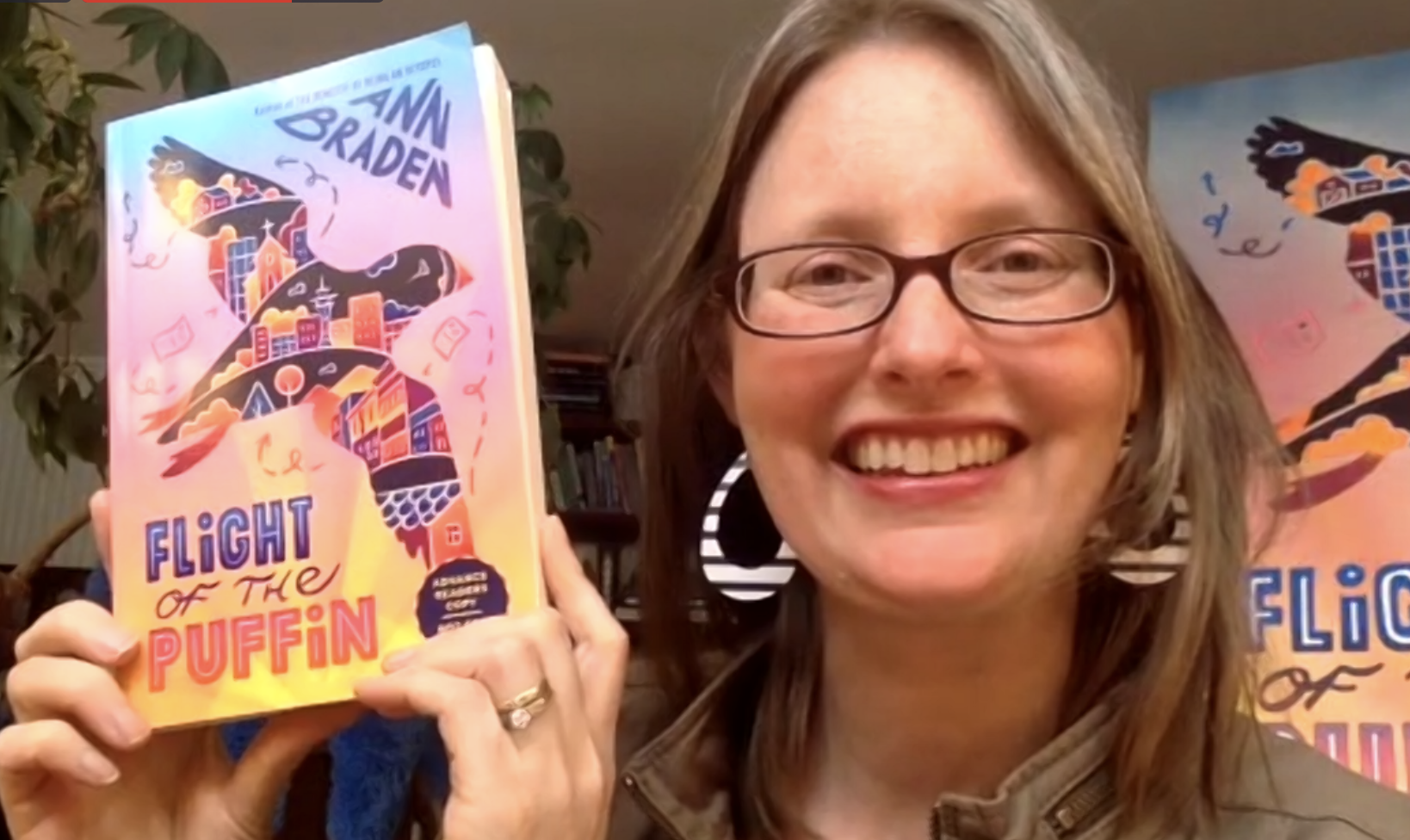
On this episode… we have Ann Braden!!!! Ann is one of my favorite authors, and she’s also a former Vermont educator with a new book out, The Flight of the Puffin. Flight of the Puffin truly feels like a middle grades book for our time: it’s the story of four completely different middle school students, in completely different circumstances, and completely different areas of the country, and how random acts of kindness wind up tying them together.
The book is based on Ann’s own experiences in responding to the 2016 election (and all that came afterwards) by putting massive amounts of love out into the universe, and quite possibly in your mailbox.
Listeners, we are DELIGHTED by this. All of it.
I’m Jeanie Phillips. Let’s chat.
Jeanie: Thank you so much of joining me Ann. Tell us a little bit about who you are and what you do.
Ann: I’m so excited to be here, any time I get to spend with you is a great time.
Jeanie: Same for me.
Ann: I used to be a middle-school social studies teacher and then I turned to writing. The Flight of the Puffin is my second book. My first was The Benefits of Being an Octopus. I’m so excited to have books.
Jeanie: Congratulations on your newest book! We should also say, because the primary audience for this podcast is Vermont, that you’re located in Brattleboro, Vermont. But before I get to anything else, how is Zoey doing?
Ann: She’s having a rough year. I think about kids like Zoey who are trapped in their little four-walled spaces with a not-awesome family relationship. And I’ve been thinking about them all this year. It’s one of those things where if we didn’t get it before, we’d better get it now.
Jeanie: Zoey, listeners, is the main character of The Benefits of Being an Octopus. I’ve been thinking about Zoey too, because she was already suffering under economic hardship, in difficult family circumstances. The stress and pressures of COVID have to have made that harder, for Zoey and kids like Zoey. I’ve been holding her in my heart. Thank you for that book. That book has been such a gift to me and to Vermont educators. I know it’s been used and is being used all over the place. Kids are loving it, so thank you for that.
Ann: My pleasure.
Jeanie: I also know you’re a great reader. As many writers are, as most writers are. What are you reading now?
Ann: I am in the middle of the Burnout book about the stress cycle, because as we all know there’s little bit to be stressed about these days. I am someone that often internally processes my stress. Like, I will seem all happy and feel all happy on the outside. And then I develop all these chronic stress-related medical issues. I’m like, “Okay, I’ve got to figure this out.” It’s very good about releasing the stress and creating opportunities for your body to recognize that you are okay. I’ve been working through that one.
Jeanie: I just listened to a podcast about that book! Just an hour-long podcast that was just so helpful about hugs and exercise. All of the ways you can let your body know that it’s okay again.
Ann: I’m not an exerciser. I’ve never been like, “Oh yes, exercise makes me feel good.” Now I’m like, doing slow Qigong is telling my body that I’m okay. It’s just as good as other exercises.
Jeanie: That’s so interesting. For me, one of the ways I manage stress is reading. Like reading, to me, and being engaged in a book? That’s deep relaxation. I like living through stories.
Ann: I love that.
Jeanie: Thank you for your books, because they relax me. Let’s jump into The Flight of the Puffin which is such a delight. Would you introduce us to the four characters in the book? Libby, Jack, Vincent and T?
Ann: Sure, do you want me to just read or just tell you about them?
Jeanie: Both, whatever works for you.
Ann: I think I will read first. I’ll just read a page of each of their chapters.
Jeanie: Perfect.
Ann: The book goes through these four different, bad perspectives. And they all live in different places, and this is all happening on the same day.
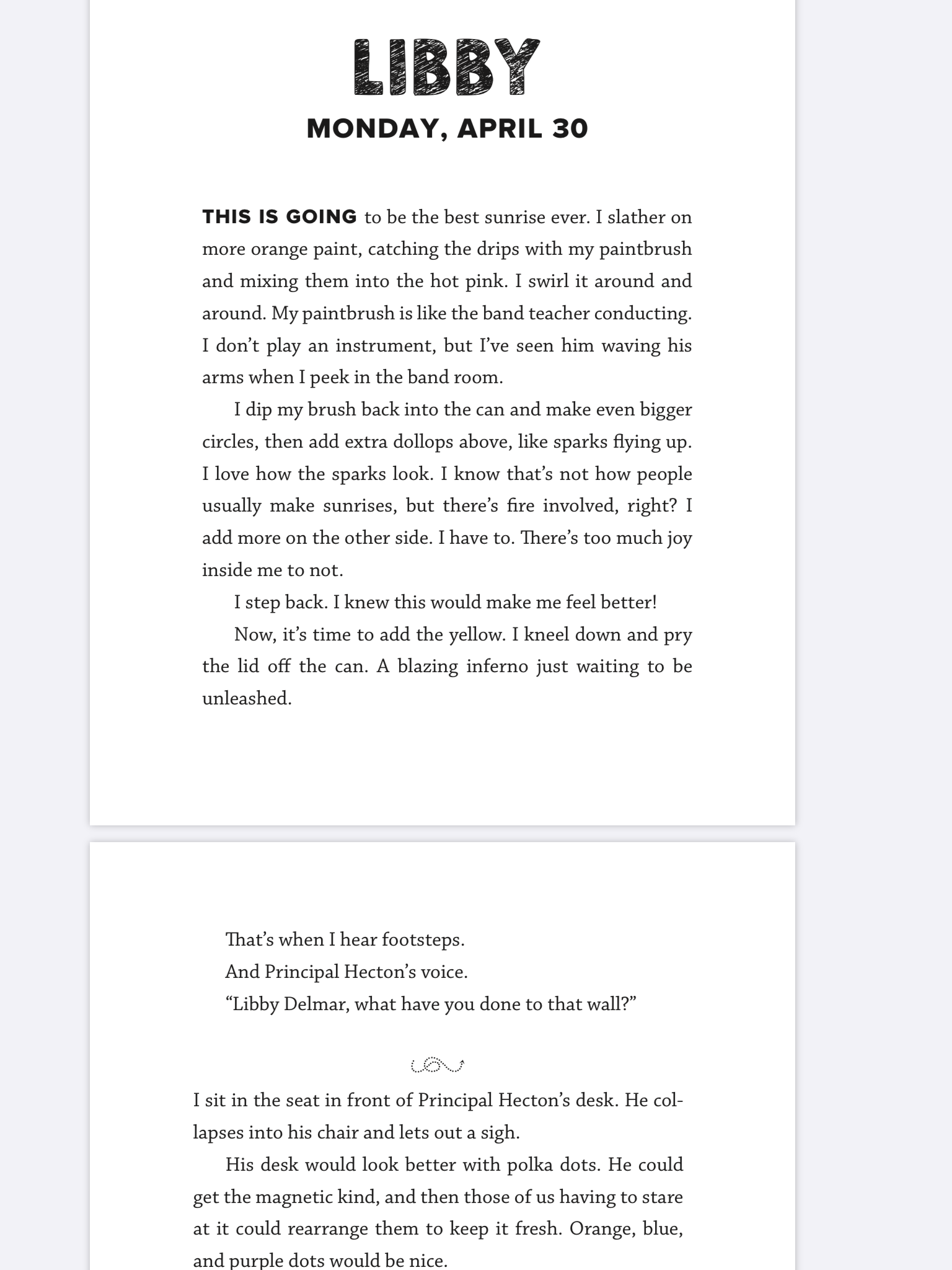
Libby:
(That’s Libby. She was not supposed to be painting a mural, on the side of the hallway.)
We’re going to now move to Jack.
“Joey is tugging my shirt again. “Jack,” he says. I stop dribbling the ball and squat down next to him on the blacktop, so I can hear him over the shrieks of the other little kids. “What’s up little man?”
He points up, “Two more points.”
Joey doesn’t see them anywhere when he’s focused on something. I put the basketball in his hands, “You ready?”
He grins, he was ready. I spin around so his face came away from me. I lift him towards the rim. “Here comes Joey for the dunk,” I yell.
I could feel Joey’s ribs through his shirt as he squeals and tips the ball into the hoop. He’s the same size as my little brother Alex was, and just as focused. I set him down on the blacktop and he runs after the ball. I know he’s going to want to go again. The blacktop is finally clear of snow, and he’s determined to get to 10 points, this recess.
I glance at Todd and searchers, who are waiting for me to come and play football, but they’ll have to wait a little longer.”
(That’s Jack. He lives in a rural area in Vermont with a tiny two-room schoolhouse for a K-8 school. There’s 17 kids in this school.)
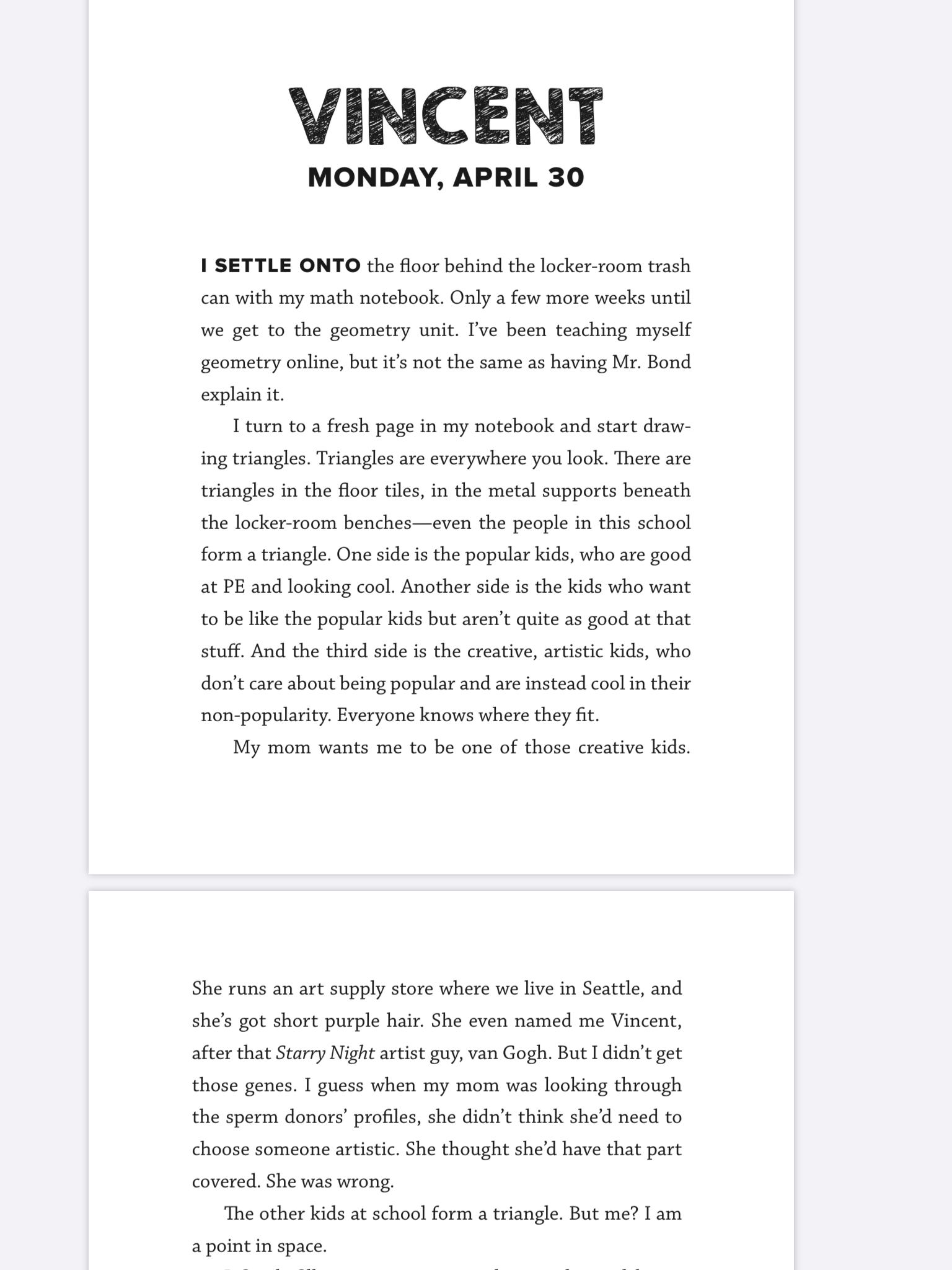
Next is Vincent, he’s in Seattle.
(That was Vincent.)
And then T.
“Wet concrete, sirens, shadows. Never safe to sleep, but so very tired. Pecos snuggles up, her fur warm against me, follow her breath. Breathe with her. Trust her, only her. One breath at a time. Still here.”
Jeanie: Thank you for that. I want to walk through each of these characters, if that’s okay, and go a little deeper. Because I love these four kids so much. I love that they all have flaws.
So like, Libby for example. At the beginning of the book, she shares that’s she’s being bullied by another girl for her awesome rainbow outfit. Those are her words. And so, I’m just going to read a little bit. It’s right after what you read on page three.
“And I get that girls aren’t supposed to give other people a bloody nose. Instead, everyone should be like model student Danielle, who fights the right way by convincing the entire softball team to stop talking to me, so that even Adrianna Randall now walks past me without a word, as if we’ve never spent nights sprawled on pillows and giggling on her bedroom floor.”
I want to unpack this a little bit. There’s a lot in that few lines.
Ann: Libby comes from a family where her dad is very much a bully, and he uses physical force as a good thing, in order to keep things the way they should be. And her older brother would get in fights all the time. Now, as long as he won it was fine with their parents. That’s the family she’s in.
And I think it’s one of those things where there is this double standard about girls. They don’t get in fights. But then the fight that happens below the surface can be far more damaging than one bloody nose.
I think that there’s one of those layers of just how, like, if a boy had give someone a bloody nose it wouldn’t be a big deal — I mean *that much* of a big deal. But a girl doing it? It’s like: “What kind of bad kid is this?”
So I wanted to bring that up a little bit. She’s sort of in this position where she’s isolated. She’s done things the way her parents would want her to, it doesn’t seem to be a great way to do things, but she’s always completely isolated from people who had been her friends. But she’s very much on her own.
Jeanie: And she carries her family with her in school. One of the things that happens over and over to her again is she’s assumed to be like her older brother and her parents. Because she and her parents grew up in the town, they know a lot about her family. But she’s like, “That’s not me, that’s not who I am.”
I wondered about Libby. I think this happens to us adults. That we see kids through the lens of our own bias. And how do we get that bias out of the way so we can really fully appreciate who Libby is?
Ann: I mean Libby, as a character, actually she was the beginning of this whole book.
Well, I had the idea of having different kids from different parts of the country, and exploring sort of, the connections that exist even when we don’t think there is any connection there.
But the characters that I had in mind first just weren’t really clicking. I hadn’t started writing and then I met this amazing teenager, Cara, in Bellows Falls [Vermont]. It was at a cross-class dialogue circle through Equity Solutions.
And that was a situation where we were in this group that was about being vulnerable and being honest. You sort of, get to the soul of people so much quicker. Cara was actually talking about trying to convince her parents about the importance of recycling. But everything she was saying it was like, she was this flower trying to push out pass the concrete. And there was so much joy inside her, and life, and sunshine. But she had so much concrete on top that she was trying to push pass. That was the seed that grew into this whole story.
So I feel like in that situation I was able to see her for who she was. Because there was trust built. And she felt like she could be honest and felt like she could really show who she was.
I think a lot of times — and certainly this is the case for Zoey and The Benefits of Being an Octopus — kids are not going to show adults who they truly are on the inside unless they feel incredibly comfortable.
Those kids that need to the most often do not feel comfortable in most school settings. And so, I think that getting to those places where there’s an intimacy and trust is the only way to be really know exactly what’s going on below the surface. And then if you can’t get there, because we can’t always do that, you just have to assume that it’s there, if you have the opportunity to be there.
Jeanie: Well, then I so appreciate that answer. And I’m thinking about how focusing, thinking about Danielle, and that nobody picks up on her meanness, also erodes the trust of students who are like, “I can’t really show who I am because nobody will believe it anyway.” So, I love that Libby is based on a real person, Cara. Does Cara know?
Ann: yes, she does.
Jeanie: How wonderful. You began with a passage about Libby painting a mural on the school wall. I think it’s like the next day that she’s meeting with the principal or later that day. And the principal says, “Tomorrow during in-school suspension you’ll be repainting that wall white again. Like it’s supposed to be.” And that totally brought back for me when I was a school librarian at Green Mountain Middle and High School, a student named Lilith painted a mural.
She was a high school student who painted a mural on the girls bathroom wall and made it beautiful. And they totally checked the security footage and realized it was her. And the custodians painted over in drab green.
…My heart broke.
Lilith’s mural was beautiful and then it was back to whatever drab color it had been.
And I guess I’d love listeners and me to quietly consider who gets to decide how things are supposed to be in school, and in world, and who does it?
Because I really want Libby to decide what goes on that wall. I want to students to decide.
Ann: That’s certainly a theme throughout the book. And I don’t mean this in a bad way. Power is a theme in The Benefits of Being an Octopus, too. Kids so rarely have control over their lives that’s meaningful. When you get a taste of it, it changes everything. It changes how you look at yourself, it changes how you look at your actions in the world. Then those actions change the people around you.
I was this kind of teacher too. Actually, I got pushback because I’ve always wanted the kids to have as much say as I could. And it meant a slightly more chaotic learning experience, like from the traditional way of looking at things.
I did not have my vocabulary list planned out ahead of time. Because I wanted the kids to be able to have a say in where we were going during that day. And I really still feel that the time students have ownership of something are things that they still remember. Things that they learned the most from.
Jeanie: Agency.
Ann: Yes! That’s positive word of power.
Jeanie: Well, there is a lot of agency in this book for each of these characters. We’ll get to that, but I want to move on to Vincent. Like Libby he is really struggling also, with being who he is rather than who folks thinks he should be. I had actually bookmarked the page that you read from, about him thinking about how he doesn’t quite fit in, in school. But also how he feels like he’s disappointing his mother. He’s not who she wants him to be.
How does a kid like Vincent, how does he make himself seen and known in the world?
Ann: It’s one of those things.
The mom in that book I think I drew from me bit. Like, she’s very well-intentioned, but she wants Vincent to be able to be creative and do things that are fun.
And he’s like, “No I just want to do more math.”
And she’s like, “I don’t understand.”
There is the song about how our children are not our children (video). And there’s nothing like being a parent to see that in a whole new way. Just like we’ve got to get out of the way, like our own expectations, we have to get out of the way of what our children are. And there’s so many different ways that that can play out.
But I think for Vincent he’s really bumping up against gender stereotypes of: this is what a boy should be. Or if you’re not that kind of boy then you should be this creative; there’s only those two options. Be the stereotypical athletic boy or be countercultural and find power in that when you don’t see yourself anywhere else.
All of these characters feel very alone in their own way.
What happens soon after the part I read is these boys come over and are giving him a hard time. He’s wearing this fourth grade black baseball shirt, which he is not a baseball player. He hated playing baseball.
And they’re like, “I bet you’re so sad you can’t be on the baseball team anymore!”
And he’s like, “No I’m not.”
Why did they think that? Did the shirt trigger that? He’s looking for shirts that are going to say: this is who I am.
And he ends up finding this very tight buttoned-down shirt with a puffin on it at the back of his closet, that he wore to an event that was about Katherine Johnson’s new book for autobiography. Because she is his hero. From Hidden Figures, she’s the awesome calculator mathematician who helped send rockets to the moon. So it’s funny because Libby starts off having this problem. Because she was bullied, she was totally wearing her own stuff. There’s problems with that, and so then Vincent is like the next step of the way being like, “Hey, I’m going to wear my own weird clothes.” And it doesn’t necessarily go well.
Jeanie: Well, there’s this whole thing that I think both of them are really dealing with that I think of as self-determination. Being who they are.
Neither one of them want’s to fit in, and I think the adults around them — and I think I could fall into this trap too — are like, “Just make it easier on yourself. Fit in!”
But I think kids are right in saying ‘I don’t need to fit in. I need to be who I am’.
Whether that’s an artist that who wears all the colors of the rainbow at once, like Libby, or Vincent with his puffin shirt that also has triangles at the corners ( triangles are big shape for Vincent).
I love that. It’s really about accepting themselves for who they are and showing up unapologetically as they are. Not caring what other people think about that.
Ann: So most of the characters are seventh graders.
I remember in the sixth grade I was wearing crazy clothes and big earrings, because I just gotten my ears pierced. I had these giant snake earrings — like really out there — big prints and everything. Then in seventh grade was just like the buttoning up of everything. Because I was so afraid of not fitting in.
The kids that have the confidence to just continue being themselves? That is such a special thing. We have to be nurturing that. Maybe not fanning the flames, because you don’t want it to get too out of control before they’re ready, but you want to make sure that you are meeting them where they are.
And I did in seventh. I did wear mis-matched socks all the time.
It was a weird time in the 80s.
Jeanie: I remember.
Ann: That was as far as I would go. My mis-matched socks. They were my reminder to myself that I was different.
Jeanie: What does it look like in classrooms and schools to celebrate that difference, instead of encouraging conformity? How might we sort of see that as strength?
Ann: This is only tangentially related. But one of my favorite units when I was teaching social studies, is we do a unit focused on social norms during the Jim Crow Era. Looking at the power of social norms, and what was put in place by law, and what put in place just by expectation. Then we had them look at their own social norms of what is expected in their own school and what are things that would push back against those norms.
I remember getting kids to start wearing weird clothes as part of this experiment, like, “I’m going to wear really high socks over my jeans.”
And I remember this case where it was a popular kid who could honestly do whatever they wanted. So it became a new trend.
But it was like one of those things where if we look at our own lives of what this social norm expectation is, we realize it’s not us, it’s this system that we’re in. Then you can step back and see it for what it is. You can realize you don’t have to be a part of it, if you don’t want to be.
Jeanie: This sounds like a fabulous lesson in criticality. In teaching kids how to be critical of social systems and structure.
What I’m thinking about is how powerful that is for kids to experience that, that way.
And I’m so thinking about the four eyes of oppression. That you might have this ideology of white supremacy, and how it shows up in institutions as Jim Crowe laws, but then also how it shows up interpersonally between people is what you’re talking about in these norms. Then internally what the message it sends to individuals. And so, I just love that and the way that you’re putting that together. Fabulous.
Ann: You just put it together in such a nice way. I needed that.
Jeanie: We’ll teach together again someday. I have so many things, from wanting to start seeing the Sweet Honey in the Rock song you mentioned (video). But let’s keep going with our characters.
Let’s talk about Jack.
Because Jack is doing some important thinking and working about his school. Living in Vermont — he’s in Vermont — and given our school consolidation efforts, I found Jack’s story really compelling.
Ann: I am a very big fan of small schools. Even if they’re not quite as efficient as others.
I just feel like community is so important. And what Jack and his school have, they have this incredible community. Now, he’s like the top of the food chain. He’s very different than Libby and Vincent, the father of bullies. He’s not a bully, he’s just… he’s almost like this backup teacher for the other teachers. Because he’s one of the older kids. He’s super-responsible. And he really sees his ownership over his school.
There’s a lady from the State Department of Education that comes and is sort of looking at the school from a critical lens, checking boxes. “You don’t seem to have wood chips”, things like that. They also don’t have a gender-neutral bathroom which Jack has never even heard of. He is the first to really be like, “I’m going to do something about this,” In part because he’s in a place of leadership, to start with.
And his focus at the beginning is saving the school and making sure they can keep being in community just the way they are.
But as we see, sometimes if things are good for you the way they are, it doesn’t mean that they are always good for others. There’s thinking involved.
Jeanie: The thing that Jack reminded me of is this program at The Cabot School, a tiny, little school in tiny little Cabot VT.
They’re fabulous. They have a program called Cabot Leads, where each student gets some sort of job that they’re interested in. And I think the thing about that program, the hope that we have for a program like that is that every kid feels like the school can’t run without him, they’re so important.
And Jack has that feeling. Like school can’t literally run without him. Because he has important roles with the younger kids, school is reciprocal. He’s not just seen as “we’re going to fill the bucket over your head,” rather like, “we need you here, you’re important.” That fosters the sense of ownership in him that’s really beautiful.
And I Iove that in the novel he goes and presents the school.
What I also love is that it’s just not a simple shiny moment; he gets caught up in something bigger.
I don’t know how much we want to give away, but he gets caught up in something bigger and has to find his way out. He gets caught up in a controversy. And he gets aligned with the side he doesn’t want to be aligned with.
Ann: It’s interesting, I recently was doing a virtual school about The Benefits of Being an Octopus. And Zoey seeming to find her voice when she’s sort of thrust into this debate of ‘which side are you on about guns?’
I’m just now realizing it’s similar for Jack, where he’s similarly thrust into a debate and he has to vocalize his opinion that it’s not the side that he’s being linked to. Sometimes that is what forces us to do some deep internal thinking about, “Well, what I think if it’s not that?”
Jeanie: And what does it mean when I think differently than my family or the people I love? I think a lot of young people are going through that struggle.
There are kids all over Vermont doing really meaningful learning about things where they have to go to homes where the ideas and thoughts being considered are in opposition to some of the values at their own home. And what do you do when kids are exploring their values? What do kids do when they have to navigate that tricky thing?
I think it’s really important in schools for us to keep that in mind, so we know how support students well. To know students well enough to know how to support them as they develop their own thinking. To provide them those opportunities to really dig into those things they’re really interested in, because it’s their birthright. That what we want is for them to develop their own thinking.
Ann: I’m realizing also now that this was the issue, this was the seed to start the book: Cara talking about trying to convince her parents how important recycling was. That was coming from some place outside of her family, and she had internalized it and she got it, and she was like, “Climate change is really important.” And this was completely in opposition to her parents. She was trying to navigate that, she was looking for advice about that, and that is like such a, it’s a weighty issue.
Because you don’t want to say, “go against your parents”, but you want kids to be able to think for themselves, regardless of teachers or parents. You want them to be able to form their own opinions based on their own experiences and what they’ve learned, and still stand in that.
Jeanie: I do want that. Each of these young people is sort of coming to themselves, as who they are, what they believe in and what they have agency over. And T is as well, but all of T’s agency is just going to surviving as who they are.
You write T in a completely different way than the other characters. I was wondering if you could talk about that?
Ann: Yeah. So, T is homeless and living on the street. One of my very first jobs after college, I was waitressing at a pizza restaurant. And my other job was working at a drop-in center for homeless teens in Seattle. It’s the experience that led me into being a teacher, in part because the way that the drop-in center was set up, it was very hands-off. It was very: you are there to provide food and services, medical supplies, but you’re not to engage at all. There’s no back and forth talking. Which I understand; I respect that. It’s so people can just come in without any thought that someone’s going to try to tell them what they should be doing.
But it was also hard to have zero involvement with these kids that I was watching. I wasn’t able to do anything to help other than feed them.
It was an important point in my life, sitting there and watching all these kids. They had so much in common with each other, just in terms of surviving on the street. This was not a shelter, this was just drop-in, in the afternoon, and the evening a little bit.
But there was so little talking. Like, there was such silence in that room.
It’s just a testament to how big a wall they had each built around themselves for protection, and how much effort basic surviving takes when you don’t have any of the supports that other people have.
So when I was writing T’s chapters, everything was through that lens of just intense survival. You don’t have lots of chatty words if you’re in that space. So they’re much more minimalist because of that.
And just to get back to what you were saying, also, I realized that you’re talking about how the other characters are sort of figuring out who they are. And T already has figured out who they are. T is on the other side, dealing with some of the consequences of that. T is older, also, so it makes sense.
But I hadn’t quite realized how T is just at this different point in the journey than the others.
Jeanie: Oh, I so appreciate that. And I love how you’re still leaving a lot of mystery here for our listeners. Thank you for going in deep with your four characters.
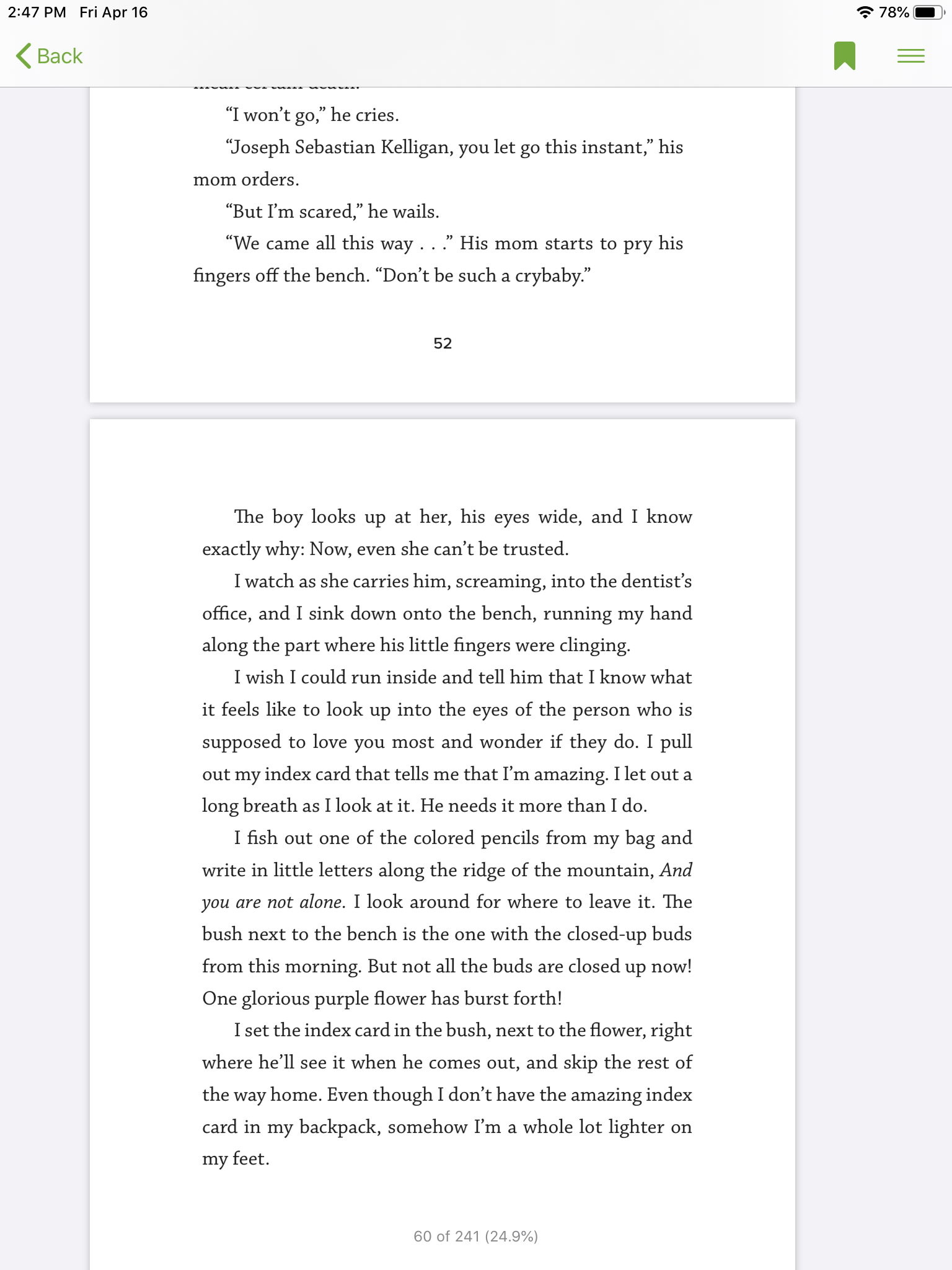
I want to talk a little bit about a seemingly small moment on page 53. I don’t know if you want to read it or if you’d like me to read it.
Ann: Yeah, this is Libby’s chapter. She is walking home from school and she sees this boy clinging to a bench outside the dentist office.
Jeanie: So I cried when I read this. It broke my heart. And I could see it from both points, right, I could see it from the mother’s point of view because I’m a mother. I have mothered a challenging child.
But I could see it from this boy’s point of view too. And I really appreciate people like Dr. Bettina Love talking about humanizing education, and how do we make spaces where we can show up with our full humanity. And the coercion in this section feels really dehumanizing.
It reminds me there are so many times when young people, small children, experience dehumanizing conditions because we demand compliance, or we want control over their bodies. I don’t know what my question is; I guess I wanted you to know how hard this hit. And I wondered if you, if you intended it to hit me and your readers that hard?
Ann: It’s interesting. It’s funny because I’m haven’t done that many interviews about the book yet. And so, I’m seeing things from a different angle. I’m realizing in this moment where this came from.
There is a pediatric dentist in Keene on the other side of the border in New Hampshire that was like one of the only pediatric dentists around. Now, I had been told that because my son was a preemie he needs to go to the dentist early. So, when he was like two, they sent this nice mailing home about how we should like it make it clear that the dentist is going to be fun, and it’s going to be fine.
So I did. I did my job as a parent of like, really showing how it was going to be fine at the dentist.
And then the dentist made a complete mockery of what I had said.
It turned into this place where they would not let my child sit in my lap as a two-year-old, they had be strapped down to a bed, and everyone was screaming. Like it was a factory of screaming children on beds.
And I was so traumatized. My son was so traumatized. We left and never came back.
But at the end, the dentist was like, “Oh, don’t you need a toy? You see how he’s sort of stopping crying as I’m offering this toy.”
It was the most inhumane and dehumanizing experience. And it’s been almost a decade and I’m still livid that that is how they were going to treat children.
But anyway. That was in my soul as a horrible experience and how not to treat children. So, I’m sure that subconsciously was coming right out.
Jeanie: Wow. I so so appreciate you sharing that story. The trauma for both you and your son and also the grief of being the person who took him there must have been tremendous.
I can’t help but see this as the other side of the agency coin, right. If we want our young people, even our very young people, to have agency, right, to be self-directed learners, to be independent thinkers, to do the right thing, we can’t also demand compliance of them. We can’t also seek to control their bodies and their minds.
Ann: You have to have control over your body.
Jeanie: And from an early age we need to foster that sense of agency. It doesn’t mean that they don’t go to the dentist.
Ann: But it can be done in a way that it’s supporting their humanity,
Jeanie: And it’s probably messier, right, but it’s better than strapping them down right? It’s always going to be messier, but the strapping them down comes at what cost.
I’m a big proponent of self-direction and agency in the classroom, as is the Vermont Agency of Education. Our whole legislation about Act 77 is about meaningful learning opportunities, and students defining the learning they want and need. Setting their own goals. I do not believe we can do that and focus on compliance and use systems of compliance at the same time. When we use systems of compliance, we’re completely eroding agency.
And there’s so much agency for the young people in this book.
The other thing that’s in here in this little section, which is so powerful, is Libby’s kindness. And I know that some of this book must be inspired by your experience in the kindness brigade.
Ann: It’s also the Love Brigade.
Jeanie: Could you talk about from people who don’t know, could you explain the local love brigade?
Ann: I said that a lot of my big concepts for books come from being angry. And this was something else that happened from my being angry.
After the 2016 presidential election, early December of 2016, I was feeling so powerless and so angry at all the hate speech that I was seeing grow unchecked.
And one of the documentaries I used to show in my classroom was The Laramie Project, which is about the death of Matthew Shepard in the 1990s. And part of that is that one of his friends is trying to figure out what to do because the Westboro Baptist Church is coming to protest. She ends up creating these huge PVC pipe, like extra-long arms, and then draping sheets over them for like, a dozen people that come together. So, they’re like these huge angel wings.
And silently they marched out, and they formed this powerful silent line in front of the protesters blocking them from the funeral.
I still get full chills thinking about that scene.
It was such a powerful demonstration that regular people are perpetuating the hate, and regular people can push back against it.
So, I had that in my mind, like, “Well, what can we do if these are regular people shouting horrible things? What can I do as a regular person to push back?”
And I kept having one conversation after another, often almost always with women, who are just as angry as I was.
And one of the things that came up, I met Kelly McCracken in Montpelier. She said, “What about postcards?” I was like, that’s really good. And I was driving home from that meeting. Someone texted me and to say that the Islamic Society of Vermont had just gotten hate mail. What can we do? I said,
“We can send them postcards covered in hearts, and show that there may be one person sending them hate mail, but we are sending them postcards of love.”
They ended up getting 500 or so postcards covered in hearts. There’s this great video of the imam coming out with this huge stack. He’s like, “You know, if the person who sent that hateful message knew that this was going to be the response, I don’t think he would have sent it.”
It was a moving experience for me to realize, oh, this can work. Like we can really balance out that original hate and sometimes it even rise above so that the person who was on the receiving end of the hate comes away feeling the love instead.
The way I started was with a Google spreadsheet, and a Facebook group, and it became the local Love Brigade, then it ended up spreading all over the country. These little chapters in different like, I think it was like 12 or 15 different states.
It was just such a simple thing of just if you hear of someone that needs love, or would appreciate some support, you can send them a postcard that’s, you know, that’s decorated, to show something positive and hopeful and, you know, funny, or whatever it is.
It was one of those things where you often don’t expect to get anything back, right. They’re postcards, you’re not writing your return address. But sometimes we would feel the effects that had gone out from those ripples.
Once there was a there was a girl in Los Angeles who filmed her uncle being taken by immigration officials. We sent love postcards to her school. And a month or so later, the principal of that school sent me a Facebook message. He said, they’re taking the seniors who would commit to get committed to go to college, on this trip to the Northeast, and he’s like, “Can we come and make love postcards with you?”
And it was like, “Oh, my gosh, yes.”
So, like, a month later, all these kids piled out of these five vans.
We all made love postcards together and sent them to whoever needed it that week.
Afterwards, a girl came over to me. She said, “That was, you know, my uncle that was taken, and I’m so worried that he’s not going to be out in time for me to see me graduate.”
And we hugged. As you’re hugging, I just thought, “What are the odds that we would be hugging? And we would connect? Like, what are the things that led up to this?”
That stayed with me. And that certainly formed the backbone of this book in terms of looking at how does the tiny action from a stranger send out these ripples? How we are all connected, whether we see it or not. So yeah, it was, it’s all very much based on real experiences.
Jeanie: That story is so powerful and beautiful. And I just have to shine a light on some things about it.
One is: can we just forever now talk about love mail?
Let’s retire hate mail as a concept and replace it with love mail.
Mail has been really important to me during the pandemic, and sending packages, and love notes and receiving them has been everything. So, big thanks for that concept. I’m never going to talk about hate mail ever again. From here on out, there’s only love mail.
The other thing I want to point out is the way that even we as adults have to figure out how to have agency sometimes.
Ann: Yes. Yes! Because that’s one of the things where I wanted this to be something that was doable, and accessible. Because I realized, like this was in those, months before inauguration, there was so much powerlessness. What can we do?
You have to remember that if you completely give up, you can’t do anything; you can’t make any change. Somehow we had to find a way to stay engaged and stay connected.
I did my undergraduate degrees in Russian. And I was just fascinated by a lot of the early Soviet literature, where you have just the isolation. This is 1984, like in terms of how a dictatorship can come in, and create so much fear and division between people that they are unable to take action. Unable to come together to organize against the government.
And I was,worried that we were going to go in that direction as a country.
So I was all about: how do we create connection and stay engaged? Stay feeling like we can do something about this, even if it’s tiny?
Because like anyone who has made the postcards, you know, you’ll feel a lot better afterwards. It’s a pretty therapeutic thing. So yeah, that was what really compelled me to action at the time.
Jeanie: You may not know I’m in a doctoral program, and I’ve been doing a lot of research about whiteness, and education and equity and anti-racism. This reminds me of a study I read about that use this quote, that was really powerful to me. And it said that one of the reasons that white dominance or white supremacy remains and stay strong, is because white people, even when they say they want to challenge the status quo where they want to end racism? Can’t acknowledge that they have power. They’re powerless, right?
And so, what you’re saying to me is like we have power and sometimes it can be hard for us to find our power.
That says two things to me.
One is like, remember that we have power.
Two is: let’s flex those muscles with kids.
Kids have agency, so let’s develop that sense of power now. Imagine what the world could be, if kids really felt their full power. If we nurtured and cultivated that in students. They have it already, it’s not that we need to give it to them. It’s that we need to nurture and cultivate it. So they can start getting used to expressing it and using it and growing.
Ann: In some ways, they have more power than adults do.
Take, for example, the gun laws in Vermont, which I’ve been intimately involved with.
Grownups could only get it so far, but kids were the ones where everyone was going to listen. Everyone is going to show up to be like, Oh, my gosh, these teenagers are telling us that we’ve screwed up and we’ve got to fix it. Their voices were 100 times more powerful than any adult saying the same thing.
Then once you recognize that it doesn’t go away. Once you find, oh, I can do something, you always have that. Even if you become an adult.
Jeanie: Well, it’s a tricky business. Because I don’t want adults feeding power to kids, because they don’t want to do the work, right? Like we owe it to our kids to do the hard work.
And I want kids to know they have power and to develop their agency, and I want to be a part of helping kids feel their full power.
This book is a great ode and I’m grateful. It leads me to this question I have about how do you hope kids will engage with this book? What are your hopes for their experiences of reading this book?
Ann: I am hoping that they send lots of postcards. That’s the most tangible thing.
I want them to have their own experience of Oh, my gosh, I can do this too. This does not have to be a fictional experience. I can send them a note saying that they are amazing. That’s the most tangible thing. But generally, I want them to come away, realizing that they are not alone. That if they’re feeling alone, there’s hundreds and thousands of kids feeling the same way. Right around them.
One of the original impetus is for writing this was to write across political divides. There’s so much common humanity from a red state person and a blue state person, you know? We need to see each other as humans and caring hearts more than anything else.
Jeanie: I can’t tell you the number of times I have pointed educators to your Teacher’s Guide for Benefits of Being an Octopus. Specifically for your activity on bridging divides. Are you going to have an educators guide for this book? Hint hint?
Ann: I believe so! I wrote all the discussion questions that are going to be in the read aloud. So there’s videos of me telling them all, as well as actual downloadable discussion questions.
It’s a discussion question per chapter. So, it’s a little different. It’s just like one question for each one, and I also wrote out, created five different class activities that are in classroom activity starters, that are also videos that are everything’s on my website under the Puffin read aloud tab. I mean, everything will be on Monday when it kicks off on April 19. But so that exists. I think that there’s also going to be an educators guide in addition to that, but it’s a pretty good set for now.
Jeanie: You are always so generous with educators and I am so grateful I loved your last educators guide and I’m looking forward and you had wonderful videos of you reading from that book too, which I know kids loved. So, any other hopes for how teachers might use this book in the classroom?
Ann: I really, I mean, I feel like what I write I write to start conversations and discussions and opportunities to really gently probe inward and outward at the same time. And so, I feel like in terms of teachers and educators, giving the spaces for those discussions to happen is the most important thing.
Jeanie: Thank you so much for this beautiful book and this wonderful conversation and sharing so much of yourself with us. I so appreciate it.
Ann: It was such a pleasure. Anytime, Jeanie anytime.
Drew Kutcher, an art teacher in her first year teaching at Proctor High School has built Social-Emotional Learning (SEL) and mindfulness into her practice. She recognized early on that her 7th grade students were struggling with the transition into the high school. They could benefit with her guidance ways to find calm and stay centered in this tumultuous year.
So, she started building intentional Social Emotional Learning (SEL) mindfulness practices into her classroom routines. And the results spread.
It all started with a curious question
Drew participated in Learning Lab, a year-long networked practicum.
A key component of Learning Lab is forming a compelling inquiry question. A question that feels important to answer in collaboration with students.
From Drew:
“My inquiry question is about mental health and incorporating mental health techniques into my teaching practice. More specifically I’m focusing on how we can stay happy, calm, creative, and connected this year.
I’m feeling good about this question. This is something I care about.
We don’t incorporate enough social emotional learning techniques at the secondary level. I’m happy to see that this is changing but I want to do my part to put that at the forefront of my practice, especially this year.
Currently I’m working with my 7th grade class to try out different techniques with them. Mondays are spent practicing mindfulness deliberately for the first 10 minutes of class.”
“We have done different writing prompts, I have sent out google forms, and also asked them to make different drawings related to their emotions. The data I have collected derives from those exercises.”
What do we mean when we talk about social emotional learning?
Drew drew upon CASEL’s definition of social emotional learning to inform her work:
“Social and emotional learning (SEL) is the process through which children and adults acquire and effectively apply the knowledge, attitudes, and skills necessary to understand and manage emotions, set and achieve positive goals, feel and show empathy for others, establish and maintain positive relationships, and make responsible decisions.” –CASEL
Students at the center
“A huge bright spot for me is that as a group we have come together to support each other with any anxieties we are feeling or troubles we are having in our daily lives. One of my students runs a ‘mental check’ every day (this was her idea) where she asks questions at the beginning of class like:
Are you feeling nervous or anxious today?
Have you told someone you loved them today?
Have you drank water?
Did you eat breakfast?
This is something that happened naturally.
But now if she forgets to do it the other students are like :
“Hey what about the mental check-in?”
I think they look forward to it now which is great!
Plus, I always participate myself because I like to be open with them about my own emotions and how I process things. It’s important to model a healthy relationship with your emotions for the kids.”
From classroom practice to school-wide impact
Drew was concerned. Her social emotional focus was working. Yet it was still separate from the art projects themselves, and she wanted to tie the two together.
But as she worked on that, word spread.
Drew’s administration was eager to learn more and asked Drew to present her work at a faculty meeting recognizing teachers’ social emotional needs as well as outcomes from her own practice and results from a school-wide student survey.
Next steps to keep up the momentum
Drew shared some classroom activities to encourage other Proctor educators to continue focusing on social emotional learning:
In addition, she joined her district’s recovery team with a focus on social emotional learning:
“I am now working to implement a summer program that combines art making with a focus on mental and physical wellness that is a part of our district recovery plan. I am also on the district task force for SEL Recovery and have made several surveys that have gone out to all of the middle school students in the district as well as all of the parents in the district for data collection so that we can get feedback from our communities on what they need in terms of SEL recovery. The SEL committee which consists of myself plus a few other staff at Proctor have created SEL focused programming for the whole school, we are hoping to really ramp up our programming for next year but we are starting small this year with just Mindfulness Monday’s.”
“All of these things started with Learning Lab, I had an interest in mental wellness before but participating in Learning Lab gave me the space to fully explore this interest and bounce ideas off of other more experienced teachers and I think it has really helped me grow as a person and a teacher. I don’t think I would have taken on the leadership roles that I have if I hadn’t participated in LL.”
What can you do?
How can you incorporate SEL into your daily curriculum and lesson planning? What did other teachers in your school district do to meet the social emotional needs of their students and colleagues this year?
And more than that:
Are you interested in getting support pursuing a yearlong action research project with your practice? Interested in joining a network of like-minded educators committed to participatory action research? Now accepting applications for the 2021-2022 Learning Lab cohort.
St. Johnsbury School District is committed to building on their assets, seeking input from all stakeholders, and planning in phases to seek sustainable transformation. Nationwide, education leaders are planning for the conclusion of one of the most challenging and weirdest school years ever. Simultaneously, they are working on medium and long-term planning for post-pandemic schooling. Much of this work will show up in proposals related to the influx of money from federal funds.
The federal government will provide financial support for education in unprecedented ways over the next several years. The timelines for providing concrete plans for those funds are incredibly tight. The pressures from all corners are intense and in some cases contradictory. How best to address “learning loss,” transform schooling based on lessons learned from the pandemic, and avoid saddling community budgets with obligations after the funds run out? It’s a tall order, no doubt.
Let’s hear how one Vermont district is approaching things in a way that prioritizes the process.
Recover? How about reignite
“We are calling our next phase in St. Johnsbury, Reigniting Education. This idea came from our Director of Learning Design, Jodie Elliott, and it captures more accurately what we are aiming to do in the next few years. I refuse to begin any work from a deficit mindset, and this is no exception. Our students and their families deserve nothing less than starting from the strengths of this past year.”
So wrote Brian Ricca, Superintendent of St. Johnsbury School District, in a blog post titled All Is Not Lost. That was at a time when the main theme going around Vermont education circles was “recovery.”
This is a powerful reframe, Brian. Reigniting captures the imagination. It fuels progress, creativity, and energy. Words matter … your team nailed this.
Lydia Cochrane, PK-3 principal at St. Johnsbury School, noted: “People’s blood sweat and tears went into making this year work. So to call it like a lost year just felt disrespectful. I mean obviously everyone needs to recover from this year, but that just felt demeaning to all the teachers, all the educators, and all the kids.”
Jeremy Ross, 4-8 principal, added: “I think the key to reigniting as opposed to recovering is that …A lot of really good learning happened this year. It may have looked different. It may not have been the same pace that it always would have been. But it may have required our students and teachers to really think outside the box and approach their learning in a different way than what we would normally have expected.”
This overarching asset-based framing is accompanied by a couple of big ideas.
Relationships and knowing students well
Brian emphasized relationships as the key to ending this school year and starting the next one well. “The number one thing where we’re going to really need to put our effort is to make sure that we’re taking the time to rebuild relationships. Reforming connections and knowing our kids individually [allows us] to help support them and meet their needs wherever they are.”
Brian shared that teachers learned a lot about what some students were capable of this year. He provided a hypothetical of what a teacher might have learned based on shifting teaching formats. “Wow this student was shining in a class size of nine. And then that might have dwindled because we all wanted everybody back in school. And then there goes that student back to being a wallflower, because it’s a much larger group and he doesn’t feel as comfortable and doesn’t have that extra time and attention.”
Seeing students adapt and respond differently in various formats drew attention to the way that the school system interacts dynamically with individual student needs. Educators are more determined than ever to get to know individual students and create responsive learning environments.
Growth orientation
Lydia noted that the concept of focusing on student growth has been strengthened over the last year. “One of the opportunities that it’s provided for us as a school is to think outside of student growth in terms of where they should be when they come in for a grade and where they should end. And instead really think about where the student is coming in and what would be the expected growth for annual growth.”
Jeremy agreed. Both principals anticipate working to build teacher skills and school structures around the measurement of growth.
Brian tied the concepts of relationships, growth, rigor, and equity together in another recent blog post.
“…We meet our students where they are and help them grow and learn from there. In this case, the emphasis on relationships means a greater level of expectations, not less. By knowing our students as well as our faculty and staff do, we are able to know what they are capable of, and if they’re not meeting their potential, we know something is amiss. The emphasis on relationships makes us expect more, not less. The emphasis on relationships makes us stronger, not softer. The emphasis on relationships welcomes the whole child, not just the student.”
Process matters
The St. Johnsbury administration is in a similar situation to others. The past year has been incredibly hard but has also offered some lessons learned. Looking toward the future, they don’t want to go back to “normal” but they also know teachers and students are craving some simple things like stability and reconnection. They want to do deep and thoughtful planning that involves all stakeholders but the timing and timelines aren’t helpful in that regard.
This conundrum became glaringly obvious at a full day retreat involving a district leadership team and community members. As Brian reported in a blog post titled In Gratitude, after a morning of thoroughly structured productivity, the community members asked to slow down and leave more room for open exploration. As a result, “conversations and discussions were richer, had more depth, and sounded more productive.”
That retreat day is a metaphor for how the district is approaching the rest of the planning process. They want to have a process that is inclusive, with room to breathe and detour as needed. Brian explained his ideal process this way:
“Here’s the process: we start with students. Principals will do a listening tour. We’re going to send out a survey to faculty asking what they need and want. We’re going to take that raw data and sort it a little bit on the leadership team end. … Then take it to our reigniting team with community partners. And then we say to our community and our families: these are the themes that emerged, what are the most important things that you see.”
But what about the planning timelines? They’ve got a plan for that.
Planning in chunks
St. Johnsbury is taking an approach that they’ve dubbed “chunking.” By the looming deadline of June 1 for submitting a Recovery Plan, they will detail their plans for this summer. Then they will add details in the early fall based on an intensive and inclusive planning process. Their approach has been approved by the Vermont Agency of Education.
Brian explains it this way: “I remind my team and my board all the time: we have the ability to do something truly great here in a focused way that meets the needs of our students or adults, our families and our community. We can’t miss this opportunity. So we do want to take it slow.”
A lot of people are talking about thinking outside of the box to transform education. St. Johnsbury refuses to be boxed in by a rushed planning process.
The chunking approach allows for short term stability with an eye toward long term transformation. Brian is clear about expectations: “I think if somebody comes in next year to this school district, they’re gonna look around and be like, huh, pretty much the same. But I think in two years. I want that same person to come back and go, this is different. And I don’t know what that’s going to look like yet, but I want to be bold.”
This toolkit from the Vermont Education Justice Coalition promotes extensive community engagement in the name of equity.
Dream big as long as it’s sustainable
St. Johnsbury District’s approach seems like a reasonable one. Brian expresses awe when he talks about the amount of funds that will be available to his district over the next few years. He wants to be ambitious about the opportunity while remaining pragmatic about the process and the aftermath.
“This is really a once in an educational lifetime opportunity to transform what we do on behalf of kids and adults. How often have we said, oh there’s no money for that? … Now, you could come to me with a mulit-million dollar idea and we can actually sit down and think about how to make it work. The only limitation I’m offering is that we can’t saddle ourselves with obligations beyond the federal money. But other than that we can be as bold as we want to be.”
Here’s hoping that St. Johnsbury’s “go slow to go fast” approach allows them to build on their considerable assets with broad stakeholder input.
And that this “recovery” period ignites the transformation, in St. Johnsbury and beyond, that our students deserve.
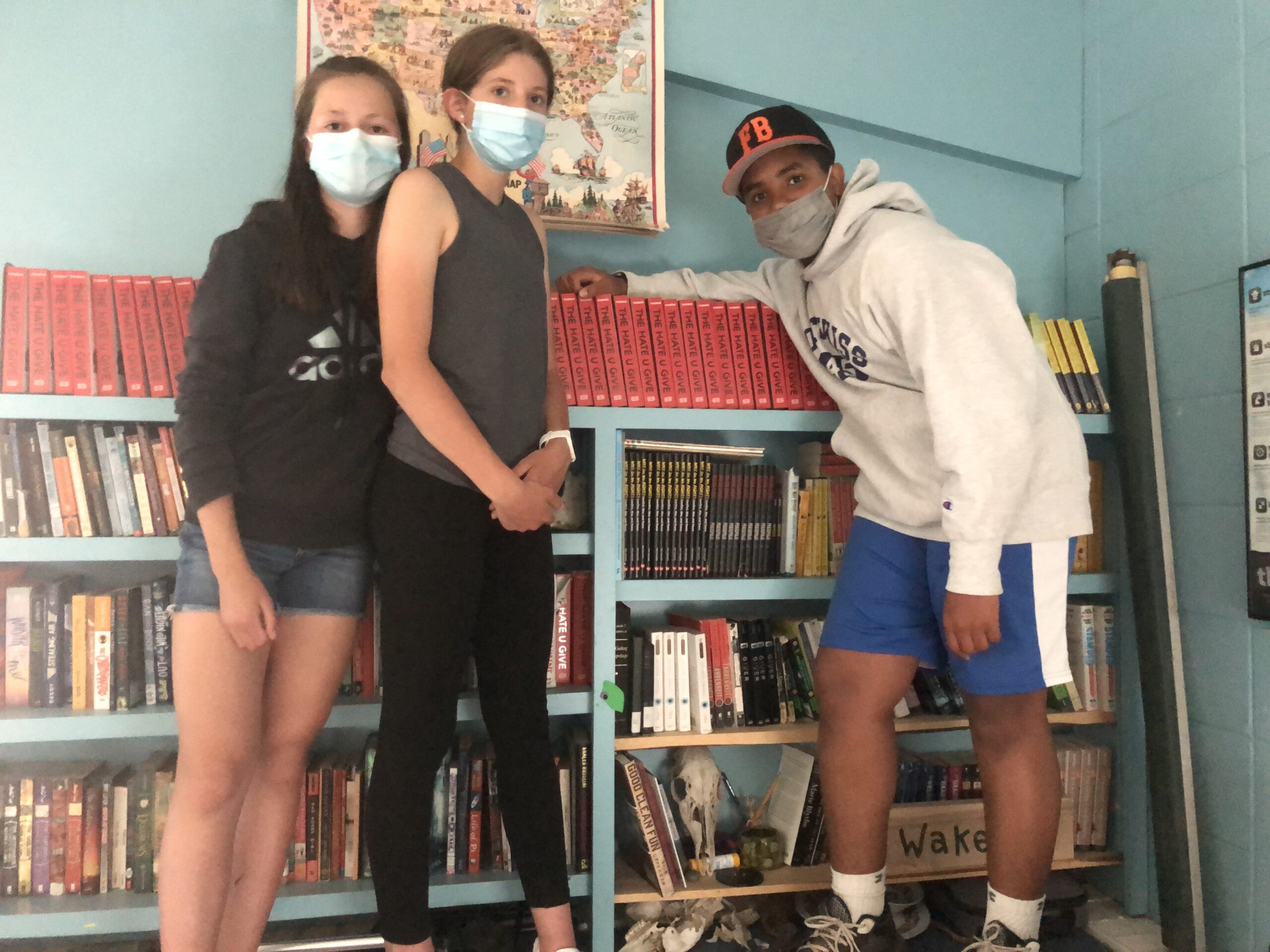
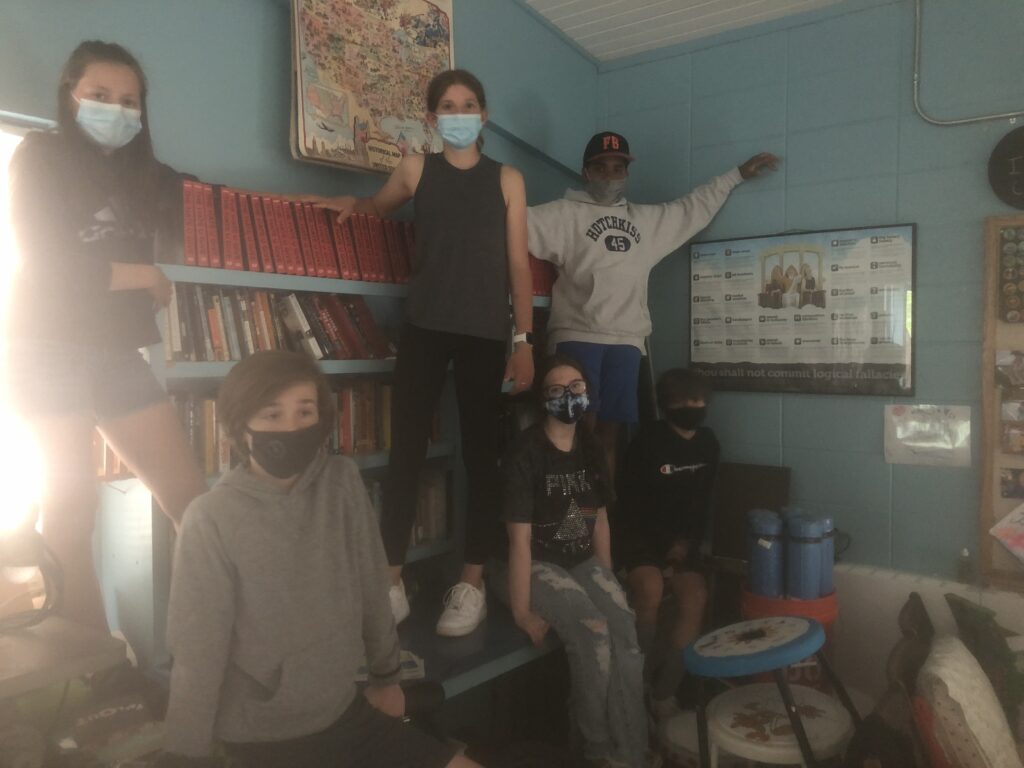
Flood Brook School has been talking about a classroom library audit for A LONG TIME. Like, a real long time. It became one of those running jokes in some of our classrooms.
7th and 8th graders talked with teachers about how inclusive (or not) our libraries are, and we always intended to do a formal classroom library audit.
To be honest, a lot of the members of our community didn’t feel like this was a pressing issue. We discussed the matter in class. We focused on identity, power, privilege, and discrimination in middle school humanities. And our school-wide library began a diversity audit last year.
Students at Flood Brook regularly use vocabulary from our humanities course. Whether debriefing team-building games by discussing power and privilege, or critically analyzing school discipline practices by debating how students are treated differently at times for behaving in seemingly similar ways, we talk a lot about identity and representation.
So why not let this one classroom practice slide when there is so much “else” to learn about every day? We’re busy people, right?
Wrong.
Thanks to the supportive push of fellow educators, our class finally made it happen. And did we ever find out how wrong we were!
The Accessibility of Bar Graphs
The classroom library audit at Flood Brook was a natural extension of a year of humanities exploration that spiraled around the core themes of identity, community, and social justice.
With everything going on in an already hectic year of pandemic classroom learning, digging into representation, and exploring the stories that surround us led our class to deeper discussions about the content that we were already learning.
Following a simple bar graph model made the work seem more manageable. And fortunately, it was VERY manageable. But it was also incredibly impactful! (Though if we did it again we would probably follow a more structured approach.)
Here’s what we did:
We began by removing all the books from our classroom library. (Added bonus to all you clutter-busters: this gave us an excuse to clean neglected crannies of our classrooms).
Students then worked in groups to research the authors we found. What does the cover art and inside cover tell us about the author? What can we find out at their website? And what about quick biographies from trusted sources?
The next step was to make a simple bar graph of the books based on our findings. Following the advice of rock-star librarian Jeanie Phillips, we made bar graphs by sorting and piling our books for a quick and tangible display of the the makeup of our library.
For our audit we chose to organize our library based on the self-identification of the author.
With that in mind, our next steps were:
Engage in conversation
The class talked about what identities the stories represent in our library. Who was included? Who was left out? And what does it say about which stories are valued?
When students were confused about the background of a writer, we read anything we could about the life of the author. Where did they grow up? What events shaped their life? How do they self identify?
Admittedly, the bibliophiles in our presence were much more into this. They delved further into the conversation to talk about how life experiences may impact the stories each author tells.
Repeat
The research was by far the most engaging part of the process. By focusing on our research and the discussion of it, students made connections between who was well represented and who was in danger of being simplified in the literature of our classroom.
Re-shelve
After a lengthy conversation about which books would go, which books would stay, and where books should go on the shelves, students re-shelved the library.
We donated books that had not been checked out in years. Or we offered them to teachers who had previously expressed interest. In *rare*circumstances, our amazing up-cyclying art teacher recycled them.
The group decided to place newer books on more accessible shelves. They tended to be purchased by student-led orders, recommended by peers, or selected because they contributed to a more inclusive collection. These included stories of joy and strength that helped to expand the horizons of our very white, rural Vermont school.
Many Hands, Light Work
Our advisory has 11 in-person learners, so keeping everyone occupied in a meaningful way took some problem-solving. The group decided to divide and conquer. Throughout the week, students took turns pulling books, researching authors, and re-shelving books.
We found that working in pairs was the most effective way for our group to do this. That way, everyone had a partner to hold them accountable, to ask questions, and to talk about the books as we moved through the audit.
Our Findings on: Gender
Our class decided to sort books based on the gender, race, and country of origin of the author. We found that, even with the bulk of our literature budget in the past few years going towards the purchase of diverse books, the results were similar to other classrooms in our school.
White men overwhelmingly dominated our bar graph.
While we quickly realized that the majority of the books that are currently checked out skew towards authors of color, the resulting change would have had no chance to catch up to the “white man” pile. This pile was literally so tall as to need structural support to plan for its height.
One student in fact, while placing books atop the highest stack turned around to his classmates. “Oh no, I would hate to think the white males might come tumbling down.” The whole room laughed.
A pause. “No guys, I really meant the books.”
We had built together literal structures holding the literature of white men above others. Meanwhile the class began discussions of the metaphorical (and literal) structures that were proving the same within our curriculum.
We found that while women authors were well represented, women of color were one of the least represented groups in our audit. I have never been so relieved to have started my year with identity work.Discussions of intersectionality became the necessary framework for meaningful discussion in our learning community.
Our Findings on: Intersectionality
To add to the disparity in gendered representation, 8th grader Trinity, an active member of our school’s Gay-Straight Alliance (GSA), noted that queer authors were poorly represented and trans authors were entirely absent.
In fact, as 7th grader Anna noted, “The only historically marginalized group that we have a lot of is women.”
Which brought us back to our discussions about intersectionality from earlier in the year. Our classroom library’s books written by women were almost exclusively written by white women.
The Z Axis of Class Sets
Enter the “Z Axis.”
While we have *a lot*of books written by women, the bulk of them are represented by titles for which we had numerous copies.
The class engaged in a lively debate here. Do we count books twice if we have two copies?
Some of us wanted to tally each title independently. Others thought the total number of copies was more important. After a lively debate and sharing our ideas with another advisory, the group came up with the idea of adding a “Z Axis” to the graph. After all, having full classroom sets of a title clearly communicates someone’s opinion of the importance of that story.
The class ultimately decided to have one copy in each stack, while piling duplicate copies in front of each pile. This way, we were able to see both ways in which our library represented authors of different backgrounds.
One big takeaway here was that white authors were heavily represented in classroom sets. After all, most of these sets were purchased in recent years, by teachers or other professionals in the district. The connection between titles taught through EngageNY curriculum was unmistakable. And while white women represented the largest quantity of books when factoring in classroom sets, the stack of titles written by white male authors still dwarfed them.
In one of the “Most Progressive” Classrooms in our District
The final step for this audit, which was actually the culminating activity for a mini-unit on reflecting on reading revolved around sharing our findings. I challenged students to find a place where they could share their findings with the world.
Students took to our middle school’s instagram account, shared with their families, and even met with our superintendent Dr. Randi Lowe to discuss their findings.
Our superintendent was not surprised to learn about the results of our audit, but we think it’s fair to say that she was disappointed. “If this is what a classroom library looks like in one of the most progressive classrooms in our district, we have to do better.”
Fortunately, the students’ work paid off. Dr. Lowe congratulated the class on their hard work, challenged them to use their findings to create action steps and left us with exciting news. Each wing in our school, in fact every school in the district, has newly dedicated funds to purchase literature that will surround us in stories that better represent the truly complex experiences of humankind on this planet.
Our first action step? Working our way through some of these great book lists/resources and purchasing books that allow for all students to see themselves reflected in our class’s literature.
This blogpost on Flood Brook Middle School was co-authored by Cliff DesMarais, Zola Bruner, and Anna Carson.
“Increasing Student Self-Direction” was a webinar presented by Rachel Mark as part of the 2020-2021 UVM Tarrant Institute Professional Learning Series. We present it here in its entirety. You can either watch the webinar recording, listen to an audio version, or read the annotated transcript. Follow-up questions about self-direction in your classroom? Email rbmarkvt@gmail.com.
My name is Rachel Mark. I have been a professional development coordinator for the Tarrant Institute for Innovative Education at the university of Vermont for five years now.
Prior to that, I was a middle school teacher in the southern part of Vermont. I taught sixth and seventh grade, many different subjects, for 16 years.
I‘m also a doctoral student at the University of Vermont working towards a degree in educational leadership and policy studies. And through my work on that degree I have been engaging in a number of different research projects related to self-direction for students in middle school. Adolescent students.
A Brief History of Self-Directed Learning in Vermont
The way that really came around to be was that in 2013, the Vermont legislature passed Act 77, which was a really ambitious series of educational reform steps.
And one of the things that moved Vermont towards proficiency-based learning was to differentiate content skills from what the Vermont state Agency of Education calls transferable skills.
Vermont decided to identify a series of very cross-cutting, large-scale skills that were important for all learners. One of those was self-direction. The others were:
clear and effective communication
responsible and involved citizenship
informed problem solving.
Things that I was familiar with as an educator. I had assessed those things before. I had a large sort of background knowledge base to draw upon.
But self-direction felt different to me and felt new.
Self-Direction in the Current Moment
Fast forward a few years, and I’m working with schools on implementing the assessment and teaching of self-direction. I’m starting to see implementation and assessment that really looks different across the different spectrums and different environments.
And I get curious about what self-direction is.
So that became the first sort of seed. And it led to more questions:
What does self-direction mean?
What is the history of this concept in education?
And how do we make that make the teaching of self-direction actionable in schools?
How do we increase self-direction for students?
I’m by no means an expert. But I’m really an aspiring self-direction person. I love talking about this topic. And I have done a fair amount of research around it. So I consider my knowledge to be emerging.
What Self-Direction Is… And What It Is Not
One of the things that’s most important to me as I start to share what I’ve learned about self-direction is for me to understand that self-direction is based upon the ability for a learner to have choice and selections based on their needs and interests.
That is critical.
So self-direction does not mean that a student follows and completes teacher directions and follows the teacher on their timeline.
Self-directed learners are not by definition, compliant learners. They may be — you may see those two things interacting.
But there are some times when self-directed learners are very uncompliant because they are showing signs that they would like more choice and would like more opportunity to self-direct their learning.
I wanted to debunk that myth because sometimes I am seeing that one interpretation of self-direction is a person’s ability to complete tasks on time. And according to instructions that are provided by a teacher.
That’s really not at all the intent of self-direction. It sometimes could completely backfire!
Self-Direction Emerged from Adult Education
You can imagine that in the sort of mid 1900s, certain educational researchers were curious about what drove adults to continue their education as adult learners. In night school or community college, where people who did not originally get a degree might be expected to go back to get a degree.
And sometimes more informally: what does it look like for adults to learn on their own?
Meet Randy Garrison
One of my favorite resources and models comes from Randy Garrison and his paper in 1997 that identified these dimensions of self-directed learning.
I think they’re really important because they have a lot of application to this idea of self-direction in schools. Garrison first identifies that in order for there to be self-direction, there has to be motivation. Motivation to both enter the learning, and motivation to sustain that learning, and stay with the task.
Those are two separate things.
In addition to that entry — motivation and the importance of motivation — Garrison identifies two other dimensions at work.
One, he calls self-monitoring. That’s really the responsibility you might think of as taking care of what you need to take care of.
And the second is control. Self-management. That to me has a lot more to do with task management.
But they’re really all intertwined. Motivation is the first thing that needs to be there. And then self-monitoring and self-management interact with one another, those three dimensions go into self-directed learning according to his research.
Motivation
Self-Monitoring
Self-Management
Yeah.
Updating Garrison for a 2020 Context: The BEST Toolkit
When we think about self-direction in a more 2020 context, there has been a lot more that’s been developed.
And what we know now is that there are several different components of self-direction, and that the interrelatedness of them is really important.
And they talk a lot about the inter-relatedness of the components of self-direction. They have five different dimensions of self-direction. These tend to be the five that are currently being used in, in the literature and the research right now.
Self-Awareness
Initiative & Ownership
Goal-Setting & Planning
Engaging & Managing (the learning process)
Monitoring & Adapting (to the learning process).
You can see this sort of metaphor of braided and threaded strands.
When the learner is emerging in their ability to be self-directed, those things seem a little disparate and disconnected.
But as the person becomes more proficient, they sync together in a better way.
What’s important about the braided visual is just imagining how these things are all very inter-related and actually dependent upon one another. In my opinion, that’s one of the reasons self-direction is so fascinating: it’s so often hard to tease these pieces apart.
Unpicking the Braid
Within the dimension of self-direction, we’re really wanting the learner to be asking:
What am I learning about myself as a learner?
For them to have that self-awareness that is very important. We want the learner to be thinking:
How can I integrate my personal interests into how I approach new learning?
So thinking about that — what they know about themselves and that self-awareness — how do they integrate that into learning opportunities and situations within goal setting and planning?
We also really want the student to be asking:
How can I break down a complex task and develop concrete steps to accomplish it?
Sounds Simple, Right?
So how can we help students plan out steps and develop goals and establish really meaningful learning targets for themselves?
We want them to be asking,
“What am I learning about locating resources, managing my time and seeking help when I need it?”
That’s about the sort of managing of the process and the learning experience. And then the monitoring and adapting that needs to happen all along that student is we want them to be asking themselves,
“Am I able to see when something isn’t working well, adjust my approach and learn from my missteps?”
There’s a way in which self-awareness informs all of these dimensions. In some cases, people who are wanting to increase self-direction for their students start with self-awareness because it seems so foundational.
“Dimensions of Self-Direction”
One of the other most common places that we’re seeing resources around teaching self-direction is from the essential skills and dispositions document that was published by the center for innovation in education and the educational policy improvement center.
They use the same five components there.
It’s just interesting to look at these two documents that I think are the most helpful in supporting schools and teachers. And it’s interesting to note that they use the same sort of five components or five different dimensions.
Gerald Grow’s Differentiated Teaching Model of Self-Direction
One of the things that really strikes me about self-direction is that it requires teachers to have an understanding of where a student’s readiness is for self-direction.
And so we have learned through the research that there’s really a continuum of readiness for self-direction.
What strikes me about self-direction is that because our learners are at different levels of readiness, our teaching to each of those learners must be different. There’s no one strategy that’s going to work for everyone in your class. Just like we differentiate all of our content for students, when we are teaching, we need to differentiate our opportunities for self-direction.
Gerald Grow’s work emerged in the 1990s out of higher education. He was a professor of journalism, and he started to become really curious about the way in which his college -evel students were compelled to be self-directed.
So he identified these four different stages.
What I think is interesting about this is that he’s identified what type of teaching really needs to match the learner’s stage of self-direction.
So if you have a stage one, dependent learner, that learner at that stage needs someone to be authoritative and coaching, and they need to get coaching with immediate feedback. They need to get informational lecture.
And that’s very different than a student who’s at stage four, who is self-directed. That person needs a teacher as a consultant. That person needs to be engaging in work that looks like internships, dissertations self-directed study group or individual group.
Those are the two extremes.
And then we have people at stages two and three, and those people also need a different type of teaching to match their learning. Grow argues that in order for the learner to advance to the self-directed stage, stage four, they need to receive the best type of teaching for the stage that they’re at along each step of the way.
Match and Mismatch Between Learner Stages and Teaching Styles
I hope you can see that when there is a match between learner stages and teacher styles, things will kind of jive and flow and work well. In this second figure by Grow, those green areas show you the areas of complete match, or near match.
So for example, if I’m an interested learner at stage two, and my teacher teaches with a style of facilitation or in a facilitator mode? That’s a pretty near match.
And what I think is so interesting about this is that I can connect back to my time teaching and think of where I saw this, you know, in a scenario.
Let’s say that I’m the teacher and I teach like this teacher one level: I’m the expert, I’m the authority, everything’s in my control, I’m lecturing. I’m giving all the instructions and not allowing for students to have any sort of involvement or responsibility.
If I have a self directed learner who’s at stage four in my class, that student is going to be pretty frustrated.
They’re going to feel like they resent this style of teaching, where the teacher’s the authority.
At the other end of the spectrum, we might have a learner who is very dependent. They don’t know how to do some things for themselves. And if the teacher teaches at this other end of the continuum where they’re a delegator and saying, “What? Go study what you want to know!” Or, “You can learn about anything you want to learn about during the next 30 minutes!” That dependent learner is going to be also very frustrated because they’re being given freedom that they’re not ready for. They’re being asked to do things that they don’t understand how to do.
Equity & Self-Direction
The interesting pieces that I have been drawn to as I’ve conducted research about self-direction is I’m wondering if and how we give our learners equal opportunities to develop self-direction.
And it turns out that there are some pretty major concerns around how students have equitable access to self directed learning opportunities.
There’s a particular study out of Europe that found that that teachers actually do some of the thinking for less self-directed children, and the children that already have high levels of self-direction received even more opportunities to practice self direction. So the implication of this is that teachers can behave in ways that actually encourage some students to develop self-direction and discourage other students from developing self-direction.
How Do We Increase Self-Direction for All Students?
What’s important to understand is what some of these things look like in the classroom.
There’s a lot of talk about planning, in terms of developing self-direction. And so if we want to teach our students how to plan, some of the things that can happen are giving people questions to frame learning goals, engaging in something like a KWL (what do you want / what do you know / what do you want to know?) Explicit instruction about and modeling based on students’ knowledge and readiness for open-ended tasks.
And so while teachers are conducting those activities, we are developing the student’s responsibility to be able to set goals, identify personal interests, reflect on learning needs and develop strategies for completing a learning task.
Some of the other instructional phases that we heard discussed in the dimensions of self-directed learning are around monitoring and adjusting.
Appropriate Classroom Activities for Self-Direction
So again, if the goal is for students to monitor and adjust, some appropriate classroom activities might be:
giving very clear teacher and peer feedback
having students self-assess
assess using some brainstorming strategies or whiteboards to make students thinking visible
doing journaling with some prompts to get student explanations out there.
And that’s so the teachers can be modeling how people monitor learning, and adjust as they move through learning tasks. We hope that as a result of that, students will be able to monitor progress, engage in self observation and really be cognizant and critical about how their learning process is going as it’s happening.
We know that another instructional phase is reflecting and evaluating. That comes down to some of the classroom resources around assessment and reflection. Showcases and presentations, for instance, so that students see that there’s a real utility for their work and an opportunity to share it with other people.
A Learning Scale for Self-Direction
My colleague Emily Hoyler and I developed a learning scale that is based upon three indicators for how teachers can develop self-direction in their learners.
First we think the environment is important. The learning environment is helping develop self-direction.
We described that indicator as that teachers will create a learning environment and design learning experiences where students can practice self-awareness. They can take initiative and take ownership of their learning. There has to be an environment for self-direction where students have opportunities and self-direction is valued. That cannot be overstated.
The next two indicators build off of that.
The second indicator is around structures and processes that you have for self-direction. So again: how is your teaching helping to provide opportunities and scaffold a process for students to make learning plans, reflect upon and monitor their progress and adjust their strategies?
And the third indicator is around curriculum and instruction.
How am I as a teacher, creating learning experiences that encourage students to take initiative and ownership, locate their own resources, manage their time and seek help when needed?
I share this with you because it’s a great tool for you to use as you investigate your own teaching. AS you think about how you might have some strengths in teaching for self-direction, and you might have some areas for growth.
And then what do you do with it?
After you have determined some growth areas, you might look for ways to improve it.
And we have lots and lots of teaching strategies related to self-direction and resources in a self-directed learning toolbox.
Again, in our toolbox are three learning indicators:
learning environment structures
processes
curriculum.
So, for example in the area of learning environment, there’s a prompt about: how do we talk about mistakes in my classroom? Because there’s certainly an amount of risk-taking that’s necessary in order for self-direction to exist and develop. Which means we need to normalize mistakes and have a belief system where mistakes are part of the culture of learning.
On Choice Boards, Hyperdocs, and Playlists
So I wanted to address a couple of particular strategies that are you know, enjoying a lot of attention right now.
I want us to consider how choice sports HyperDocs and playlists support self-direction.
So. HyperDocs!
HyperDocs, they’re basically a Google Doc that is created as not just links out to resources, but as an instructional sequence, if you will, to let the learners know what they actually need to be doing with those resources. It’s providing a frame and instructional steps through links out to content and what students are supposed to then go ahead and do it.
So, HyperDocs, choice boards and playlists are all enjoying some notoriety right now in our educational spaces. They are great tools. They are lovely tools, because they look pretty, they are assembled along a theme or a particular skill that needs to be developed. And they do allow students — in almost all cases — to progress at their own pace. Pacing is something that has been really impacted by using tools like this.
What I want to make sure is that if we use choice boards, HyperDocs or playlists to encourage and develop self-direction, then they need to be more than just a set of instructions. There needs to be an element of choice. (Believe it or not, I have actually seen choice boards that don’t have any choice.)
We also use the word “menu” sometimes, and that’s a similar structure, but a choice board is more than just saying, do this, do this, do this, do this, do this, and do that at your own pace until you’ve mastered the information.
There needs to be choice.
There needs to be a place where you say:
“Do this if you need to learn more about this, or do this other thing if you’re interested in this other topic.”
I can’t overstate the importance for choice in these three different structures that are similar. So students are making choices.
They’re also given the opportunity to make decisions about the content, and about the learning process based on what they know about themselves and their needs as a learner and their personal interests.
Another kind of critical component to any of these processes or structures is that there’s a reflection component for students. A place where they can practice and exercise some metacognition about:
How is it going?
Did I make the right choice?
Did the choice I made in my learning process help me understand this better?
Or did I make some wrong choices?
And now I know more about myself!
Final Thoughts on Self-Direction
My final thought I want to leave you with is that I can’t overemphasize the importance for us to be providing *opportunities* for self-direction in order for our students to demonstrate and develop self-direction. Without opportunities, how can students even try?
I really think that we can start that as early as possible in our schools. There are probably classrooms of kindergartners and first graders that are doing that really well. It makes me think about going into my children’s kindergarten class and seeing those different centers that students can choose and go to. They’re using self-direction to do that.
Q & A Session
Question on Self-Direction & Proficiency-Based Assessment
“This is perhaps custom to the Vermont context, but I’d like to ask you about self-direction and assessment. Self-direction is something we’re being encouraged to assess in students, at the same time Vermont’s Act 77 legislation encourages us also to use proficiencies. Can you talk us through maybe a little bit about how you might tie those two concepts together?”
Answer:
So first of all, Vermont does have rubrics that they developed, the Agency of Education has rubrics for different grade bands and they’re sort of what the criteria looks like for self-direction that are supposed to be student friendly. They’re written as “I can” statements. Like “I can locate a resource and determine whether that is a trustworthy source.” That actually is one of that’s part of the criteria of self-direction which seems more like it kind of like bleeds into library media and technology skills too, but that’s because a lot of the emphasis of self-direction is on locating resources and, and managing resources.
Those are a great place to start, but know that the resources that I shared here from the best tool kit that has very good resources also for rubrics.
Self-direction is this really big concept and we as teachers typically give it one space on an assessment, and instead we’d probably be better off diving deeper into the criteria and being really specific about the assessment of that particular part of self-direction.
Like, maybe you are great at self-awareness, but not great at like, monitoring and adjusting as you’re in the process.
I think we need to separate those things out for students so that they can see where their growth areas are and take steps to do better. You know, ironically there, our assessment of their self-direction should inform their self direction in the classroom. It’s a two way street.
Question on Self-Direction & Flexible Pathways
“Are there ways that you can envision self-direction being key for learners to actually take advantage of the opportunity to pursue flexible pathways in their learning?”
Answer:
Absolutely. Those two things are so wedded together.
I believe that aspiration starts in grade seven. There are 14 year olds who don’t know the pathway they want to take because they have not had to exercise that muscle before, of knowing who they are as learners and knowing what choices they’re going to make that will take them in the direction they want to go as learners.
If we’re developing self-direction in students, in primary K to five school and then middle school, grades 6-8, by the time we’re ready for them to go out and enjoy some flexible pathways, they should have a sense of who they are and what they’re interested in. What they want to do.
So my, one of my fears is that we haven’t, in some systems we haven’t introduced self-direction early enough, so that by the time they arrive at the doorstep of the flexible pathway opportunities, they they’ve lost their muscle to know what’s what they want and where they want to go. And they’re like, why are, you know, I kind of think about people that I know and think that, that there’s a kid saying, why are you asking me now what I want to learn about? And so it’s too late, we’ve missed the window and that we needed to have been doing that all along. So that by the time we’ve got a kid who can do an internship off campus for credit they’ve they’re primed and ready hope. That makes sense.
Question on Self-Direction & Project-Based Learning
“In terms of the popularity of project-based learning as a scaffold for, for authentic and meaningful learning opportunities for students, do you see a role that self-direction can play in the PBL cycle? Especially when you have a PBL that’s done in groups and you’re trying to assign the various types of activities, the various responsibilities; is there a way that you can fold self-direction into that as an explicit part of the process?”
Answer:
Well yes.
Self-direction can be reinforced in PBL environments.
Project-based learning environments typically do allow students to have some amount of choice about which kind of angle they’re going to follow of this topic or this theme. There’s a little bit of flexibility in terms of the task itself if there’s project based learning that is in groups. We know when you work in a group, there’s an amount of compromise and collaboration and you can’t just be like, well, I’m in charge and this is what I want to do.
The other piece I would say about project based learning reinforcing self-direction is the fact that project-based learning is building towards a culmination.
There should be some iteration that’s happening, which allows students to be monitoring and adjusting. If I’m building towards a a presentation I’m going to give, I’ve gone through some of the pre stages so that I can see where I need to adjust and maybe I need more research there or something. So I think just that aspect that project-based learning is usually there’s usually some iteration building up to this culminating event, and that takes monitoring on the student end.
Question on The Most Challenging Aspect of Self-Direction
“We know that there is some element of choice and agency that all really great teachers give to their students in the classroom. As educators become more familiar with inculcating self-direction in students, what could you identify as maybe the most challenging aspect of trying to build self-direction in students? What have you perhaps experienced as, as a common challenge for educators trying to build this up, or the research tells us is a challenge in getting started on this process?”
Answer:
That’s a great question. I can think of a few things.
There’s a really fine balancing act that teachers need to walk. That’s where Emily and I came up with our title of our course, “The Sweet Spot”. That’s balancing between them getting there on their own and you helping them get there.
The Sweet Spot
The sweet spot is this just-right grain size of place, where for them to play with what they want to know about in a way that is manageable.
And sometimes it’s really hard to get somebody to that sweet spot, right? If we let kids take on something that’s too big in scope they will get frustrated and fall short and maybe give up. If we let them do something too small in scope, we know that they’ll just finish and not know what to do.
And so there’s a way that teachers can, in their language of coaching help get to something that feels like the right size. One of the things that’s really hard for teachers is to stay in a place of language that promote self-direction. What that looks like is saying:
“Well, what do you think you need to do next? Hmm. Yeah, I hear you. I wonder how you might find a way to solve that? I wonder what tools you have around you to solve that question that you have?”
It takes time to use that kind of language. It takes patience. Sometimes even the most well-intentioned teachers go to a teacher directed place and say, this is what you need to do.
Middle school students are ever-changing, curious, socially and globally aware, and incredibly capable. Their energy and urge to explore can be channeled into rich and fertile learning territory. It’s such a privilege to walk alongside them as they grow during these often tumultuous years.
Folks often say it takes a special kind of person to teach at the middle level (count me in). It also takes a particular approach to teaching to best meet the academic, social, emotional, and cognitive and individual needs of this age group.
I recently sat down for some quality time with the revised 5th edition of this book. It left me feeling so inspired and excited about the alignment between this book and another one of my passions: Education for Sustainability.
While The Successful Middle School dives clearly into the what and the why of promising practices in middle-level education, Education for Sustainability (EFS) can be a powerful ally when it comes to the how.
“Early adolescence is a time of considerable moral development, and issues of equity, injustice, and sustainability are important fodder for middle school curriculum. Students benefit from seeing that their work can make a difference in the world around them.” The Successful Middle School p.38
Ok, so then, what is Education for Sustainability?
Before we get to defining Education for Sustainability, let’s get clear on what we mean by ‘sustainability.’
Often the word brings to mind things like recycling or solar panels. Those things are part of the story… but only part.
When we’re talking about sustainability, we’re talking about three core concepts, often called the 3 E’s of sustainability:
environment
equity
economy.
More specifically, we’re looking for the intersection of economic vitality, ecological integrity and social equity. Find the balance where each of these criteria are met, and that’s the center of sustainability.
So when we talk about Education for Sustainability (EFS), we’re talking about an approach to education that engages students in authentic and meaningful learning that strives to create conditions for sustainability.
EFS links inquiry and action through:
Rooting learning in the natural and human communities that students are part of,
Helping students develop their understanding of systems and interconnectedness, and
Engaging students in making a difference in their own communities, here and now.
Through these place-based service-learning opportunities, students begin to develop a deep connection to place and community and sense of agency.
Through Education for Sustainability, we can nurture the development of community members engaged in creating sustainable and democratic communities.
The successful, sustainable middle school
Central to both effective middle level education and Education for Sustainability is the importance of a whole-child approach. Both prioritize nurturing students’ sense of wellbeing, as well as their academic growth. Both approaches also signal the importance of providing opportunities for students to participate as active citizens in their local and global communities.
“[Students] engage in active citizenship by participating in endeavors that serve and benefit [their] communities, such as exploring more socially just and ecologically sustainable ways of living.” The Successful Middle School, p.5
Arguably, the most important ingredient in thriving schools is strong and caring relationships. It’s the secret sauce that holds it all together. Relationships are crucial. Students should be rooted in caring relationships within and beyond schools. Students are seen. Their multiple identities are honored and valued. And students are recognized as the capable and creative young people they are through engaging them as partners in the learning. We take them seriously and make room for them to shine.
We also value the power of collaboration. Middle grades students are social creatures by nature. Making space and supporting collaborative learning is both highly engaging and effective. And the collaboration doesn’t end with peers.
…and community partnerships
Not only do these strong relationships create a culture of safety and affirmation at school, but they extend out into the community. Community partnerships are key for creating authentic and meaningful learning.
“Genuine, innovative, and sustainable community partnerships are a fundamental component of successful schools for young adolescents.” The Successful Middle School p.21
“…these relationships are vital to connecting the curriculum to relevant, real-world issues.” Shelburne Farms’ Sustainable Schools Project
Community partnerships offer opportunities for students to engage in learning that makes a difference. This could look like collaborations on community gardens, community mural projects, or even addressing food insecurity or racial justice issues in the local community. By connecting with young adolescents questions about themselves, their community, and the world, learning becomes highly engaging and empowering.
And speaking of meaningful, relevant learning:
Successful, sustainable middle schools find leverage when they engage pedagogies that put students at the center.
“Negotiated curriculum, youth-adult partnerships, personalized learning, and YPAR offer well-established frameworks for engaging students meaningfully in their learning and in the world around them.” The Successful Middle School p.39
These approaches give students a sense of purpose. They also provide an authentic context through which to develop essential skills such as problem-solving, effective communication, collaboration, and self-direction. Exactly the kind of humans the world needs!
That sounds great. How do we pull it off?
EFS engages several student-centered pedagogies, including project-based learning, place-based learning, negotiated curriculum, and service-learning. It sounds like a lot.
But actually, these approaches blend together quite easily with impressive results.
When you engage students in generating questions about themselves, their community, and the world (negotiated curriculum + place-based education) and then use those questions to drive inquiry and action to make a difference here and now (project-based learning + service-learning), you get some personally meaningful, highly engaging, and civically-oriented learning.
Chicago-based educator and twitter wunderkind Jess Lifshitz joins Jeanie on the podcast to talk about Dr. Gholdy Muhammad’s seminal text on equity and criticality: Cultivating Genius: An Equity Framework for Culturally and Historically Responsive Literacy.
Jeanie: Thank you so much for joining me, Jess. Just tell us a little bit about who you are and what you do.
Jess: Thank you for having me. My name is Jess Lifshitz. And I teach fifth grade in a public school in the suburbs of Chicago. I teach ELA, so I get to teach two groups of fifth graders; I teach literacy to them both. And I am mom to an eight year old who’s in second grade. So that keeps me busy when I’m not in the classroom.
Jeanie: I see all around you, Jess, on our Zoom call, books, books, and books, and more books. It’s like a room after my own heart. I recognize things I’ve read even! What are you reading right now?
Jess: Right now I am in the middle of a book that I know my fifth graders will love. It’s called The Jumbies at least that’s how I say it in my own head by Tracy Baptiste. And it is a creepy, super creepy fantasy, and I am loving it, but I’ve been reading it before bed and it, it creeps me out — which means my fifth graders will love it. Then teacher-wise, the most recent thing I read that is The Anti-Racist Writing Workshop and that’s by Felicia Rose Chavez. And I finished that probably a month or two ago. And it was one of those transformative books. So that has stuck with me as well.
Jeanie: Thank you for those suggestions. I’m totally adding those to my, to be read list. Yeah,
Jess: I sure that I will bring up the anti-racist writing workshop again, at some point in this conversation because there’s so many connections to cultivating genius with the book.
Jeanie: Excellent. Well, this book, Cultivating Genius, came my way via a tweet. You put out saying you were revisiting it. And I, I just want to start by saying we haven’t met in person, but I’m a huge fan of yours and the Twittersphere.
And one of the things I love so much is the way you publicly share your work on Twitter. You’re often sharing plans. You share examples of student work and most especially you share charts that you’re using with your students. And like, it’s such a deep and thoughtful practice. And I’m so grateful that you put it out there. I wonder: I think that’s really scary for a lot of teachers. What was your journey to making your practice public like that? How did you come to have the courage to do that? And what does it mean to you?
Jess: It’s so funny because it doesn’t at all feel courageous. It feels like it has enhanced my teaching in so many ways. I can’t even remember when I first got on Twitter. Maybe six years ago? Maybe it was longer than that? I don’t know time is weird now.
But when I first got on, I was at a point in my career where I had sort of plateaued in terms of my own development. I think I, you know, had sort of gone as far as I could in terms of what my district was offering. I just sort of felt stuck. And I remember we had some PD where someone had mentioned twitter and I was like, Oh, well I’ll try that. And when I first got on there, I just thought the world it opened up in terms of the voices that I was hearing? Was really powerful.
For a long time, I didn’t necessarily share my own practice, but just learned from the practice of others.
And the more that I, I think I learned from others, the more I wanted to grow my own practice.
And the more thinking that it led me to, the more I wanted to, I don’t know, cultivate my, my own teaching in a way that I could share it with others in the way I was gaining from teachers I was reading about.
So I guess I just started sharing and it led me to connect with people who thought similarly and also thought in a different way, but that enhanced my own thinking? And the community that I found — especially in terms of educators dedicated to social justice — has really helped me to grow. My world was very white. Especially my educational world. I’m also just not a very social human being in real life.
So this was a really safe place for me to reach out and expand my own circle and who I was hearing from.
The more deliberate I was, especially in reaching out and seeking out voices of educators of color, the more I found myself growing in ways I hadn’t before. That sort of then, you know, continued to lead me to, to share some of that new thinking.
I’m always so amazed at what my students do with what I bring them. I’m so amazed at the work that they’re capable of. And so to be able to share that with others and show people what’s possible? Is really fulfilling to me. It also sort of motivates me to keep going. So I know it’s funny, people always ask about the chart paper, always about the charts, and the truth is I am just a really scattered human and my brain goes in so many places.
When I bring a lesson to my kids that has this series of complex thoughts, I want to make sure that I remember all the points I want to hit.
So those charts started as a way for me to guide my students but then also made the conversations really easy to share publicly as well. Without *ever* putting my own students in, in that vulnerable spot. Especially, you know, if I didn’t have explicit permission to do so.
So…yeah! It helps me be a better teacher to share in that way. I love the feedback that I get from others, the resources that people share. I know that the world of social media can be a pretty terrible place and it can also be a really beautiful place. And I think it’s depending on who you follow and the sort of relationships that you grow there. So I’ve been really grateful to be able to share my work, but also to learn from the work of so many other brilliant educators.
Jeanie: I love all of that folks, listeners, if you don’t already, you got to follow Jess on Twitter. Her Twitter handle is @Jess5th.
You both share charts and Google Docs all the time — two great ways to share without putting pictures of students up. And I’m so grateful for all you put out there. I’ve learned so much from your teaching from afar. Who knew I could learn from a teacher outside of Chicago? If you’d asked me five years ago, I would’ve been like, “Not much of a confluence there!”
Jess: Yeah.
Jeanie: So this book once you put it out there, I was like: Oh, I gotta read this book. And I’m so glad I did.
Let’s frame the book a little bit for our listeners. I guess the way I’ll start is the way Gholdy Muhammad starts, which is with her research of Black literary societies from the 19th century. Which I think she stumbled upon, and then she did a deep dive into. And she writes about them:
“Literary societies were organized reading and writing groups for developing literacy literacy skills, but they also help members to read, write and think in ways that would help foster a better humanity for all.”
And then she goes on to say, “Reading and writing are transformative acts that improve self and society.”
And I found these opening lines in her books. So inspirational and *aspirational*. I like aspire to that: to literacy as a way to improve humanity for all. How did that resonate for you when you read it, given that you teach ELA? That literacy is your whole thing?
Jess: It is my whole thing. To the point that a student of mine the other day was like, “Do you *know* things about math?” And I chuckled and said: “Very little.”
But yeah, I, for me, what was so powerful about this book is just that idea that we get so bogged down in sort of this checklist mentality of education.
And I think in particular of literacy that we start to see it as a list of standards that we have to check off.
For so long in my teaching, I’d say that first, probably decade of my teaching, I taught with that checklist mentality in mind.
“I am teaching how to infer.” (Check.)
“I am teaching how to synthesize.” (Check.)
What this book reinforces — and where I got to in my own thinking about teaching literacy — is that all of those skills are tools for a greater purpose.
And it’s the greater purpose we have to have in mind when we’re teaching literacy or our students will not understand what to do with the skills that we’re teaching them. And Gholdy Muhammad talks about that so often in her book, as she refers to, you know, the four aspects of her framework. That we can’t teach these isolated skills to kids and then expect kids to go out into the world and make the kind of changes that we know are needed? And that we hope for them to make.
For so long kids have been doing that in spite of us. And we want kids to do that *because* of what we’re teaching in school.
And so the way she’s framed literacy in this book just really reinforced that idea for me. That we need to have a greater purpose. We need these skills to help kids think critically about texts, so that kids can learn to think critically about the world.
And the texts are almost the vehicles for that thinking? And the list of skills become the vehicles for that kind of thinking? But the greater purpose is that we’re tapping into this genius that exists within the kids.
For me, that was what was so powerful about her book. To the point where I feel like I almost need a re-read of it every school year. Because it’s so easy to exist in this truth when you’re reading the book? And then the second you walk into the classroom, right, we’re in the middle of standardized testing season, it’s so easy to feel the weight of that in the day to day? That her book gives us that reminder that there needs to be more than that. And that we’re capable of more than that.
Not only is she so affirming of children, but she’s so affirming of teachers. That we are capable of so much more than I think we sometimes give ourselves credit for.
Jeanie: That’s. Beautiful. And it makes me think of a couple of things.
One is, you know, in Vermont, we have this state legislation called Act 77. And one portion of it is that we’re required to make learning *personally meaningful* to our students. And in many ways, what you’re talking about is that personally meaningful part. I’m not saying, Jess, we do that all the time. But that’s one of the mandates: learning should be personally meaningful. And what I hear you saying is that we, and often, I think what happens, especially as kids are younger is we say, “Oh, once they can do all the skills, *then* we’ll do the meaningful stuff.”
Butwhat Dr. Muhammad is saying, what you are saying, is that is that they learn the skills through the meaningful stuff. That’s the whole point of the reading and the writing. Is to do the meaningful work. Otherwise, why do it?
Then the other thing you say is drawing out that genius.
And so that’s the other thing that I just, I love how this book is framed because Dr Muhammad is really clear that that power and genius come from within the young people themselves. It reminded me of Dr. Jamila Scott, and her saying, “If you think you’re giving kids voice, you’re fooling yourself. They already have voice. It is not our job to give it to them.” And so Dr. Muhammad like Dr. Scott says our job isn’t to empower them, but rather — and I’m going to quote her again because she’s so quotable — “deeply knowing them and their ancestries to teach in ways that raise, grow, and develop their existing genius” (pg. 13).
Another part of Act 77 really is knowing learners, knowing students, well. ‘Cause you have to know them well in order to cultivate what’s great within them.
I don’t have a question there, I guess, but assume I left a question mark at the end?
Jess: I think that that is *the* truth, right? And it’s, it is the thing that matters most? Yet somehow it’s the first thing to go when we’re feeling rushed.
And it is soul crushing, right? To know that there are so many kids who feel unseen and feel unknown.
Again, teachers are capable of so many amazing things. And I think this year has really shown it to us? I think that remote learning obviously has been a struggle and awful for so many things. *And yet* teachers have done these amazing things.
My daughter has been remote this whole year. And the way her second grade teacher knows her? Is unbelievable. She has never met my child in person. Yet she has made a conscious choice to place her relationships with these kids above everything else. I’m sure it’ll come up again in our conversation.
My kid is not the kid that school is made for. She doesn’t see herself as a reader and writer and mathematician in a way that school always values. And yet my daughter’s teacher sees genius in her. And sees brilliance because she’s made that choice, right? She’s consciously chosen to do the things, to get to know my kid.
And as a mom, *nothing* could be more important.
So I try to remember that when I’m feeling frustrated with a child, right? When I’m feeling frustrated with a student. That I need to know them, I need to understand them or nothing that we do is going to work. Again, Cultivating Genius just reinforces all of that. And it gives us this framework that allows us to use our curriculum, to get to know our students, but to know them in more ways than just can they get the right answer when I ask them a question.
It gives us so many inroads to be able to get to know our students so that it’s not something separate, right? It’s not something we do the first month of the school year. It is something that’s woven into the framework of our teaching. And that I think, is so much of what is brilliant about this book.
Jeanie: Yeah. And kids have great BS detectors. My son was, you know, hard to like in the classroom. And he knew when teachers appreciated him. When they used a strengths-based lens around him. When they could see some sort of genius or brilliance in him. And he knew when they couldn’t.
And it doesn’t matter how hard how nice teachers were or how hard they tried to hide it. Kids know if you see something in them, that’s positive. Or if you only see what’s in them, that’s inconvenient, or troublesome.
Jess: You know, kids also give grace.
I always re remind coworkers and other teachers we’re humans. So yes, in a moment, I am going to get frustrated with a child. Because they’re human and I’m human.
But when that frustration rests on a foundation of love. When they know I love them first, and sometimes frustrated with them? They are willing to give such grace.
It’s been said many times before, but one of the greatest things I think kids can see us do is apologize for when we are short on patience and remind them, I love you… *and* the way you were acting brought me to a point where I didn’t like the way I was acting. Again, she reminds us that relationships are the foundation of everything else and they give us the space to be human.
Jeanie: Yeah. Well, I’m going to reveal some of my humanity now. And I’m going to get really humble, and vulnerable.
I attended a webinar with Dr. Muhammad recently because I love this book so much.
And and I had one of those moments of like, Oh, a Doh! moment, I would say. A paradigm shift. And this happens to me.
Sometimes paradigm shifts are fun and you’re like: Woo! I see things through a new vantage!
And sometimes they’re just like: Ugh. Crud. How did I not see this before?
Now, I’m a librarian, right? And I’m an advocate for reading from diverse perspectives. I make sure that I’m always reading more than half of my books by people of color. And I cite Black women, I encourage others to do so — I’m not new to this game.
And yet when Dr. Muhammad started talking about all of the foundational educational scholarship we’re all exposed to during our pre-service teacher training (or in my case librarian training) years, that it was all from white people and mostly men, Dewey and Piaget, Vygotsky and Bloom–
I just had that moment of like: why haven’t I noticed that before?
Because I hadn’t. I never thought about that before.
And then *her* book, which is based on the work of real Black scholars and educators — Anna Julia Cooper, Carter G. Woodson, Mary McLeod Bethune, and so many others. And I was just like: Right, why haven’t I read them? Like, I know those names, but why haven’t I studied them? Why haven’t I gone deep?
And so there’s this like both-and of like, mortification? And also like: Oh, I have all this rich ideas and texts to reach into and to enlighten myself with.
I don’t know. How do you deal with those moments of like utter humility and mortification when the paradigm shift is a little embarrassing? Does that happen to you or just me?
Jess: Oh, it happens to me all the time. All the time. And usually then I like talk about it publicly. Someone points it out to me.
I think that doing the work means that we have those moments, especially as white women. Right. the, I think the only way to not have those moments is if we weren’t doing any of the work.
Jeanie: Thank you for that. Thank you so much for that.
Jess: I always think of it as the growing pains that I grew up and continue to exist in a really racist world, centered around white supremacy. The more I understand that, the more… of the holes in my own learning, I can identify. I don’t waste time feeling guilty about the holes, because that stops me from starting to fill them in. Right? I work to understand how those gaps happen. And I work to understand why I didn’t notice those gaps? That you know, in my own sort of journey… towards understanding my own race and my own racial identity?
I think the more that I can start to see the way that the character characteristics of white supremacy I mistook for, for norms, for so long as, as truth.
And the more I worked to understand how white supremacy shows up in so many ways — and that’s a phrase that Trisha Barbia and Dr. Sonya Cherry Paul introduced at their racial literacy institute this summer. When we can work to understand the ways that white supremacy shows up in all aspects of our lives, then we’re more capable to do something about it.
And so, yes! Those moments feel heavy, and those moments feel you know, to me… not even embarrassing as much as as an understanding of the world that we live in.
And so my solution is just to be more deliberate in the voices I’m listening to now. Because not only do I notice that all of, sort of my foundational understandings of education, but then current professional development has been really white as well. And when we just sit with the professional development, our own districts give us? Sometimes that just continues to perpetuate the problem.
And so I am no longer waiting for people to give me the right development? I am seeking it out myself. Because the responsibility is on me. We can say we don’t know what we don’t know, but we can’t stop there. We have a responsibility to question what it is we don’t know and why we don’t know it. And how we can go and seek it out.
So those moments happens to me all the time. I try not to get sort of stuck in my own feelings about them and instead think about what that’s the result of? How I’m complicit in it? And how I can work to do better.
Jeanie: I so appreciate that approach. And it’s like, yes, we’re all inculturated in white supremacy, but it doesn’t mean we have to stay there. Right?
Jess: As we’re saying this, this is the exact conversation I have with my ten-year-old students, too! Right?
And what’s beautiful about children is they’re so willing and eager to blame adults around them, that they are willing to accept that they carry bias and that a lot of their racial biases lead to racism. They’re willing to accept that, once they understand that’s because they’ve grown up in a world that’s racist, and those messages have been fed to them since they were younger. And what’s great about kids. They’re like: “Yeah! you all have really messed us up!”
And it’s like, well, we can accept that. How do we do better? Right? How do we teach kids to notice when the information they’re being given by their schools is centering whiteness and how do we teach kids to demand better?
Because I truly think that’s where the change is going to come. Right?
I think when students start pushing for a curriculum that honors and centers more than whiteness, that’s when we’re going to start to see the changes. Because kids are loud.
And so I want to take them processes so that they question what’s put in front of them even, and especially when I’m the one putting information in front of them. So I think this is a really important conversation to have with educators? And specifically white educators? Because it’s the set of skills then that we can teach to our students, which is exactly what is described in Cultivating Genius. Right? It’s, it’s exactly what all of the framework that’s provided is sort of giving us. That we can teach kids to do more with literacy.
Jeanie: A teacher in my own, my son’s former middle school, Cliff DeMarais in Vermont took a challenge I gave. Which is just to stack all the books in your classroom library, all the books you read, stack them by race.
So his students stack them by race and gender. Books by white men, books by white women. And at one point the books by white men was getting so tall, he said, that one of his students was like, “Oh! We wouldn’t want all these white men to topple all over the ground!” And this was his students. Right?
Which is exactly what you’re saying. They’re quick to develop a critical consciousness if we give them the opportunity.
And the other thing I want to note is that I saw that you are doing some analysis on how gender shows up recently in your classroom in a similar way. Like, working with your students to interrogate gender stereotypes.
Jess: Yeah. It it’s, it’s fascinating. And it is so inspiring to watch their eyes open to the world around them.
We started with some work that I, you know, I’m sure people are sick of seeing me talk about — but every year it’s so powerful to me — but I show my students, lots of picture books. I just reveal images on the covers. And I ask them to match those images with summaries of what they think the book is about. I don’t really tell them what we’re doing and they just sort of go along with it.
Ass we go through these sets of picture books, I ask to tell me: What is it that made you guess book A was about this and book B was about this? And they’re so willing to talk about the things that they use to make these guesses, whether that’s the gender of the person on the cover, whether that’s the race, whether it looks like they’re in a rural village or in a big city, whether the characters look like them or not.
As we start to reveal that often they make the wrong guesses, the kids start to realize that a lot of their guesses and they don’t use this language, but I sort of provide it to them. As we reveal these understandings, a lot of their guesses are based on the biases they carry. And the emotions they associate with gender or race.
It’s a really safe way for them to confront the fact that they do have biases and that their biases do in fact, impact the decisions that they make? And then we ask the question, well, where do these biases come from? And so that’s the work we’re doing right now.
We start with gender and we looked at the Pottery Barn Kids website and the bedrooms that are still separated: boys, bedrooms and girls bedrooms. And I teach them how to make observations of what you can see on the screen, and then interpret those observations into what messages might those send.
Because I want them to understand how that implicit bias is formed.
That no one on Pottery Barn is writing out, “Boys are better at science than girls.” And yet when image after image and the boys room is filled with science-themed bedrooms, and none are in the girls, the closest we get are flowers? That is sending a message. So it starts to get them to understand how these messages form, even when adults aren’t saying word for word, those stereotypes, how do we get those in our heads?
It is amazing when the kids start to notice it. And then once we do those websites, now, we’re looking at Sleeping Beauty and talking about how it’s very based on word choices, really pulling out the individual words that are used to represent different genders. In which genders are represented and which aren’t in these stories to begin with. It is amazing what kids are able to see.
Then once they see it in one place, they’re seeing it everywhere. And I get emails from parents about, “Oh, we were at the store and my son insisted, I take this picture to send you a display of books for boys and books for girls.” So they see it everywhere!
Again, I think that’s the kind of learning that Dr. Muhammad is talking about, right? That really impacts the way they’re looking at the world. And! We’re still teaching skills like “supporting our claims with evidence from the text” and “inferring the author’s message”. Right? It just looks a little different than what we may have been used to in the past.
Jeanie: Wow. We could use you teaching these skills to adults. This is like, I wish more adults had these skills. Right.
And you made me think about this picture book from a few years back, We Forgot Brock! by Carter Goodrich, which is just so full of those stereotypes about gender. And I’ve seen librarians — I’m a school librarian by training — use that book to sort of think about: why is the imaginary friend of the girl a princess? And the boy a pirate? How are these imaginary friends different? Right? And how narrow are those notions?
Jess: Yeah! And, you know, I say all the time, we work really hard to protect our students from problematic texts, right? At least I think we’re getting better at that?
And yet the second they walk out of our learning spaces, they are confronted with problematic texts *everywhere*. from what they see in advertising, when they log onto the internet to the books their parents are reading them, because they were read to them as children as well.
So instead of just protecting them by bringing the right books into my classroom and being really deliberate about what that means, I also want to provide them with the skills they will need to identify the problems within a text when they encounter them.
Because as I say to my students, the more aware we can be of the way biases form? The more power we have to interrupt those processes and push back against them.
And, you know, I was really grateful today that that’s the work we’ve been doing because as I woke up to news of yet another Black man killed by police officers, I… I couldn’t, you know… not say anything to my students. I told them:
You know, as I was listening to the news today, I thought about the work we were doing, and it feels kind of light and easy that we’re reading these fairytales but as I watched even footage from the Derek Chauvin trial, there’s so much conversation of what bias do police officers carry into a situation? And as we’ve talked about, sometimes we’re not even aware of our own biases! What a world we would live in. If more people were willing to confront their own biases? And learn how to interrupt them. So the work we’re doing it is so much bigger than identifying bias messages in a fairy tale.
It is about how do we stop ourselves from walking around the world, carrying biases that can lead us to harm other human beings.
And this is how that works starts, right? So when you’re doing this really relevant work, it makes it so much easier to bring in these moments that are unfolding around us in a way that feels really natural because this is the work we’re doing. And so I was grateful to have that work today to kind of ground us and to, you know, remind me of why we do it.
Jeanie: That just speaks of authenticity, right? Like, this is authentic work that we need to do just to understand the world.
But I’m also thinking about all the layers that you are teaching students to do this. And by doing that, you’re sending this message of like: whoever you are, when you show up here, I’m going to interrogate my own biases and make this a space you can learn in.
And I’m sure your students are picking up that message as well. Right?
Oh, such appreciation for that.
Now, thinking about how I love how Dr. Muhammad made me think more broadly about literacy. Changed my notions about literacy. And on page 33 of her book, she has 10 lessons from Black literary societies.
And number four is literacy.
Instruction was responsive to social events and people at the time, which you just nailed.
Number five — which is my personal favorite — is literacy was tied to joy, love and aesthetic fulfillment.
That was so true for me as a young person. And still is! That like reading and writing? Are about love and about belonging and about (sometimes, for me) escape. So I just felt this to my core: reading and writing as a way to practice love and joy.
And I wondered if one of these especially rang true for you.
Jess: Yeah. Again, because I think I’m stuck in the world of, you know, worrying about my own kid as a reader, that idea that number three, literacy learning involved print and oral literacy, and these were developed simultaneously? The way that school just puts the written word sort of high up in terms of hierarchy and it is the end all be all of what a text is?
I think about how many kids that leaves out, right.
Again, under my own journey and understanding white supremacy and understanding that the written word above all else is one of the traits of white supremacy. It really reminded me of how much more inclusive our teaching could be if we didn’t insist that the only texts that are worthy of reading are the written ones.
Really, her discussion of that, that it is oral to write that. Telling stories is a part of literacy. That looking at images and collecting images and creating images, is a form of literacy. And the way she really honors that? I think has so much power for us.
If we say we really want to reach all kids, we can’t leave out those who struggle with the written word. And so for me, that was really impactful because I see that with my own kid too, you know? I see how much more she’s capable of when I’m reading to her versus when she is struggling through a text on her own.
Jeanie: That resonates to my core. My son was sort of considered behind reading and second grade and I was like, that’s just decoding. I read chapter books to him like crazy! He can comprehend all sorts of things! And so this, this false equivalency of decoding as literacy, I appreciate.
And then also this idea of that Dr. Muhammad uses of text sets, right. Of like rich text sets or what does she call it? She has another word for it. Anyway, where she curates images, poetry, journalism, fiction, non-fiction, oral storytelling, video — and like sort of thinks about how do these things work together to as tools for literacy development?
I really appreciated that as a librarian and who made sure anybody who wanted an audio book could get that audio book because listening to audio books is reading, folks…
Jess: Well, and what it does is it provides us more opportunities to teach kids, to navigate the world beyond our classroom. Because most of the things that, you know, if we think of reading as taking in information, most of the ways our students are doing that when they’re not doing work we assign them is not through a written word.
It’s through image and video.
Being able to bring those into the classroom means I can then teach you how to navigate these responsibly.
If I am limiting you to only articles that are written, you know, on a news site, that’s only teaching you to navigate one very narrow area of the world when I know most of you are getting your information from YouTube, right?
So I can say YouTube is not allowed here in the classroom, or I can say, let’s learn what YouTube is and how we can use it responsibly. I don’t mean responsibly so we’re not on inappropriate sites. I mean, responsibly so that we can tell what’s valid and what’s not. So we can seek out multiple perspectives. And we can use all of these tools in really powerful ways.
But I have to allow them and bring them in before I can teach you to use them appropriately. And I don’t think we always do that in school.
Jeanie: Right. And then that what she calls layered texts. See, I remembered the layered texts of being able to pair that with other things in order to really develop a fuller picture. A fuller understanding.
Okay. Let’s dive into her framework. Cause her framework itself is really powerful. It’s going to take us a little bit to to unpack it.
So she calls it historically responsive literacy. And she really does tie it to you know, this whole field of scholarship mostly by Black scholars of culturally responsive pedagogies, culturally sustaining pedagogies, culturally relevant pedagogies. She’s tying it to this rich field that I adore. I’ve been doing a deep dive in culturally responsive pedagogy. So I’m really appreciative of that.
Using this historically responsive approach, she thinks of literacy practices as multiple and diverse, just as you were just saying about YouTube video and all sorts of formats.
And then she uses these four different frames, if you will.
And the first is identity development.
I think you, you already have alluded to this and like how you continue to get to know your students throughout the year. But what does Dr. Muhammad mean? And what does it look like to use identity development with literacy?
Jess: So for me identity development is sort of — like I’ve said before — sort of the foundation of everything. This year I actually rewrote and am currently rewriting our social, emotional learning curriculum in fifth grade. Because I found that it taught a lot of like school skills? Which were sort of replicating these systems of oppression that I was trying to teach my students to break down.
So I started our year on identity.
And we spent the first third of our required sort of SEL minutes thinking about identity and the parts of our identity.
What I realized is after reading Cultivating Genius, is that that made it so much easier for me to teach students that who we are impacts what we understand about a text.
And I think one of the saddest sort of consequences of Common Core is this idea that what it means to read is contained within the corners of a page, right? That meaning is simply the words written on a page.
And that discounted everything that child brings into that reading.
We can help kids understand that, but that becomes so much more powerful when they first understand themselves, right? They understand their own identity. *Then* they can think about: how does my identity impact what I understand about the text?
Jeanie: Wait, wait, wait, wait, wait, wait, wait. You’re just like blowing my mind here, because just that thing you said about reading isn’t just about the corners of the page. But I’m a reader. I read a lot and reading isn’t about the page. It’s about what happens inside of me when I’m interacting with the page or the audiobook or the image. Whatever it is I’m reading or the story I’m listening to. It’s all about what’s happening in my body and brain. And heart. So I just so appreciate, like, it’s not about the page. Okay.
Jess: We wonder why kids hate reading, but we’ve taken them completely out of the experience, right? That’s why we read: because it moves us.
But when we take emotion out of it and, and who we are out of it and why I can get something from a book one year and get something totally different from it another year?
We as teachers need to honor that in children too, it’s not that you don’t understand a text because you understand something differently than I do. It’s because we are two different readers interacting with one text and isn’t that a beautiful thing. Right?
Jeanie: That’s so humanizing, right? Like honestly? I wouldn’t read just for the ideas. Right. Don’t tell anyone, but I read because of the feelings.
Jess: Right, right. And your feelings are based on your identity. And again, we need to honor that with kids.
In fact, you know, as I mentioned earlier, we’re heading into this awful standardized testing season, and what I tell my students is, I am really honest with them, that these testing companies are profiting off of tricking us.
So we’re gonna talk a little bit about how we can outsmart them. And figure out what they want us to pick as the right answer.
I’m really deliberate in my language that we’re not finding the right answer. We’re finding what the testing company says is the right answer. And that’s such a more empowering place to be.
Jeanie: And subversive.
Jess: Absolutely! And I write it up on a chart.
I was just writing these charts this morning and I put up there, “The testing companies are profiting off of us.” So that any administrator that walks in my room — I mean, at this point, they all expect it — but they can see that too.
Okay, you want me to prepare these kids for standardized testing? I’ll prepare them. I want them to know this isn’t the right answer. We’re figuring out what the testing company says is the right answer.
Again, that’s honoring kids. That’s being honest with them.
And to tie it back to the book? (See, this is why I need anchor charts, because all of a sudden I’m talking about standardized testing, which is not in this book.) But again, I want them to know that who they are is going to impact what they think is the right answer.
I want them to use who they are when they’re taking a standardized test. We’re going to just figure out the game and we’ll play it. I want them to understand the real reading, right. So that I can teach them in this moment. We’re gonna suspend that.
Jeanie: Well, and then it seems to me, if, if learning’s going to be personally meaningful — back to Vermont’s Act 77 — it has to engage my identity in some way. It has to be important to me in some way. Because it impacts me and people like me, because it makes me worried about people who were like, or not like me. Like, what is it that brings it to life for me? Because I know nothing about it, because I know a lot about it. Like, there are so many ways in which my identity helps me create interest in something.
Jess: Right? It goes back to giving kids an authentic purpose for reading, you know? She talks about how kids have to see themselves in their learning. And I want them to know that one reason to read is so that we feel less alone in the world, right?
Jeanie: Yes!
Jess: And that’s how we start our school year. Like, tell me about a time you read something and you felt like: Oh my goodness, I’m not the only one! Right? That’s a power reading can have.
I want them to know those things and that honors their identity. And it honors, you know, the reason that we’re readers, because it connects us to this world. And we can also read so that we better understand those who have experiences that are different than ours.
Jeanie: Love all of that. So it really, these aren’t separate by the way? They like compound and build, but we’re sort of treating them separate. But the second goal is skills development.
And this is, I think when I, when I saw Dr. Muhammad in a webinar, she said, this is the thing: most teachers know how know how to do the proficiencies or the standards that are connected to the learning, but she asks us to step it up a little bit. She’s like those standards aren’t good enough. That it’s also about that those experiences have to be rich and meaningful.
Like we were just talking about, this seems connected both to motivation and like stickiness, if it doesn’t mean anything, it’s not going to stick with me. I’m not going to remember it.
So I felt this section was a little hard for me. And so maybe it’s because I don’t teach in a classroom. And I wondered if you could tell me what I’m missing.
Jess: I don’t think you’re missing anything. But I do think this is, to me, skills was the one place that schools tend to put the focus on. Right.
But what I got from reading the book is we have to be better about those skills. We have to work harder to find meaning behind them.
And I think this is where, especially white educators, say we don’t have power? When we do.
I think we look at a list of skills and we teach it the way we think we’re told to teach it. Except a lot of that is self-imposed.
Yes, there are mandates from districts. Yes. There are things we have to do. And! I think we can be more creative with the mandates that we’re given, but we’re scared. Because we don’t want to make people unhappy. We don’t want to veer away from the way things have always been done.
And I think we’re afraid of the discomfort.
I was just having this conversation over the weekend. We have to really evaluate:
Am I stuck doing this because if I don’t I will lose my job?
Or am I stuck doing this because I might face this comfort if I try it a different way?
And if it’s the discomfort I say, we have to push through that. We have to choose children over potential discomfort for ourselves.
There are moments where that’s not possible. Where it is a true fear: if I don’t do this, I will lose my livelihood. And I can’t support my family. I’m not talking about that. (I also think as a white educator, I have a privilege in terms of my own whiteness. And, and I recognize that is not the case for everyone.)
But when we can choose to see a list of skilled and envision them as more than they’ve been? I don’t know that we are always making that choice. And I think we need to do that more often. That’s what this section or chapter really said to me
Jeanie: That reminds me that Dr. Muhammad in the webinar said: “Yeah, the Common Core. I mean, it’s a start like, like there’s so much more, it could be.”
Jess: I always tell teachers know the Common Core so that you can use it, right? So that you can use it to get to the work we really need to be doing.
I use that as a way for us to look at and evaluate the images within a picture book. To talk about how they either reinforce stereotypes or push us beyond them. But what it requires of us as educators is to be vigilant as ourselves about what we’re reading, right?
Because I read the information that Dr. Debbie Reese, so generously puts into the world in terms of how to be critical about the ways Indigenous people are represented in children’s literature, I have that information and I can look at a standard, right? I know the standards well, and I know more than the standards.
So I can use those standards to get in the teaching that I really think is necessary.
So great. There’s a standard that talks about using images to support meaning or whatever it is? Great. I’ll use that and I’ll use it for when a parent questions, “Well, why are you teaching about how pictures reinforce stereotypes?”
Well, I’ll tell you it’s connected to this standard.
So that’s on us, right? That is the work we have to do. And I think it’s become too easy not to do that work for teachers when we’re handed this book that has done it for us already.
Jeanie: I love everything you just said, and I’m a big fan of Dr. Debbie Reese.
One of the things that I’m hearing from you — and I just did a consult with somebody today that, that mirrored this — is that we as educators, don’t have to know all the answers about how stereotypes or oppression shows up.
We have to have the willingness to be curious enough to learn with alongside of our students, right? And so you don’t need to know everything.
You just have to, you know, use that instructional time for your learning and their learning in the way you’re talking about it. I really appreciate that.
And it, to me, it links to the third goal in this framework, which is creating an intellectual culture. The pursuit of intellect, right? Cause what you’re really doing is creating intellectual students who can think critically about the world.
Jess: And it brings it back to that idea of inquiry being at the center of so much.
When I read the chapter on intellect, I just kept thinking about: to me, that’s what inquiry is, right? Just really teaching kids to notice what they’re curious about? And giving them processes to seek out information in a way that provides multiple perspectives on their own curiosity.
There is no greater thing we can teach our students in terms of literacy.
That idea that we’re teaching toward the pursuit of intellect, as she titled the chapter.
It is what allows us to say, I am not teaching children, what to think. I am giving them processes that allow them to notice their own thinking and seek out responsibly information that enhances it.
Right? And develops that intellect. If that’s what we’re doing, then we’re, we’re empowering our students. And we’re honoring who they are and what they want to know. So this chapter really resonated with me because it reinforced so much of what I believe about what teaching can be and what literacy can be for students.
Jeanie: Yeah. So for me, this is the difference of like, I have this content that must get into your head. And I want you to understand yourself as a lifelong learner.
Jess: Yeah. Yeah!
Jeanie: I want you to have everything you need so that you can learn about anything things I will never know about. Yeah. Phew! So now we get to my favorite, my favorite goal in the four: criticality. First off I needed that word: criticality.
Jess: Agreed. And now that I know it, I use it all the time.
Jeanie: Same, right. Like I didn’t have that word in my vocabulary before I met Dr. Muhammad.
And and speaking of which, if I could invite one scholar to tea it would be Dr. Muhammad. She’s such a joy to be around. She makes you feel good. And to thank her, I would make her quite a tea, to thank her for the word criticality. I love how she sort of defines criticality on page 120. Would you, would you like to read that for as long as you’d like?
Jess: Yeah, I would. And it’s funny cause I have that part underlined and starred and obviously it spoke to me as well.
So she asks:
What is criticality? Criticality is the capacity to read, write and think in ways of understanding power privilege, social justice and oppression, particularly for populations who have been historically marginalized in the world. [And there is cited ‘Muhammad 2018’.] When you have criticality, they are able to see name and interrogate the world. Not only to make sense of injustice, but also to work towards social transformation. Thus students need spaces to name and critique injustice, and ultimately have the agency to build a better world for all. As long as oppression is present in the world, students need pedagogy that nurtures criticality, and we have never had a world free from oppression.
I’ll stop there.
Jeanie: Mm that’s so good.
Jess: Oh, it’s so good.
Jeanie: Right? One of our transferable skills to Vermont is critical thinking. This is the ultimate critical thinking, right? Being able to notice what’s not right in the world and critique it. And look for a path forward.
Jess: And just that idea that everything we teach provides an opportunity for us to reveal the systems that are at play in the world we’re living in. And for us to question our own role within those systems.
But as teachers, we need to be looking for those spaces. And that’s what this chapter gave me. That idea that everything I teach can be an opportunity to pull aside the curtain and reveal the systems at work.
I teach in a very wealthy, mostly white district and it is amazing to watch fifth graders really come to terms with their role in the systems they’re a part of. And they are willing to do it. They’re so brave in doing it.
But again, we have to help them to see those things or to have the skills, to question those things.
And I think texts give us the perfect place to practice, right? When I can teach them to read a fairy tale. To notice that there are only two genders represented, which means there are all sorts of people not being represented.
Then I’m also teaching them when they grow up to walk into a boardroom and do the same thing. Right?
So the more I can teach them to be critical as readers, the more likely they are to notice the systems of oppression. They may be a part of in rung one role or another in the world in general.
Jeanie: I love that. And I love that Dr. Muhammad frames it as like: we don’t just do the social justice, a unit during Black history moms. Right, right. Like that you can use critical quality as a lens in anything.
Thank you so much for making your work public for sharing your thoughts for inspiring me for making me laugh. I so appreciate you taking this hour or so with me.
Jess: Thank you for having me. This has been such a joyful conversation. That’s it really tie it all together. It really is. The time went so quickly. So thank you for having me and having such thoughtful questions for discussion.
At their heart, Culturally Responsive Practices (CRP) are about teaching the way students learn. It is an unfortunate truth of being human that we are biased by our own experiences. As Mahzarin Banaji, a professor of social ethics at Harvard University says,
“The quickest way to define what implicit bias is [is] to say it is the thumbprint of the culture on your brain.”
For educators, this means our internalized notions of what good teaching looks like emerge from our own experience.
Our task then is to think outside of our own ways of knowing, being, and learning in order to meet the needs of our students and build on their cultural ways of knowing, being, and learning.
Now let’s explore some of the ways we can expand our methods so that all students can exercise and grow their genius.
Culturally Responsive Instruction and Assessment
We are going to use four themes from the research literature on Culturally Responsive Pedagogies to look more closely at instruction and assessment:
Be transparent and intentional about culture.
Take an appreciative stance.
Provide mirrors and windows.
Educate about and for social justice.
Each theme will allow us to tease out culturally responsive practices and examples for consideration as you plan instruction and assessment.
1. Be transparent and intentional about culture
In her seminal book The Dreamkeepers, Gloria Ladson Billings noted, “All instruction is culturally responsive. The question is: to which culture is it currently oriented?”
Unless teachers are intentional, classrooms are likely to parallel the dominant culture. As institutions, schools have embedded and unquestioned structures (the “grammar of schooling”) that traditionally have not centered the needs and assets of students, especially students from historically marginalized populations.
Since most teachers experienced some form of traditional schooling, culturally responsive teachers often seek to look beyond their own experience. They constantly ask themselves “Whose ways of knowing am I centering? How might I incorporate different ways of knowing?”
It is a safe assumption that every classroom represents a range of learner types and dispositions at any given moment. And most youth cultures value novelty. The Education Alliance at Brown University’s site on culturally responsive teaching notes that “instruction is culturally mediated when it incorporates and integrates diverse ways of knowing, understanding, and representing information.”
Thus a hallmark of culturally responsive classrooms is variation in instructional format – independent work, small group learning, direct instruction, self-paced activities, student-directed workshops, whole group discussion, etc. These formats are not used willy-nilly, though. They are carefully chosen for purpose and embedded in routines. A good example is Team Quest at Crossett Brook Middle School in Duxbury, Vermont, who revamped their schedule to increase student voice and choice. The two-person team transformed their approach based on the perceived needs and input of their learners.
Cultural validity in assessment
Assessment validity refers to accuracy. Just like instruction, if the assessment process is a mismatch for a student’s culture, it’s not going to accurately measure what students know and can do.
“Achieving cultural validity in assessment means, first, recognizing that tests and assessments are cultural artifacts and that the ways in which students respond to them are affected by their cultural knowledge and experiences. It means accounting for students’ cultural and linguistic backgrounds, epistemologies, educational experiences, communication styles, and socioeconomic situations in the processes of assessment development and implementation” (para 12).
The article includes an excellent list of research-based questions that teachers can ask themselves at each phase of the assessment process. The overarching idea here is intentionality. Teachers must keep culture at the forefront of their instruction and assessment practices. Otherwise they will default to their own acculturation and biases.
Image by Elise Trumbull & Sharon Nelson-Barber, “The Ongoing Quest for Culturally-Responsive Assessment for Indigenous Students in the U.S.”. Licensed via Creative Commons 4.0 (International-Attribution).
2. Take an appreciative stance
“You are good enough. I appreciate you and care for you unconditionally.” A teacher who carries and lives this sentiment embodies culturally responsive practices. These educators are what Lisa Delpit calls “warm demanders,” and they inspire young people to reach their full potential.
In an interview titled “Antiracist grading starts with you,” Cornelius Minor points to three harmful beliefs (what he calls “pernicious ideologies”) in assessment that get in the way of appreciating students.
Should know – expectations and assumptions about what students should know and be able to do based on grade level
Transactional gratitude – I’ll teach you as long as you are thankful for it
Deservedness – intertwining the grading of behavior and academic skills
These ideologies are huge barriers to appreciating where students are and focusing on how to help them grow. Growth-oriented systems such as proficiency-based education (PBE) can help teachers move away from these problematic ideologies. The TIIE toolkit on PBE, for example, includes this core belief: “The goal of education is not to sort and rank learners, rather to help ALL learners grow towards their potential.”
By being appreciative we build student agency. As put in the report Equity and Assessment: Moving Toward Culturally Relevant Assessment, “Our assessments approaches— how we assess and the process of assessment itself—should align with the students we have, empowering them with narratives to share and document their learning journey.”
Culturally responsive instruction and assessment uses assessments that let students author their own narratives, such as portfolios, personalized learning plans, and student led conferences. Students can use multimedia tools to tell the story of their growth from their own perspective. The appreciative stance firmly takes hold when students are supported in appreciating their own learning.
3. Provide mirrors and windows
Rudine Sims Bishop developed the metaphor of mirrors, windows and sliding glass doors to help us understand the importance of diverse representation in literature. This metaphor can also guide us to more culturally responsive pedagogy. It can remind us to make certain that students see their own ways of knowing, being, and learning mirrored in our classroom.
If our instructional practices are only mirrors of the way we learn best they are most certainly not culturally responsive. If, on the other hand, they are intentionally varied, they provide mirrors for all kinds of learners to see their strengths.
Look at the view from the windows in your classroom
As educators we can position ourselves such that our work with students allows us to learn from the windows they provide for us, thus better informing our instructional practices.
Perhaps the most straightforward way for teachers to benefit from student perspectives is to ask them directly. Conferencing allows feedback from students about what is working and what could improve along with direction from teachers about next steps for students. CRP teachers survey their classrooms regularly to check in about the extent to which students feel they belong or how the teacher’s instruction affirms cultural identity (see, for example, the Copilot-Elevate measures). Teachers may also employ more targeted data gathering through action research.
Other pedagogical approaches, like formative assessment and negotiated curriculum , provide the opportunity to learn more about our students. They provide windows into the cognitive processes of our learners, allowing us to inform our instruction.
Not all windows are transparent
While we definitely want to get to know our students well, we don’t need to know everything about them in order to plan instruction. It is a both/and. Yes, our students provide us with windows into their world, which helps us make our instruction culturally responsive. AND we don’t need to know everything about their lives (or deserve to) in order to plan instruction that is relevant and meaningful to them.
Universal Design for Learning (UDL) is an approach to designing instruction that is accessible and engaging for all learners. It specifically asks educators to identify and remove barriers to learning. This UDL tool (.pdf) for example, pairs barriers with instructional strategies to engage all learners.
Another pedagogical approach that should be adopted outright is trauma-informed practice.
It is safe to assume, no matter where you teach, that some of your students will have experienced trauma. This doesn’t mean you need to know the specific traumas young people have suffered. You should plan for trauma no matter what.
Being trauma-informed means you understand you do *not* have a right to anyone's story, you will *not* ever fully know which of your students have experienced trauma, and you commit to *not* being a "trauma detective."
Alex Shevrin Venet, in her book Equity-Centered Trauma-Informed Education, explains an approach to designing instruction that is culturally responsive and trauma-informed. As she designs a unit she prioritizes predictability, flexibility, empowerment, and connection. This approach, it should be noted, works within the larger context of a trauma-informed classroom and school.
4. Educate about and for social justice
Culturally responsive instruction and assessment engages students in what Gholdy Muhammad calls criticality:
“criticality helps students to name, question, interrogate, understand and disrupt hurt, pain and harm within the world.”
Culturally responsive teachers seek to to “create a better humanity for all” according to Muhammad. They engage students in the work of actively dismantling oppressive systems.
Problems that are critical: meaningful problems related to justice
Content that is critical: content related to the experiences of minoritized and marginalized groups
Discourse that is critical: includes a variety of voices and moves beyond “academic language”
The four pillars of Critical-Problem Based Learning. Image by Caires-Hurley, Jimenez-Silva, and Harrington, “Toward a Critical-PBL: Centering a Critical Consciousness in the Middle Grades”. Licensed via Creative Commons 4.0 (CC BY-NC-ND 4.0).
This approach engages learners in the work of social justice while simultaneously engaging them in academic content and skills. The model units at the end of the article provide examples of these four pillars at work.
For example, Edmund’s Middle School teacher Jeremy DeMink engages learners in addressing social inequities through Hands-Joined Learning. Both PBL and C-PBL provide instructional trajectories that lead students to informed action that disrupts inequity.
Remember that what makes it culturally responsive isn’t just criticality, but also the connection to young people’s lives. As Alex Shevrin Venet says,
“Students’ lives are full of rich areas for exploration and real problems to solve. We don’t need to give students fake work that is meaningless in the context of their lives.”
Performance assessments for social justice
A well-designed performance task provides an opportunity for students to practice skills, demonstrate critical understandings, and center their lived experience. In the article Keeping Students at the Center with Culturally Relevant Performance Assessment, researcher Maya Kaul explains outlines two critical components:
“Put relationships at the center and provide the space for students to share their stories.”
“Use students’ personal experiences to drive civic and community engagement.”
For example, she describes districts in California where students graduate based on assembling portfolios. This allows students to center their accomplishments. She also points to another model, where the Hawaiian Focused Charter School network has developed a series of capstone projects that each incorporate skills such as research papers and oral presentations deployed to make social impact. Ultimately,
“Such assessments provide a powerful vehicle for understanding students’ cultural identities, not as tangential to their learning, but as essential to their education and critical to their becoming valued contributors who are poised to serve their schools and communities. Historical trauma is reclaimed as a platform to empower individuals as social and political change agents, transforming and restoring the health and well-being to communities.”
School systems should measure what matters. To produce genuinely culturally responsive instruction and assessment, we must intentionally design assessments about and for social justice.
In search of wholeness
Equity is a process, an approach, and a lens for viewing the world and our work as educators. It is about more than equal outcomes. The ultimate goal is that every person is valued as their whole human selves in all spaces.
This blog series on Culturally Responsive Practices has focused on educational spaces. To properly apply CRP, we need all four of the themes. Many of the aspects seem like “good teaching.” But if we leave out teaching about and for social justice, for example, we won’t have the transformative impact that we need.
Similarly, although it’s helpful in some ways to separately consider the learning environment, curriculum, and pedagogy, we must attend to the whole system. Superstar teachers and isolated classrooms aren’t going to bring the transformation we need, either. The practices are powerful but can only be sustained and reach their true potential with systemic support. The inequities and oppression baked into our systems, through aspects that directly contradict CRP like standardized testing and tracking as well as more nuanced obstacles such as compliance culture, must be disrupted and dismantled.
To all the CRP educators whose work provided ideas and examples for this series, we thank you. For educators who are at an earlier stage of your efforts to become culturally responsive, we salute you. Your students deserve it.
This post is the last in a four-part series. In part one we identified four aspects of cultural responsiveness: cultural transparency, an appreciative lens, windows and mirrors, and a focus on social justice. We used these four aspects to explore culturally responsive learning environments in part two . In part three we took a look at culturally responsive curriculum through the lens of the four aspects. The series is co-authored by Jeanie Phillips and Life LeGeros.
This year, for Teacher Appreciation Week 2021, we decided to do something different.
We love and respect and miss and admire teachers so much, and really, nothing we could do this year could adequately express that. You all deserve everything your heart desires. Certainly you deserve so much more than you’ve gotten. And that got us thinking: who were the teachers we’re still appreciating? Who were those educators who rocked our middle school worlds, and made us the education nerds we are today?
Reader, we have them.
Also some truly spectacular photos from our younger years. Truly.
So for Teacher Appreciation Week 2021, we salute educators everywhere fighting the good fight. And we have a couple special shout-outs for a chosen few.
Susan Hennessey
“Mr. Camille’s reputation as a tough and demanding English teacher was well known. Seeing his name on my 9th grade course schedule instilled fear in my heart. But it turned out to have been wasted energy on my part. His love of language, constant punning, and acrobatic word play was as delightful to me as was his demand we understand how to use gerunds properly. It was his modeling of matching your work life to your passions that inspired me to become an English teacher. Forever grateful!”
Emily Hoyler
“Mr. Hamilton, my second grade teacher, played the guitar for us, cooked squid for us, and most memorably brought us to the small copse of woods behind the school and had us hug trees. (We also watched them change throughout the year, did bark and leaf rubbings, and sat under their boughs to write poetry.) I eternally grateful for these experiences and know that they shaped who I am and my work today.”
Life LeGeros
“Mrs. Vasa put up with a lot from me in 5th grade. I’ll never forget how empathetic and kind she was about my unsatisfactory behavior grades at conferences with my parents. She encouraged me to write my irreverent and borderline inappropriate stories. She once let me “read” anime comic books my grandma gave me, even though I didn’t understand Japanese. And she allowed me to perform my rap song that was misaligned with the assignment and probably far off the beat. And that time I accidentally spontaneously told her “thanks, I love you” in front of the entire class, she laughingly defused my humiliation. She had competed to be part of the Challenger mission and when our class watched the disaster unfold together she found a way to comfort us without shielding us from reality.
Thank you Mrs. Vasa for being a real one, and for letting me be me.”
Rachel Mark
“When I was in 7th grade, my math teacher Anthony (Tony) Stanco made a lasting impact. He was an unusual man and was unlike any teacher that I’ve ever had. Mr. Stanco was silly, creative, curious, and a divergent thinker.
I remember most that Mr. Stanco was completely authentic and unique. He encouraged me to find that same confidence in being who I was. I now realize that he truly created an environment where I felt like I belonged. For that, I am forever grateful.
Mr. Stanco only stayed a year in this teaching position. Turns out he was a bit too quirky and divergent for some of the parents and school board members in my school. When he left, I was devastated. I felt like this teacher who really saw me and accepted me unconditionally, was being taken away. Because of my heartbreak, I could not adequately say goodbye and thank him for all that he’d done for me.
In the thirty years since, I’ve unsuccessfully tried to find Mr. Stanco on the inter webs. I hope to someday to find him and let him know that he made a difference in my life.
Thank you, Mr. Stanco. And thanks to all teachers who make a difference in a child’s life.”
Robin Merritt
Mrs. Kus was my middle school physical education & health teacher and my middle school volleyball coach. She created an atmosphere in PE where regardless of ability, we all found a way to love being active. And in health class, she approached the topic of sexual education (tee hee!) with ridiculous humor, exaggerating the awkwardness of it all… mostly so we didn’t have to feel self-conscious about our own awkward feelings toward and questions about the subject.
But the personal influence that Mrs. Kus had in my life was during my 8th grade year when we had a conversation helping me to weigh my future high school athletic options.
You see at Sweet Home High School (yes, that was truly the name of my school), girls volleyball was a powerhouse. One that saw many female athletes earning athletic scholarships to universities all over the country.
As an eight grader planning my future, I asked Mrs. Kus straight out if she thought that I could eventually be a scholarship volleyball student-athlete.
In her typical positive and humorous way, she painted the pathway of possibility as a volleyball player who is really good in a specific position, perhaps a setter or defensive specialist.
And she pointed to the reality of my genetics.
The tallest person in my family generously stood at 5’6. At the time, I was approximately 4’6 and needed friends’ help to reach items on the top shelf of my locker.
She painted the picture of the other path, highlighting the accolades that I had already earned as a field hockey player and then shared her own story. The legendary volleyball coach, Sally Kus, was a field hockey player. She confessed that she had learned the rules of volleyball out of a book after being asked by the athletic director if she would consider coaching.
Mrs. Kus encouraged me to choose with my heart, to put in the hard work, and I left that meeting feeling that whatever I decided to do, she believed in me, believed that I could reach my goal. I did eventually reach my 8th grader goal, and did it as a field hockey student-athlete.
I am so grateful for Mrs. Kus’s honesty and guidance, while also oozing confidence in me. Above all, she is a mentor and an educator. She cared for all of her players and her students. And made sure we all knew it.”
Jeanie Phillips
“I will never forget the year I fell in love with reading: 4th grade with Miss Polink. Everyday she read aloud to us from a novel: Island of the Blue Dolphins (a problematic choice and one I would no longer recommend), Charlotte’s Web, Charlie and the Chocolate Factory…
I had already learned how to decode and read text, Miss Polink taught me that stories could take your breath away, provide an escape from reality, and transport you to another time and place. When we finished a novel she would loan it to me so I could reread it at home on my own.
I did not come from a family of readers. I am forever grateful that she shared her love of reading with me, a gift I treasure and cherish and aspire to share with others. Thank you, educators, for all of the read-alouds and the seeds they plant!”
Scott Thompson
“I am forever grateful for my 11th grade chemistry teacher, Mr. Michael Revison. Affectionately know as ‘Rev.’
Fair to say I was a late bloomer with school and Mr. Revision was the first teacher that helped me be excited about learning. He was a lot like Bill Nye the science guy. Lots of flash but incredible knowledgable. It was his passion for science that inspired me. Every day he had me captivated, curious, and consumed with the material. It wasn’t like that in other subjects. He was also a real person with personality and emotion. He also took a real interest in me. And he was the first teacher I felt I could just have a conversation with. I knew he cared about me and my success. Plus I emailed him a few years ago to say thank you and he remembered me. I am grateful for him.
Sometime you never know the true difference you make in someone’s life. But know you DO make a difference. Thank you for all you do educators. Keep inspiring!”