Introducing our updated PLP Toolkit
Knowing each student well is essential to a year of flourishing for students and educators. It’s a prerequisite to ensuring equitable access to belonging and wellbeing, a culturally-responsive learning environment, and deep learning. And it enriches the relationships so central to a thriving school. Personal learning plans (PLPs) can drive a rich and sustained process of knowing each student well. Teachers, peers, parents and other important adults—and certainly the student—will appreciate the evolving insights PLPs can offer. And students’ learning experiences from the summer, team development activities to launch the school year, and identity units will help you use PLPs to know students well.

 Subscribe to our channel

We’ve pulled together our favorite blog posts and other resources to help you launch or deepen your work with PLPs. You’ll find this and plenty more in our updated toolkit. Below you can get a taste of some of the highlights. Enjoy!
According to Vermont’s Agency of Education, “A PLP is a plan created by a student, with the support of parents/guardians, teachers/mentors and peers, that defines the scope and rigor of academic and experiential opportunities that will lead to secondary school completion, postsecondary readiness, and civic engagement. Creating Personalized Learning Plans provides students the opportunity to reflect upon their learning and shape their future, and enables the adults in their lives to better understand each student as a unique individual…. PLPs not only help articulate and clarify students’ goals and needs but also are a reflection of the importance of student agency in learning as they work to meet graduation proficiencies.”
Clarify Your Purpose
Clarifying your own purposes for PLPs is key to unlocking their power. In our book, Personalized Learning in the Middle Grades: A Guide for Classroom Teachers and School Leaders, we invite educators to begin their planning for PLPs by first asking themselves a number of questions. These questions are meant to invite thinking about critical gaps in current schooling, especially for students poorly served by current practices, that PLP work can help to fill.
- What life opportunities do I hope my students will engage in when they launch into adulthood 8-10 years from now? As citizens, wage earners, and family members?
- What kinds of learning would I like to see more of in my classroom or school?
- What kinds of learning do I wish were valued more by the rest of my school system?
- What kinds of evidence of learning and growth do these learning opportunities produce?
- How can I welcome this evidence into a system of student record-keeping?
- Who are the stakeholders in my educational community and what evidence or experiences do they need in order to support the learning I want for my students?
And remember, PLPs aren’t just for the teacher. Here are some ways we think PLPs can help various stakeholders. Notice the many ways stakeholders can use PLPs to know students well.
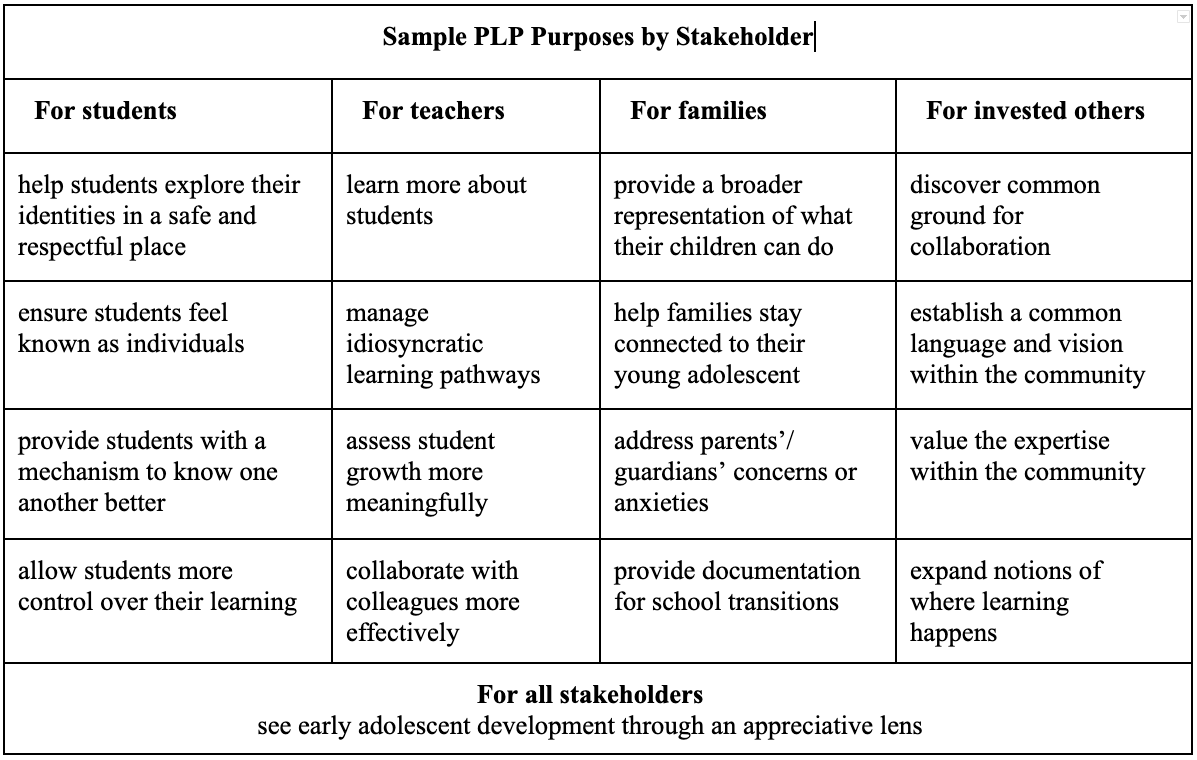
Consider these purposes and discover new ones as you explore the resources below. Start by hearing what students have to say about PLPs that work for them.
Center Personally Meaningful Learning
Foremost among the lessons we’ve learned from teachers and students, PLPs must center the learning students’ find most meaningful. That often means learning at the edges of or beyond regular school-based curriculum. Moreover, while most facets of schooling serve other stakeholder priorities, PLPs are meant to focus on learning that students value most.
- What Matters Most Now: Lesson Two – Rethink What We Teach
- The learning students find most engaging and meaningful often reflects 21st century, transferable, or essential skills and dispositions. These are learning outcomes valued outside of school as well. Not surprisingly, they form the backbone of Vermont’s Portrait of a Graduate.
- Outdoor learning, community-based learning, J-term or year-end studies, service learning, place- and project-based, and so many other effective and compelling approaches to curriculum are ideal fodder for PLPs.
- Student-centered personalized learning starts with identity
- Exploring personal and collective identity is a cornerstone of PLPs, essential for healthy adolescent development, and helps teachers know students well. It’s also deeply engaging for students.
- Introducing our updated Identity Toolkit
- Activities in which students explore and express their identities can be large or small, cross boundaries of curriculum and instruction, and help students pursue critically important questions about equity and justice.
- The rise of the project-based PLP
- Students and teachers across several schools discover that engaging project-based learning lends purpose and meaning to PLPs.
- Starting with the Learner Profile
- The learner profile, a standard element in most PLP designs, is an invitation to engaging, multi-modal, and deeply personal learning experiences.
Build Powerful Opportunities into the Process
A robust PLP process is rich with depth, complexity and culture. In the following examples we see educators and students embrace that richness with processes that are collaborative, reflective, and iterative–the same traits we seek from each students’ PLP experience. PLPs to know students well yields benefits across the curriculum and the school community.
- Peer collaboration on PLPs
- Partnering students for PLP work deepens the experience for students and takes much of the day-to-day logistical load off of teachers.
- Elements of Personalization — Moving Step by Step
- Regular reflection, goal-setting, documenting evidence of learning in multiple ways are foundational practices in their own right. They are also integral to PLPs.
- Using Data to Inform the PLP Process
- Collecting and analyzing feedback with students informs PLP implementation and deepens their role in a learning community.
- Use a student leadership team for feedback on PLPs
- A student leadership team was established to help guide a school’s PLP work. It ended up be vital to getting the PLP program back on track.
- Student-led conferences and engagement in PLPs
- Teacher Katie Bryant’s action research reveals the power of integrating PLPs and student-led conferences.
Borrow from Others
Growing a PLP program responsive to the needs and interests of students, educators, and families must be iterative. Fortunately, embracing iteration is easier now more than ever. You’ve got plenty of rich examples to draw upon. Some are fully formed systems honed over years. Others speak to creative approaches to critical elements.
- A PLP program from Don Taylor of Main Street Middle School in Montpelier
- Care and Feeding of the PLP from Margaret Dunne and Emma Vastola of Two Rivers Supervisory Union
Consider Platforms with Purpose in Mind
A clear purpose will guide you toward the technologies that meet the needs of students, teachers, and other stakeholders.
- Using Seesaw with Google Classroom for PLPs
- PLPs in Seesaw
- Google Tools for personal learning plans (PLPs)
Scaffold Evidence Gathering, Reflection & Goal Setting
A commitment to meaningful learning and student ownership of PLPs opens many avenues for scaffolding key skills students will need for PLPs and their lives ahead.
- Evidence & Assessment by PLP Pathways
- Providing support for goal-setting in a PLP
- How can students reflect on their PLPs?
- Screencasting as PLP reflection
- Increasing student engagement in PLPs
Keep the Bigger Picture in Mind
It is important (and helpful) to remember that PLPs make sense within a larger system meant to spur deeper and personally-meaningful learning. We’ve found that PLPs often falter without meaningful learning opportunities and authentic assessment that values them.